Curses, HBC Trade Gun back in the bucket list!

Canuck Bob

Regular
EE Expired
Rating - 100%
13   0   0
It's your fault Ol' Flinter, that is in jest of course. Flinter offered some astute advice about some rifle questions I had recently. I mentioned I had abandoned a TG plan. His advice re-educated me.

My list of guns of historical impact for Canada include an PH Enfield, a Lee Enfield, and a Win 94. However I keep trying to justify American longrifles to my flintlock bucket list. They had a limited place but nothing like the impact of the lowly smoothbore North West or HBC Trade Gun. It was instrumental in opening our country. So back in the bucket it goes. I'm interested in the era around the NWC and HBC merger, say 1800 to 1830.

How prevalent was a 28 gauge TG? Research suggests the HBC settled on 24 gauge at one point (maybe after the merger with the NWC). The area of interest is Alberta.

My resources for this are limited but what print material would be recommended for a TG build from scratch?

Flakey Bob
 
The old old old Upper Canada Arms Collectors Association published a stapled booklet on the trade guns. If you can find a copy, you will have the state of knowledge as of the date of publication. If I can predict anything, there will have been limited further study once "the book" came out or the author died.

In the early 1980s I went to an estate auction near Westport, Ontario. The collector had been into everything pre 1900. I have some $$$ and was keen on seeing what I could get. The entire lot was scooped for cashiers cheque before the sale began. There were plenty of US black powder pieces and as I recall some Trade Guns. I heard later that the buyer separated the collection to recoup his high interest bank draft, and most of it went to the US. If you want HBC pieces, expect to pay US funds unless you get lucky.

Correction - Upper Canada not Lower Canada
 
Last edited:
I am interested in fairly accurate repros. It turns out from researching just now that the NWC Trade Guns are just as important. My family homesteaded in Salt Prairie just north of Grouard AB on the west shore of Lesser Slave Lake near High Prairie AB. The NWC established a small post at present day Grouard (Buffalo Bay) in the early 1800's and the HBC arrived later to compete over what was considered the Athabasca region.

So either the NWC or HBC Trade Gun would be appropriate pre-merger. This has solidified my plan to build a Trade Gun as correct as possible.
 
Use a Barnett or Wilson lock both are British patterns. Don’t use the Track of the wolf trade gun lock. It’s a copy of the Tryon lock, similar to the Grostomski or Davis Tryon lock. And that’s American. Look into Wilson and Barnett tradeguns to make your own copy, and I suggest a visit to the Glenbow Museum. They have a massive collection of Trade guns in there. Ignore any that have an elephant on the lock, they mislabeled two that were meant for the African trade.
 
Use a Barnett or Wilson lock both are British patterns. Don’t use the Track of the wolf trade gun lock. It’s a copy of the Tryon lock, similar to the Grostomski or Davis Tryon lock. And that’s American. Look into Wilson and Barnett tradeguns to make your own copy, and I suggest a visit to the Glenbow Museum. They have a massive collection of Trade guns in there. Ignore any that have an elephant on the lock, they mislabeled two that were meant for the African trade.

Thanks for reminding us about the Glenbow. I was there in the 80s and was very impressed. A typical Barnett lock has a brass dragon sideplate. The buttplate was just a flat steel plate, which apparently often became a hide scraper.
 
In the 19th century, 24ga was more or less the standard for NW guns. Earlier guns tending to be slightly larger.
The single best reference book on trade guns is the one published by the Museum of the Fur Trade, "Firearms of the Fur Trade". The price might bring tears to your eyes, but it is the best.
There are parts available which may be used to build a representative NW gun. Creating an exact reproduction of a specific gun (NW Co., HBC, of a certain date, etc.) is a lot more complicated.
You mention 1800 - 1830. Pre-merger, NW Co guns used double bridled locks secured with two side nails (screws). HBC guns' locks were inferior, and used unbridled locks with three screws. To the best of my knowledge, there is no reproduction of an unbridled 3 screw lock. The 2 screw double bridled lock with a pointed tail was used until about 1850, when the round tailed double bridled lock with double throated #### was introduced. It lasted until the end of the flintlock production. I do not believe this lock has ever been reproduced. The standardized percussion guns used Enfield pattern locks with matching breech.
A double bridled two screw lock would be round faced, about 6" long, with serpentine ####.
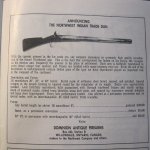
Here is an ad we ran in the December 1972 issue of Muzzle Blasts:
007.jpg
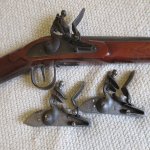
Here is a gun I made for myself the better part of 40 years ago:
012.jpg
Stock is cherry, carved from a plank.
Note that the lock on the gun has the circle fox mark, and is stamped Barnett.
The left detached lock is blank, while the right has a tombstone fox, and W Chance.
To make our wax casting dies, a nos Chance lock was borrowed from the Museum of the Fur Trade. We had the markings removed. The tombstone fox lockplate came from The Upper Missouri Trading Company. I think they borrowed the same lock we did. The ####, frizzen and spring are from our production.
One of my stalled projects is a replica of a late percussion gun. I have most of the metal parts, and walnut boards. Just got to get to it. The barrel is a North Star, breeched with fittings from a Parker Hale rifled musket.
 

Attachments

  • 007.jpg
    007.jpg
    90.2 KB · Views: 505
  • 012.jpg
    012.jpg
    113.2 KB · Views: 507
Last edited:
Wonderful news about the Glenbow. I'll check the current access rules and get down there very soon. The one historical sin is maybe a LH build. I will most likely use a Chambers Siler lock regardless of fine history details. It is interesting that the double throat #### is not copied. Many originals that I can find pictures of use them. It is a robust chunk of iron!

The only plan I can find is the Track full size drawing. I'll order one but is that it?

Glad it was pointed out about the American connection. It turns out my bookmarks are often focused on their history. Thank you all and off to the search engine!

I could almost buy a lock for the book from the museum. The history is starting to interest me, almost a hobby itself. For those who bought it were you happy you did?
 
Last edited:
A Siler lock would be really wrong for a NW gun. Wrong style, wrong size.

There were a large number of generic smaller bore flintlock fusils widely used. Something like that might be appropriate to your needs.
 
You can order a double throat #### from my friend Chris Hirsch in Sugarland Texas. He produces a number of locks one of which is double throat, and I think it shouldn’t be an issue to retrofit it to another lock. I would look at the Wilson and Barnett trade locks that track of the wolf carries by Davis.
 
Chris Hirsch has a very nice reproduction of a lock from a Belgian trade gun. This would be correct for mid 19th century. Track has 3 locks they advertise for trade guns. These 4 locks are pointed tail, goosenecked cocks. The double throated #### used on the late locks is very much alike the #### used on late British service flintlock carbines. One of these pointed tail locks could have the tail altered and a #### retrofitted.
 
In the 19th century, 24ga was more or less the standard for NW guns. Earlier guns tending to be slightly larger.
The single best reference book on trade guns is the one published by the Museum of the Fur Trade, "Firearms of the Fur Trade". The price might bring tears to your eyes, but it is the best.
There are parts available which may be used to build a representative NW gun. Creating an exact reproduction of a specific gun (NW Co., HBC, of a certain date, etc.) is a lot more complicated.
You mention 1800 - 1830. Pre-merger, NW Co guns used double bridled locks secured with two side nails (screws). HBC guns' locks were inferior, and used unbridled locks with three screws. To the best of my knowledge, there is no reproduction of an unbridled 3 screw lock. The 2 screw double bridled lock with a pointed tail was used until about 1850, when the round tailed double bridled lock with double throated #### was introduced. It lasted until the end of the flintlock production. I do not believe this lock has ever been reproduced. The standardized percussion guns used Enfield pattern locks with matching breech.
A double bridled two screw lock would be round faced, about 6" long, with serpentine ####.
Here is an ad we ran in the December 1972 issue of Muzzle Blasts:
View attachment 386429
Here is a gun I made for myself the better part of 40 years ago:
View attachment 386430
Stock is cherry, carved from a plank.
Note that the lock on the gun has the circle fox mark, and is stamped Barnett.
The left detached lock is blank, while the right has a tombstone fox, and W Chance.
To make our wax casting dies, a nos Chance lock was borrowed from the Museum of the Fur Trade. We had the markings removed. The tombstone fox lockplate came from The Upper Missouri Trading Company. I think they borrowed the same lock we did. The ####, frizzen and spring are from our production.
One of my stalled projects is a replica of a late percussion gun. I have most of the metal parts, and walnut boards. Just got to get to it. The barrel is a North Star, breeched with fittings from a Parker Hale rifled musket.

that cherry is beautiful I was at my neighbors yesterday needed a fence board ripped down she had some very nice rough sawn cherry sitting there I may have to grab some off of her now.
 
Cherry can make fine stocks. There is the risk of sap pockets in it. Some pieces can be a bit fibrous, and not cut clean.
 
Unless things have changed, it is easier to get good planks of cherry than walnut. Maple planks are the easiest to get. Figured wood is another issue. There is more tiger striped maple than figured walnut. Cherry generally doesn't have a lot of figure. When we were making those trade guns, we used to go to a lumber yard in Toronto where they would let us root through their stacks of hardwood planks. A lot of hardwood now is sawn and milled to 1". Hard to find planks thick enough for gun stocks. There is a lot of hardwood growing in SW ON. Do you know of any small country sawmills? They can be worth checking. Often they are buying individual trees; might be possible to get some nice pieces put to one side.
Years ago at an auction I bought a batch of walnut planks, 1 3/4 to 2 1/4 thick, up to 14" wide. I've been slowly nibbling my way through it. Also have a number of bandsawed ML sized maple blanks, some with curl.
 
Unless things have changed, it is easier to get good planks of cherry than walnut. Maple planks are the easiest to get. Figured wood is another issue. There is more tiger striped maple than figured walnut. Cherry generally doesn't have a lot of figure. When we were making those trade guns, we used to go to a lumber yard in Toronto where they would let us root through their stacks of hardwood planks. A lot of hardwood now is sawn and milled to 1". Hard to find planks thick enough for gun stocks. There is a lot of hardwood growing in SW ON. Do you know of any small country sawmills? They can be worth checking. Often they are buying individual trees; might be possible to get some nice pieces put to one side.
Years ago at an auction I bought a batch of walnut planks, 1 3/4 to 2 1/4 thick, up to 14" wide. I've been slowly nibbling my way through it. Also have a number of bandsawed ML sized maple blanks, some with curl.

no sawmills that I know of but plenty of people around here either have a bandsaw mill or chainsaw mill see maple and walnut for sale quite often. that cherry was at least 2" thick btw some was live edge didn't get a good look being 6 feet apart and all. the trees down here some like they are new growth for the most part but lots of Carolinian mix still my neighbor had a 3ft diameter maple taken out a few year back I would loved to have had.
 
What about Stan Hollenbaugh's F&I War Period Lock. I'm committed to a LH flintlock. Once that was decided I realized I am going to build a facsimile gun, a 20 foot lookalike. Stan gets great reviews for his locks.

http://www.stanhollenbaughgunsmith.com/page3.html

I do not wish to be disrespectful of the genuine good will and good advice from everyone. Considering my circumstances, resources, and skills I'm confident that building a simple reasonably complete kit is possible this winter. Tuning a lock and fitting a different hammer and multiple source shipping is not possible.

Tiriaq, in what way does the Siler not work. You mentioned size, is it too small or large? Chambers makes a builders lock with a rectangular lock plate for the builder to modify in LH. Could it be fitted to make a wannabe trade gun lock.
 
Does anyone have a link to a resource on the late percussion trade guns?

Were percussion conversions on NWC serpentine lock guns common?
 
What about Stan Hollenbaugh's F&I War Period Lock. I'm committed to a LH flintlock. Once that was decided I realized I am going to build a facsimile gun, a 20 foot lookalike. Stan gets great reviews for his locks.

http://www.stanhollenbaughgunsmith.com/page3.html

I do not wish to be disrespectful of the genuine good will and good advice from everyone. Considering my circumstances, resources, and skills I'm confident that building a simple reasonably complete kit is possible this winter. Tuning a lock and fitting a different hammer and multiple source shipping is not possible.

Tiriaq, in what way does the Siler not work. You mentioned size, is it too small or large? Chambers makes a builders lock with a rectangular lock plate for the builder to modify in LH. Could it be fitted to make a wannabe trade gun lock.

From the standpoint of making sparks, a Siler type would be just fine. From the standpoint of size and style, it is wrong. It is a Germanic styled rifle lock, that is close to 20% too small.
 
Does anyone have a link to a resource on the late percussion trade guns?

Were percussion conversions on NWC serpentine lock guns common?


If you search the 'net for trade guns, NW guns, HBC guns, you will find information. As I mentioned earlier in this thread, the best single source in print is the Museum of the Fur Trade's encyclopedic book.

Many, many NW guns were converted to percussion.
 
Back
Top Bottom