This is F'ed ,LOADING SUCESS!

Last edited:
Negative, The one from RCBS appears discontinued.Doesn't list that part # at RCBS either.

I did drill the current one out to ensure it contacts lower down the ogive.

May have to just get a new seating die.What do you all suggest?

https://shop.nosler.com/accubond-lr-seating-plug-30-cal.html

I'd recommend the Forster BR seater either with or without the micrometer. The seating stem is designed with long VLD bullets in mind. It happens to be a great product as well.
 
This is another possibility. I have loaded many compressed loads before and the seating can become very inconsistent! Even with long drop tubes or vibration/tapping to settle everything.

Post #25

Just loaded 8 shells.

No powder.

3.541” to 3.557”

Shell #7 3.542” ,#8 3.557”

Onto the next test.
 
way to much neck tension and no matter what seater you use your going to have issues, reloading premium precision rifle ammo on standard hunting dies is never going to happen, if your set on using standard type reloading dies then you have 2 options, load and shoot without all the measurements, or swap over to a lee collet neck sizing die to get less neck tension, or a larger expander ball in your RCBS die, a simple email to RCBS explaining your surplus of neck tension will likely have them sending you out a new replacement expander ball.

Anything over 2 thou neck tension is asking for problems, guys that claim to be loading with more then 2 thou are generally guys running neck turned brass with a wall thickness of 9 thou, standard 12-14 thou necks will not tolerate the seating pressure well, in fact, it will also crack the seating stem of redding cometition micrometer bullet seating dies

want the issue to go away without changing anything??? anneal those necks, they will open up way easier and allow for easier more consistent seating
 
way to much neck tension and no matter what seater you use your going to have issues, reloading premium precision rifle ammo on standard hunting dies is never going to happen, if your set on using standard type reloading dies then you have 2 options, load and shoot without all the measurements, or swap over to a lee collet neck sizing die to get less neck tension, or a larger expander ball in your RCBS die, a simple email to RCBS explaining your surplus of neck tension will likely have them sending you out a new replacement expander ball.

Anything over 2 thou neck tension is asking for problems, guys that claim to be loading with more then 2 thou are generally guys running neck turned brass with a wall thickness of 9 thou, standard 12-14 thou necks will not tolerate the seating pressure well, in fact, it will also crack the seating stem of redding cometition micrometer bullet seating dies

want the issue to go away without changing anything??? anneal those necks, they will open up way easier and allow for easier more consistent seating

The Hornady brass was annealed prior to these loading and turned slightly but yes, I may have to look at different dies , sizing and seater.

I do have another set of 300 dies from RCBS which I could try to see if there is a difference.I'll measure the expander ball and see what is what.

So all I did to get my desired length was set the die deep and just stop and measure the longer shells to get the right length by not going all the way up on the ram, for now.
 
I'd recommend the Forster BR seater either with or without the micrometer. The seating stem is designed with long VLD bullets in mind. It happens to be a great product as well.

+1 on the Forster seating dies. I'm partial to their Ultra Micrometer dies myself. I use them in most of my reloading and have no problems with long VLD bullets. They also don't have a built in crimp which I prefer.
 
if your feeling great differences in seating force lightly roll case sizing lube on your bullets, it won't be enough to contaminate your powder, and it down't be enough to upset the ability of the case to hold the bullet under recoil if loading from a magazine, My seating depth began to wander when using a ultrasonic cleaner, the insides of the neck are so clean they become sticky, an hour in the corncob tumbler adds enough polish to the necks that i got my consistency back leading me to believe that some things are best not done to well a job on, I do however love the way the ultrasonic gets my primer pockets sparkly clean, and all of the carbon out of the inside of the cases, but clean brass presented the new issue of sticky necks when seating bullets
 
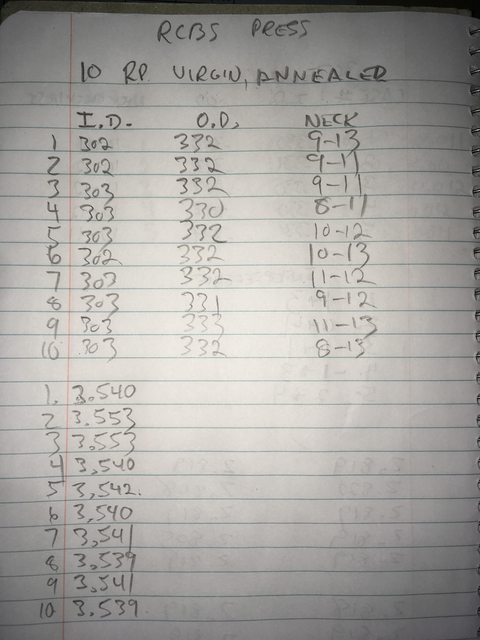
Okay, so I took 10 virgin RP brass, annealed them , neck sized, chamfered , cleaned inside and loaded without powder.

I measured all the important dimensions...


Everything felt smooth, no weirdness. So even with the brass inconsistencies the end results don't look too terrible.

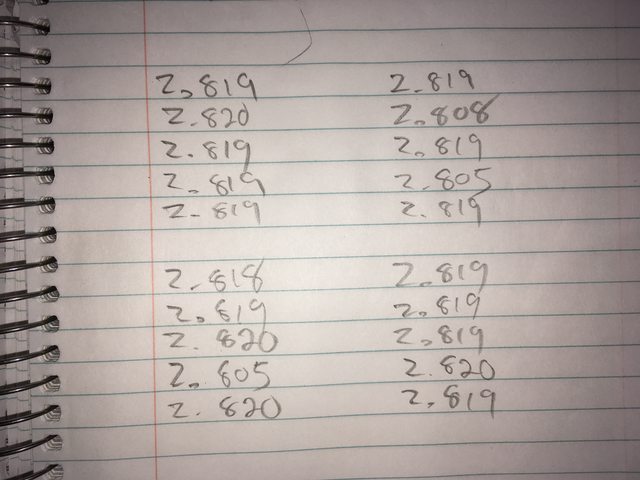
So, looking at the two wing dings here and the three delinquents that I measured with the seating stem and bullet inserted , I'm fairly confident that is it the seating issue, especially when you see it is 0.011" to 0.015" difference.

Here is the bullet/stem measurements for reference.

 
Last edited:
I would use graphite powder on a brush to the inside of the case neck before charging, or in your test before seating the bullet. Even with my Rockchucker, I can seat, then if the BTOG is a hair long I can run it in again but harder on the handle, it will be seated deeper. I however usually just give a slight adjustment to the Mic seating die.
 
throw that expander ball out, 5-6 thou neck tension is way to much, you should be getting 306 on an RCBS expander ball
 
Have you checked concentricity? May give some clue...? I have experimented with aluminium foil in the past to create a better interface between the bullet and seating plug, had mixed results; just something to consider.
 
Looking at your pics of the bullet and seater stem, it strikes me that the stem is deforming the bullet where it touches. The big question is why?

You're measuring from case head to bullet tip, correct? If that's the case, you can expect some variation, 0.005" isn't uncommon at all.

You'd have better accuracy (no pun intended) measuring to the ogive. The Hornady bullet comparator costs less than a box of bullets.

I'm loading 6.5 Match Kings with a plain old set of RCBS full length dies, nothing fancy. My case head to ogive measurements vary 0.003" at the most, usually within 0.002"

Seating force is very light, we're talking 2 fingers light here. Neck tension less than 0.002".

What you might have is a sizing die with an undersized neck area, so it's squeezing the necks smaller than it needs to. Then the expander ball struggles to open them back up, resulting in some spring back of the brass and high neck tension.

Overly thick necks might be the culprit too, though that's unlikely.

The inside of the necks is chamfered with a VLD type narrow angle seating tool, right? Square-ish necks or a flat angle will result in excessive seating pressure too.

Next time you're seating bullets, take note of how much pressure it takes to seat each one, then relate that to the measurement you get for that particular round. You may find that the ones with lighter pressure are shorter, with less bullet deformation than the ones that required more pressure to seat.
Logic says that a dented bullet will result in a longer overall length, it pretty much has to.

I think I've read all the posts in this thread, if I've missed something that would rule out my suggestions I'll apologize now. It's early yet!

 
I do have the Hornady comparator and that is one of the first things I did was to compare cartridge length between tip measurements and ogive measurements, they did correspond.

So my next purchase with be a slightly larger expander ball , as well as a different seater die.

I can wing it for now to get the COAL I want by just seating the long cartridges deeper by adjusting the die deeper and being careful with the ram.

But , like you says , why do we have what we have?

They aren’t competition rounds but I am not excited about seeing on paper results go from just over half MOA to 1.5 MOA.

Looking at your pics of the bullet and seater stem, it strikes me that the stem is deforming the bullet where it touches. The big question is why?

You're measuring from case head to bullet tip, correct? If that's the case, you can expect some variation, 0.005" isn't uncommon at all.

You'd have better accuracy (no pun intended) measuring to the ogive. The Hornady bullet comparator costs less than a box of bullets.

I'm loading 6.5 Match Kings with a plain old set of RCBS full length dies, nothing fancy. My case head to ogive measurements vary 0.003" at the most, usually within 0.002"

Seating force is very light, we're talking 2 fingers light here. Neck tension less than 0.002".

What you might have is a sizing die with an undersized neck area, so it's squeezing the necks smaller than it needs to. Then the expander ball struggles to open them back up, resulting in some spring back of the brass and high neck tension.

Overly thick necks might be the culprit too, though that's unlikely.

The inside of the necks is chamfered with a VLD type narrow angle seating tool, right? Square-ish necks or a flat angle will result in excessive seating pressure too.

Next time you're seating bullets, take note of how much pressure it takes to seat each one, then relate that to the measurement you get for that particular round. You may find that the ones with lighter pressure are shorter, with less bullet deformation than the ones that required more pressure to seat.
Logic says that a dented bullet will result in a longer overall length, it pretty much has to.

I think I've read all the posts in this thread, if I've missed something that would rule out my suggestions I'll apologize now. It's early yet!

 
Hmmm i keep waiting to here reports of some guy in P.A. locked in a dark corner of his loading room trying to learn how to knit. ;) Hopefully the new seater die works for you.
 
Back
Top Bottom