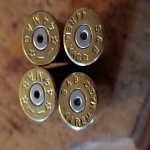
Pierced CCI primers

One thing I did notice on one of the bullets I have left is kind of a smear of oil. Might be sunscreen or something.
Would a bit of grease on the brass cause something like this?
I know it can prevent the expanding brass from adhering to the chamber walls, but would it cause such a deep primer dent?
To be clear these arnt fully punched out holes in thses primers. It's more of a pin hole in a few of them.
There are 5 total deep dents and I can see a dot of light coming through 2 of them. It appears there is no damage to either firing pin, but I want to get to the bottom of this before I run more handloads.
I have 580 of the same lot of primers left. I dont mind tossing them and starting a separate lot.
I just dont want to use cci again if this was a problem other people had experienced.
I already stopped using Winchester primers because of their QC issues.
I also find it very hard to believe that with the millions of primers CCI produces that they have never had a bad batch. It happens with every product on the market.
I do have a problem with responses stating it must be your fault we never make a mistake.
 
Your story rings a bell with me. This past weekend there was a PRS-type match, and one of the guys on my squad was running a 6.5 Creed gun. He was running same load he has ran for a couple years now, but suddenly at the match he was piercing about 75% of his primers. Barrel had been cleaned, no one could come up with an explanation. I have to wonder if he used the same batch of primers you are using.

Did you post the exact model number of primer you are using so we can cross-reference?
 
Do you have any of the pierced primers on hand? Pictures would be great... Perhaps you could delicately section one or otherwise inspect it. I'm still inclined to blame your gun but if you tried two different rifles I suppose that does lean towards the primers. If your gun is properly headspaced and uses a locking system of some kind, which a .44 mag almost certainly will, small amounts of grease or other lubes on the bullet or cartridge won't matter.

Your story rings a bell with me. This past weekend there was a PRS-type match, and one of the guys on my squad was running a 6.5 Creed gun. He was running same load he has ran for a couple years now, but suddenly at the match he was piercing about 75% of his primers. Barrel had been cleaned, no one could come up with an explanation. I have to wonder if he used the same batch of primers you are using.

Did you post the exact model number of primer you are using so we can cross-reference?

If he was using LP primers like the OP that would certainly explain his issue.
 
I have had pierced primers and CCI told me I was seating them wrongly
after proving them I was seating them right they told me the primers were old and they could not warrant them
oh well, I switched to Federal

still have 900 CCI 450 for sale :)
kidding, wouldn't sell that crap
 
I'm thinking of switching
Judging by the responses they gave me as well. They basically told me they have never had a single complaint about their primers and that I must be doing something wrong or my guns are at fault.
If it was my gun or a hot load fine but is it so hard to comprehend CCI could mess up.
Or that both or my rifles must be faulty all of the sudden.
 
That was certainly a thought as well.
I did ask that question above and got a reply in post #23 saying it wont effect anything.
I'm thinking it could be the culprit however to play it safe I'm going to pull all the ammo I have loaded recently and prime them with a fresh lot of primers. I may even change brands all together for a while.
 
You mention residue.
Anything like lube, water, or sunscreen, on your cartridge will cause pressure spikes in your chamber.

Unless he has the cartridges coated in a significant layer it's not going to matter. Not sure how an increase in bolt thrust from a low pressure load would cause that anyway. I was not going to bother with this anymore since the OP seems to have a stick up his butt about guy's responses but I would guess this is an instance of ####ty luck.

CCI has some of the best QC there is so of course I was skeptical about blaming them after you said they hadn't received any complaints about that lot. Looking at those primers my only conclusion are loose headspace in your guns or you just have some thin primer cups. You could always deprime and check them out... Every manufacturer has stuff that slips by. I had a round of Federal 55fmj blow up a rifle. Since they had no other complaints about that lot I was told too bad.
 
Unless he has the cartridges coated in a significant layer it's not going to matter. Not sure how an increase in bolt thrust from a low pressure load would cause that anyway. I was not going to bother with this anymore since the OP seems to have a stick up his butt about guy's responses but I would guess this is an instance of ####ty luck.

CCI has some of the best QC there is so of course I was skeptical about blaming them after you said they hadn't received any complaints about that lot. Looking at those primers my only conclusion are loose headspace in your guns or you just have some thin primer cups. You could always deprime and check them out... Every manufacturer has stuff that slips by. I had a round of Federal 55fmj blow up a rifle. Since they had no other complaints about that lot I was told too bad.

Oh, I wasn’t aware this was a low pressure load. Where was the pressure stated?
Lube, water, otherwise incompressible matter in the chamber will spike pressure DRASTICALLY. No ifs, ands, or buts about it.
Guys pressure out at matches from using cases marked with magic marker. Over time that marker builds up on the camber wall and BOOM! Sticky bolt.
Keep your ammo clean. Diligently. If you’re marking your brass, keep it in the extractor groove.
 
Unless he has the cartridges coated in a significant layer it's not going to matter. Not sure how an increase in bolt thrust from a low pressure load would cause that anyway. I was not going to bother with this anymore since the OP seems to have a stick up his butt about guy's responses but I would guess this is an instance of ####ty luck.

CCI has some of the best QC there is so of course I was skeptical about blaming them after you said they hadn't received any complaints about that lot. Looking at those primers my only conclusion are loose headspace in your guns or you just have some thin primer cups. You could always deprime and check them out... Every manufacturer has stuff that slips by. I had a round of Federal 55fmj blow up a rifle. Since they had no other complaints about that lot I was told too bad.

Stick up my butt eh
Ok man whatever
 
Oh, I wasn’t aware this was a low pressure load. Where was the pressure stated?
Lube, water, otherwise incompressible matter in the chamber will spike pressure DRASTICALLY. No ifs, ands, or buts about it.
Guys pressure out at matches from using cases marked with magic marker. Over time that marker builds up on the camber wall and BOOM! Sticky bolt.
Keep your ammo clean. Diligently. If you’re marking your brass, keep it in the extractor groove.

It doesn't increase pressure it increases bolt thrust. He listed his loads somewhere in the thread. If you want to argue that I have some very long articles I can shamelessly copy and paste.
 
Last edited:
It increases pressure in the chamber by reducing the volume the cartridge has to expand into. Chamber pressure is a component of bolt thrust.

And what is the volume removed by the lube? A warm chamber probably causes more volume loss. Soak it perhaps and some difference may be seen but no one is going to put a cartridge completely wet with lube into their gun. You are still wrong.

NATO Evpat tests involve lubing a cartridge to measure bolt thrust, it is to remove/reduce the effect of friction of case material from the equation. If lube increased pressure appreciably that would invalidate the test. Keep in mind one test involves 25% overloaded proof rounds yet the rounds are still lubricated.

There are many examples of actual organizations and experts purposely lubricating cartridges and it never has anything to do with pressure. There are certainly issues with lubing bullets but pressure isn't one of them. Lubed cases in blowback guns are a huge no-no for instance.
 
Last edited:
And what is the volume removed by the lube? A warm chamber probably causes more volume loss. Soak it perhaps and some difference may be seen but no one is going to put a cartridge completely wet with lube into their gun. You are still wrong.

NATO Evpat tests involve lubing a cartridge to measure bolt thrust, it is to remove/reduce the effect of friction of case material from the equation. If lube increased pressure appreciably that would invalidate the test. Keep in mind one test involves 25% overloaded proof rounds yet the rounds are still lubricated.

There are many examples of actual organizations and experts purposely lubricating cartridges and it never has anything to do with pressure. There are certainly issues with lubing bullets but pressure isn't one of them. Lubed cases in blowback guns are a huge no-no for instance.
NATO lubes the projectile. Not the outside of the case.
Op, load some test rounds with the same primer, make sure they’re clean, and fire them over the chronograph. If one punctures, stop.
Incompressible matter on the CASE will 100% raise chamber pressure. No two ways about it.
 
In the U.S. under SAAMI "guidelines" one dry proof pressure cartridge is used for proof testing.

In Europe under CIP requirments two oiled proof pressure cartridges are used to proof firearms.

NATO does not lube any projectiles and follows CIP requirments for proof testing. "BUT" if there is excessive oil or grease on the cartridge or in the chamber it can be squeezed forward of the bullet and raise chamber pressure. The CIP proof pressure cartridges do not have excessive oil on the case and do not raise chamber pressure. But they do increase the bolt thrust because the case can not grip the chamber walls. In a dry oil free chamber with a dry oil free cartridge the case the bolt thrust is reduced. This is because the brass case acts like a shock absorber as the brass stretches to meet the bolt face.

Example a 30-30 case at 38,000 cup or 42,000 psi always has the primer protruding from the rear of the case. This is because the max chamber pressure is not high enough to make the case stretch to meet the bolt face. This also happens when you make workup loads starting at the suggested start loads and have protruding primers.

A lubed cartridge case almost doubles the amount of bolt thrust. And if the headspace increases over a given amount for the firearm type it fails proof testing.

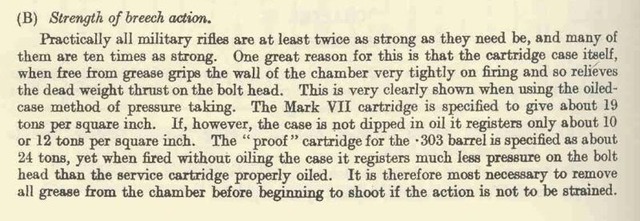
Below is from the 1929 British Textbook of Small Arms and the base crusher system was used to measure chamber pressure.

W8oz09S.jpg


Cartridge Pressure Standards
Measuring Cartridge Pressures
http://kwk.us/pressures.html

In Britain, a third set of crusher standards were developed, using a "base" crusher. The crusher was a short, thick tube placed behind a piston at the base of the cartridge, and the firing pin passed through the center. The cartridge case was well oiled before firing, to minimize cling to the chamber walls
 
Last edited:
NATO lubes the projectile. Not the outside of the case.
Op, load some test rounds with the same primer, make sure they’re clean, and fire them over the chronograph. If one punctures, stop.
Incompressible matter on the CASE will 100% raise chamber pressure. No two ways about it.

I am just worried about pittng my firing pin.
I have escaped damage luckily this far. I have made sure my remaining loads are completely clean and dry and have them set aside. The first batch that I noticed the issue were shot over a chrony with no noticable spikes in velocity. They were very typical of what I have measured before in velocity. I did not set up a chrony for my last range session as I have fired hundreds of this load before. If I get brave again I will try them again and run them over the chronograph.
 
Back
Top Bottom