Experimenting with rifle dies

MartyK2500

CGN Ultra frequent flyer
Rating - 100%
278   0   0
Location
Quebec
With the season short on matches and competitions, I still go to the range every week, and have kept from growing bored by making experiments of my own.

I have set 2 batches of brass aside, each used with their respective die kit.
Each load developed with it’s die kit, as different neck tension equaled different node placement.

Kit #1
Redding body die, Lee collet die, Lee bullet seating die

Kit #2
Forster FLS honed 0.285’’ die with expander ball removed, Sinclair expanding die with 21st century expanding mandrel, Forster micrometer seating die
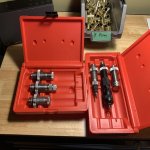
37012A85-89B8-4829-B20B-322349A5899A.jpg


Here is my take on it so far...

Shoulder bump : Both redding body die and Forster FLS are set to 1.5/2.0 thous shoulder bump, and both have the same consistency in doing it.

Runout : the Lee collet die is a zero thou runout setup, while the Forster die keeps me between 0.5-1.0 thou runout, which is still good but not as perfect as the Lee.

Neck turning : When using the Lee collet die, brass flows a little different than with the Forster FLS die.
While using the Lee, during my neck turning (done every firing due to too tight of a neck on this one), I seem to only shave off 4 vertical grooves, which are obviously caused by the collet.
With my Forster FLS I seem to be shaving the base only, and know there will be a donut there if it wasn’t for regular neck turning.

Bullet tension : On the Lee collet die, it’s factory set for a 2/2.5 thous neck tension. Which causes slight irregular bullet seating depths (0.001/0.002’’ inconsistencies on Ogive). Not to mention the Lee collet is not pleasant to use, I always feel like it’s making my Co-Ax torque in a twisting motion not meant to be, due to the brute force needed to operate this die.
On the Forster FLS honed die setup, my fire case 0.291’’ goes down to 0.285’’ once resized. Back up to 0.2865’’ once expander mandrel passed through, and 0.2875’’ once bullet seated. I love the fact that I can have different mandrels to tune neck tension to my exact liking. At 1 thou neck tension, bullet seating depth is always perfect dead on. In both cases Imperial dry neck lube is applied before sizing necks.

Accuracy/Velocity : load development is slightly different in both scenarios, I blame it on the neck tension.
If both setups we’re running the same tension I’d have a better idea what’s going on.
The Forster die/expander setup win big in this area.
All testing done at 300M with a labradar beside me.

Forster setup have better SD/ES, both low single digit (vs 5 SD/ 10 ES with collet)
Forster setup can go higher in powder loads and in speed without showing pressure signs (would a lower neck tension do that?)
Forster setup has better accuracy, 1/3 moa 5 shot groups being the norm, while having a few 0.20 moa 5 shot groups (while Collet die setup is pretty constant at 1/2 moa never really going under or over).


That’s it for now, if anyone has got anything to share on the subject please do.
While my experiment is not quite over with, it’s coming to an end.
Once I decide on the final outcome I’ll follow through with my other calibers to see what gives!

 

Attachments

  • 37012A85-89B8-4829-B20B-322349A5899A.jpg
    37012A85-89B8-4829-B20B-322349A5899A.jpg
    79.9 KB · Views: 333
I love experiments, thanks for sharing Marty! One question I have is regarding the Lee seating die. How do your chosen bullets fit the seating stem? The exact reason I bought a Forster BR seater for my 308 was because Hornady 178 HPBT bullets had very inconsistent seating depths using a Lee Dead Length seating die. This was caused by the bullet making contact with the seating stem at a much higher point than the ogive. Measuring base to ogive on loaded rounds with a comparator of course. The Forster is designed for long slippery bullets and contacts them right down near or at the ogive. Seating depths with the Forster are within .0005". That's why I ask.
 
Thanks for reading!

My Lee bullet seating die is very accurate (as accurate as the Forster seating die but without the helpful MIC) when used in conjunction with my Forster FLS die setup.
Reason being, Lee does not offer the 6.5x47 Lapua caliber as a factory setup.
So I had to send in fired brass casings and a loose bullet so that they custom build the dies for me.
 
Ah, I gotcha. That is interesting then indeed. I wonder what would happen if you used the Forster seater with the Redding/Lee sizers to see if the seating depth can be brought down to 0 variance and see what that does to both SD/ES as well as group sizes.
 
I have tried,
Both seaters interchange without having the slightest effect either way in terms of ogive lenght.
It may be in my mind, but when using the lee seater with my forster FLS kit my runout hangs out around the 1.0 thous mark without having much lower runout ones.
Only did a small sample interchanged so it’s nothing that’s proven yet.

The varying seating depth really seems to stem from the bigger neck tension, creating more friction in the long necks and allowing for more variance.
 
Lee Collet die kit is running 37.4gn H4350
Forster die kit is running 37.8gn H4350

Both have same velocities and similar accuracy spots. Both running around 2690FPS with 139OTM and very accurate.
In fact the 0F lapua brass only expanded and neck turned is running at exactly 37.4gn to be accurate, just like the Lee collet die setup, both running at 2/2.5 thous neck tension (both unfired and fired with lee collet).
As if 1.5 thous extra neck tension equates in 0.4gn powder difference to be in the same spot.

This is nothing scientific Jerry just lot’s of messing around this summer/fall.
I can definitely go a good bit higher powder charge with less pressure signs in the smaller neck tension setup.
 
I have the exact same set up as you only for my 6mm BR . The Lee/ body die set-up with the Forster seater works so good and gets me such great accuracy that I haven't tested the Forester set-up yet. One thing I have noticed is that the Forester die sizes the cases more than the body die espically at the .200 line. As you mentioned the Lee seater die is good, only in my testing not quite as good a #'s as the Forester die in terms of run-out .JME
 
Rotate the Collet die 1/8 of a turn, just the loose mandrel between sizing, gets rid of the ridges and gives more consistent neck tension.
 
I ran a similar experiment 2 weeks ago with the intention of posting it here but the results were nearly identical so I didn’t bother.

I compared Lee collet/ Redding body die vs Forster Fl die. Both batches bullets were seated with a Forster bench rest seater. Brass was all identically prepped and 2x fired. Charge weights were identical. Rifle is a 6.5CM with 140 Berger Hybrids.

I shot 5, 5 round groups for each batch at 300 yards, round robin style. Groups varied in size from 0.8” to 1.2” for both batches. ES remained consistent throughout at 12 FPS.


Marty- you seem to be putting a lot more force on your Lee collet die than I do. I’m using a rockchucker press and I’ve found the force required about the same as full length resizing a large magnum case.
 
To be honest I have been measuring necks and progressively torquing and remeasuring to see when it fully resizes.
And then give myself a small margin of extra torque when doing large batches just to be sure.

In the past I had a Lee classic cast, had a very long handle and required torque was minimal to get it done.
With my Forster co-ax, a short handle and different press design does not lend as well to collet neck sizing.
While being possible and working, you get the feeling the press ain’t liking what’s happening for long term repeated use.
 
Lee Collet die kit is running 37.4gn H4350
Forster die kit is running 37.8gn H4350

Both have same velocities and similar accuracy spots. Both running around 2690FPS with 139OTM and very accurate.
In fact the 0F lapua brass only expanded and neck turned is running at exactly 37.4gn to be accurate, just like the Lee collet die setup, both running at 2/2.5 thous neck tension (both unfired and fired with lee collet).
As if 1.5 thous extra neck tension equates in 0.4gn powder difference to be in the same spot.

This is nothing scientific Jerry just lot’s of messing around this summer/fall.
I can definitely go a good bit higher powder charge with less pressure signs in the smaller neck tension setup.

That's cool... love to see how the barrel reacts as it ages a bit. Another test you might consider is adjusting the neck thickness. For my 308's I found a 'thinner' neck thickness lead to the most consistent results over a wide range of brass, bullets and barrels. Might have just been a lucky quirk of the components but it worked out nicely in the end.

Always stuff to experiment with and the barrel/target will tell you how to proceed.

Jerry
 
That's cool... love to see how the barrel reacts as it ages a bit. Another test you might consider is adjusting the neck thickness. For my 308's I found a 'thinner' neck thickness lead to the most consistent results over a wide range of brass, bullets and barrels. Might have just been a lucky quirk of the components but it worked out nicely in the end.

Always stuff to experiment with and the barrel/target will tell you how to proceed.

Jerry

Since I spent so much time experimenting with this 6.5 lately, this morning decided to give it a break and return to my 2500x fired .308 barrel (1st IBI barrel you sold me) with 175 SMKs and Varget.
Last night I measured the lands and have barely moved since it's new (in fact I doubt they moved at all), I bet a bore camera would show some serious erosion and they are about to go back, don't know I can't see it.
I think shooting 42.7gn of Varget all it's life has given it a good life expectancy.
Just did a very small test, but got my head scratching bad.


Batch #1, Redding body die, Lee collet, 2 thous neck tension, 5 rounds of 42.7gn Varget (my original recipe) and 5 rounds 43.0gn Varget, 200M. This setup was usually zero runout, neglected to double check.

Batch #2, Redding Body die, Lee Collet, 21st Century expander, 1 thou neck tension, 5 rounds of 42.7gn Varget, 5 rounds of 43.0gn Varget, 200M. Neglected to double check if expander induced runout.


In batch #1, I had the same past repeatable results. 42.7gn (2700fps) being 5/8 moa and 43.0gn (2714fps) being 3/4 moa, steady single digit SD-ES.
In batch #2, my 42.7gn (2690fps) was 3/4 moa and my 43.0gn (2700fps) was just a tad under 1/2 moa, 43.0 in batch 2 had the same velocity as 42.7 in batch 1, was more accurate, and even fell into low double digit ES even though there was no vertical on target (200M is close though by all means).

I felt like I was approaching a sweeter spot than usual, and will have to retest the whole 43.0, 43.2, 43.4, 43.6, 43.8 spectrum with only 1 thou neck tension, to see if there's a trend for a very sweet spot.

What's making me scratch my head, I have a very tedious and meticulous loading process, and how my batch #2 got into double digits ES when A. neck tension is very well regulated, and B. my FX120 counts to the kernel close and even use tweezers to add/substract a kernel to get it dead on when testing.


(As far as necks go, my 308 is already running 13.5 thou neck thickness, which gives me plenty of space as my barrel is already running factory ammo fine by expanding 3 thous, and factory 308 is usually 15 thou neck thickness.
On my 6.5 I could shave it a bit more, currently sitting at 12 thous neck thickness and fired cases expand 3 thous exactly, kind of weary of going thinner than 12 thous thickness for no good reason.)
 
Last edited:
I run 12 to 13 thou neck thickness. Test at 13 and then if really bored, test at 12 :)

If you shoot a bunch more groups, does the results repeat? maybe your set up just likes 1 thou neck tension better?

Watch the target and the plot. Start to see errant shots vs wind and your shot call, time to put the barrel to pasture and for practise only.

For F class, I would be very nervous shooting a barrel over 2000rds at a big match at 900m... for practise, run it until you can't keep it in the 5 ring.

enjoy.....

Jerry
 
Back
Top Bottom