sticky bolt lift in out 7-08 with 308 sized brass

WhelanLad

CGN Ultra frequent flyer
Rating - 0%
0   0   0
Location
Australia AU
hey all, sized NNY 308 brass to 7-08, full length then necked but reaaal tight in the ass end i assume? is this due to the down sizing?

or the brass may be thicker or perhaps moore sizing needed down the body initially??

had to stop firing the rounds as after firing lift was difficult, an then alot goin in were difficult as an working the extractor claw , i didnt like it.

now same thing happened wit hthe 120s back in the day and i thought the loads were hot, but theres no way either 120 load or 162 loads were hot for the amount of bolt lift difficulty...

scrap the NNY 308 brass all together an just stick to 7-08 yeh?
 
Have to hold on the upstroke of the press for 10 Mississippi's to help make sure there is little spring back. Also make sure you trim to length.
 
Probably not a bad call to stick with 7-08 brass. Was this 308 brass previously fired? May be the cause that that chamber was a little "looser" near the head of the case in that little portion that your sizing die doesn't quite get down to? If you had a small base 308 die (or perhaps a SB body die) it could possibly bring it down if your sure the issue is back there and not up front with a thicker neck or something. But honestly if it were me id just go with the 7-08 brass. I'm running lapua in mine, its a little pricey but you get what you pay for.

Cheers
 
It's been a while since I've necked down bottle neck cases but the issue I ran into most often was the thickness of the brass in the necks.
They might need turning and for a case as common as 7-08 I don't think it would be worth the effort.

One way to check the location of the tight spot is to paint the case with a marker or similar and see where the rub marks are after chambering.
 
Probably not a bad call to stick with 7-08 brass. Was this 308 brass previously fired? May be the cause that that chamber was a little "looser" near the head of the case in that little portion that your sizing die doesn't quite get down to? If you had a small base 308 die (or perhaps a SB body die) it could possibly bring it down if your sure the issue is back there and not up front with a thicker neck or something. But honestly if it were me id just go with the 7-08 brass. I'm running lapua in mine, its a little pricey but you get what you pay for.

Cheers

i feel like You're onto it mate! i rekon it is the lower section of the case doin the drama.....


interesting one with the Trim comment.... these 308s , once sized are often well short of the trim length,,,, i thought it be oopposide by necking down an not up??

Thanks for the 10 missisippiis, i will keep that one in mind ha ha!


i will acquire some more 7-08 "new" brand of some sort in the price range next time im down town...... save the NNY for a ...uh..308 :(
 
It's been a while since I've necked down bottle neck cases but the issue I ran into most often was the thickness of the brass in the necks.
They might need turning and for a case as common as 7-08 I don't think it would be worth the effort.

One way to check the location of the tight spot is to paint the case with a marker or similar and see where the rub marks are after chambering.


i noted one low charge that shot exceptionally high and was exceptionally difficult to chamber.... i knew it wasnt a great idea to fire it after the issue to get it in there but i thought, how else would it come out lol..... now i dont see a tight Base of case, causing the projectile to fly high or aka Higher pressure............ but i can see a Neck issue here....... damn.

scrapping the NNY combo.
 
The little I know of my buddy doing it for his gun :
He was resizing first the case in a .308 small base sizing die - then in the 7-08 die and turning the neck or they will not chamber with a bullet in.
Cannot help more than this. If I remember well, he was annealing before turning the neck..but I might be wrong.
Will talk to him soon and try to find out more.
 
One way to test if it's the neck thickness causing the problem is to chamber a resized, empty case before loading it. If it chambers easily when empty, the case is externally the right size. This doesn't mean the neck isn't too thick.

Then seat a bullet in that same case and try again. If it's now tight chambering you have a neck thickness issue.
Dangerous because the brass has no where to go when the round fires. It can't release the bullet easily and pressure will spike.
 
In the late 1970's (?) early 1980's (?) I was given a bunch of previously once fired 7.62x51 brass - IVI head stamps - primers were crimped in place - had been scooped up at the RCMP Training Depot range in Regina, I was told - so at the time, likely had been fired in their 308 Win Winchester M70's. I ran about half of them through an RCBS Full Length 243 Win sizing die - did not, still do not, own a neck thinning tool - used them like that in a Rem 788 243 with 85 grain Speer bullets - they were reloaded many times - probably still have some of them left... So, sometimes get lucky with the brass and the rifle, and the re-forming works with no "drama"!!
 
In the late 1970's (?) early 1980's (?) I was given a bunch of previously once fired 7.62x51 brass - IVI head stamps - primers were crimped in place - had been scooped up at the RCMP Training Depot range in Regina, I was told - so at the time, likely had been fired in their 308 Win Winchester M70's. I ran about half of them through an RCBS Full Length 243 Win sizing die - did not, still do not, own a neck thinning tool - used them like that in a Rem 788 243 with 85 grain Speer bullets - they were reloaded many times - probably still have some of them left... So, sometimes get lucky with the brass and the rifle, and the re-forming works with no "drama"!!

I tried the same thing with some Federal 308 brass, sizing it to 243 Win. I wasn't happy with the way they turned out, probably because I didn't anneal the neck/shoulder area first.
The article I read before starting suggested using a 7-08 die first, then the 243 die, sizing down in 2 steps. I didn't have a 7-08 die so I went all the way in one go.
Anyway, I never tried using them, so I can't comment on what they worked like in the rifle.
I don't recall measuring the neck thickness before and after, although I do remember reading that the necks tended to get thick as a result of downsizing the calibre.
If the chamber in the rifle is "generous", it might not cause a problem. A tighter chamber may give more issues with thick necks.
Conversely, thin-walled brass might not be a problem. Winchester comes to mind.
It'd be interesting to compare the outside neck diameter of a problematic loaded round vs. either factory ammo or a fairly new reloaded case using original 7-08 brass. Necks will apparently thicken somewhat over several loadings, as the brass flows forward. How much I don't know.

Incidentally, what is NNY brass? I've never heard the acronym before.
 
I think NNY brass is known as PPU here in North America - Prvi Partisan. Something like NNY is the Russian Cryllic spelling of the name and PPU is the "anglicized" spelling of the same name.
 
Some article that I had read had suggested using a bullet seating die - without the seating stem - as an intermediate step in re-forming brass cases. I did do that when making 7x61 Sharpe and Hart from 7mm Rem Mag brass - so was not changing the neck diameter, so much as pushing back the shoulder to new angle / new location. Was using a smaller RCBS single stage press, not my current Rockchucker with its compound leverage - so maybe the less leverage on the little press was actually a good thing. Pretty sure I used the S&H Seating die as the intermediary step, rather than buy the $200 series of reforming dies from RCBS. And I did anneal all those brass shoulders and necks first - I think we re-formed 80 of them plus lost 3 right at the beginning, until we got the sequence figured out.
 
WhelanLad

You can have your problem anytime you resize a case that was fired in another chamber. And what you are dealing with is brass spring back after sizing and the case wanting to spring back to its fired size. I buy once fired military Lake City 7.62 brass for my .308 and size it with a small base die to help bring the case body diameter back to minimum SAAMI specs.

I also used the same 7.62 brass to form to .243 Win and had to turn the necks to a uniform neck thickness. Reducing the neck diameter was causing an increase in neck thickness variations. And this forced me to neck turn so I only made 20 cases and gave up on the idea. Lake City brass is very hard and the majority of the cases are fired in fat chambered machine guns and a pain to resize and have more brass spring back.

Chambers and resizing dies can vary in size and the advice about 10 Mississippi is a good idea and save you from buying a small base die. "BUT" you might have to size the cases a second time and add 10 Massachusetts or Vegemite twice. ;)

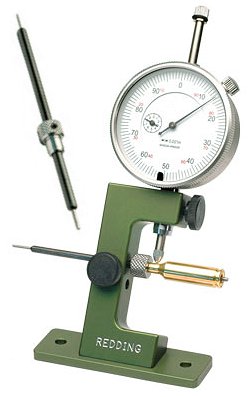
I use the neck thickness gauge below and it is good to have for sorting cases and neck turning. And I think a must have when reducing the neck diameter and checking neck uniformity. Reducing the neck diameter can effect neck runout and the accuracy of the cases.

blZCE83.jpg
 
I've taken .308 brass and necked down for 7mm-08.... I determined conclusively the neck was just too thick and wouldn't chamber easily.... remainder of case dimensions were ok.... I didn't want to turn necks so I just scrapped the project....
 
I would suggest that you try a small base die to do the initial resize.

I sometimes buy large quantities of once fired IVI brass, and after resizing with a normal resizing die, some of the cases are still too tight. So in response to that problem I implemented a second sizing with a small base die as part of the process and it does resolve the problem.

I could not size only one time with the small base die because it was too much of a resize in a single step. So it had to be done as a two step process.
 
The term "small base die" can be deceiving because the small base die reduces the entire case body .001 to .003 in diameter. And brings the case closer to what a new unfired case diameter would be. And chambers and dies vary in size, as an example, I have a standard Lee .223 die that will reduce the body diameter more than my RCBS .223 small base die.

And any time you resize a case fired in another chamber you can have problems dealing with brass spring back and the case not fitting the chamber properly.

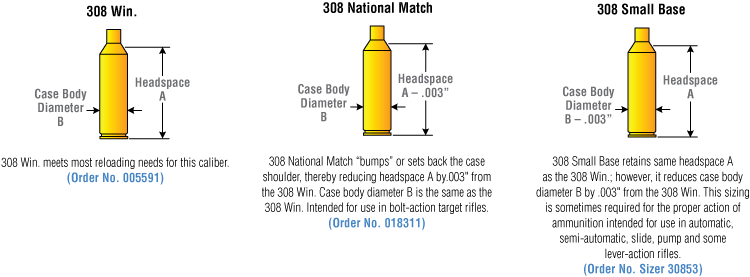
Below are three types of Forster ,308 Winchester dies.

gFCObJR.png


Case gauges also vary in diameter and most have a body diameter closer to max SAAMI diameter.

Below is a Dillon .308 case gauge and placed in the gauge is a "FIRED" Lake City 7.62 case.

UPCvxyL.jpg


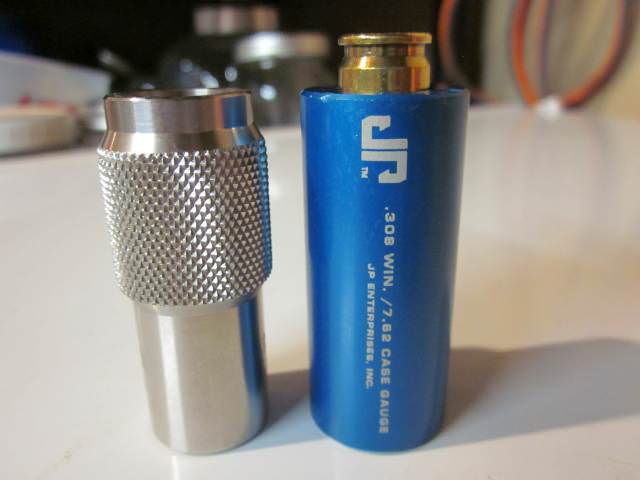
Below is the very same "FIRED" 7.62 Lake City case in a JP Enterprise case gauge showing its smaller body diameter. And If the resized case and loaded round fits in this gauge it will fit in any chamber. And when using once fired brass having a case gauge with a smaller body diameter will solve problems before the case is put in your chamber.

zOVqgmU.jpg


In a semi-auto the resized case should be .003 to .005 smaller in diameter than its fired diameter. This allows the case to chamber freely and spring back from the chamber walls and extract reliably.
 
Last edited:
As a side note, military Lake City brass is very hard, and once fired machine gun fired brass can be extremely hard to resize.

There are some tricks to dealing with brass spring back and sizing .308 cases.

1. Size the .308 case first in a 30-06 die to reduce the case body diameter, Then size again in a .308 die and check in a good case gauge.
2. You can size the .308 case first in a carbide .45 acp die and reduce the case base diameter. This is in effect a small base die as it is only sizing the base of the case. Then size in a standard .308 die and check in a good case gauge.

The above methods were in several reloading forums when dealing with hard to size military 7.62 cases and I tried them both. And my point being these methods may save you from buying a small base die. And pausing at the top of the ram stroke also greatly reduces brass spring back and might save you the price of a small base die.
 
So i got to load some left over FC from my woodleigh loads, wit hthe 162 SST with the same charges that showed promise with NNY minus the bolt lifting issues, and whattya know.... I shot one of the best groups ive shot for maybe 4 years ha ha an one of the best Ive ever shot with the Kimber.........

so to say im stoked and have a Fallow deer Summer load loaded up that is accurate, is certainly a happy day down under!

will run through this thread shortly an catch up.... bottom line that brass just didnt suit such tight chamber?
 
WhelanLad

You can have your problem anytime you resize a case that was fired in another chamber. And what you are dealing with is brass spring back after sizing and the case wanting to spring back to its fired size. I buy once fired military Lake City 7.62 brass for my .308 and size it with a small base die to help bring the case body diameter back to minimum SAAMI specs.


blZCE83.jpg
Hey Biped, Thanks for your info mate!!! all making sense.
 
Back
Top Bottom