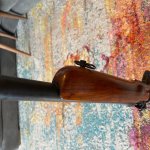
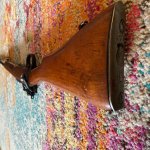
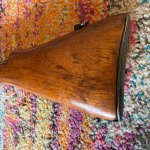
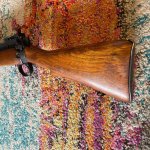
Help Identifying .303 enfield

Rating - 100%
30   0   0
Hello All,
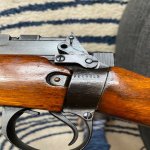
Im having a bit of a hard time identifying this .303. It has no4 MK1 on it if i read it correctly, but not seeing any other marking inline with Enfield, (but im not an expert on military stuff in any way)
This forum has tremendous amount of knowledge and i was hoping to trouble you for some help please and What would a fair value be (?)

https://flic.kr/p/2kiXXzA
https://flic.kr/p/2kiUbtG
https://flic.kr/p/2kiYwbt
https://flic.kr/p/2ki###r
https://flic.kr/p/2kiXXwK
https://flic.kr/p/2kiUbrH
 
What are people paying for un-restorable No.4 rifles these days? I'm still at like $125 for a plain jane example, but I'm sure that's way out of touch now... It does look nearly un-used at least.

You don't see other markings? There's a big S next to No4 Mk1 *, that's how it was identified as Savage manufacture. The serial number is on the left, between the safety and the trigger. Serial on the bolt handle hopefully matches. All the other bits *may* have S on them as well, and you may find other stamps including dates on the receiver and barrel. It can be interesting to find out a more specific history, but this is not generally a desirable historical piece after what was done to make it a cheap, light-weight deer gun.

Since it was sold out of British service after the War, it had to be proven and thus has British proof marks (crown British Nitro Proof) and the recipe they used: a 0,303 inch bullet in a cartridge 2,222 inches long, producing 18 tons per [picture of a square] inch. AKA a .303 British cartridge proof load. It didn't go kaboom so it's safe to sell!
 
Thank you very much for all the input!
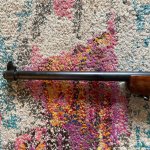
Its possible that im missing something, but I can't figure out where was it cut (?) I had looked at other guns as well, perhaps this one had the stock changed ?

ps. the bolt numbers match!


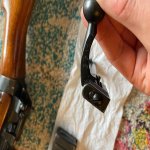
IMG_1717.jpg
IMG_1718.jpg
IMG_1719.jpg
IMG_1720.jpg
IMG_1721.jpg
IMG_1722.jpg
 

Attachments

  • IMG_1717.jpg
    IMG_1717.jpg
    89.3 KB · Views: 433
  • IMG_1718.jpg
    IMG_1718.jpg
    132.2 KB · Views: 430
  • IMG_1719.jpg
    IMG_1719.jpg
    145.9 KB · Views: 431
  • IMG_1720.jpg
    IMG_1720.jpg
    149.8 KB · Views: 430
  • IMG_1721.jpg
    IMG_1721.jpg
    71.1 KB · Views: 428
  • IMG_1722.jpg
    IMG_1722.jpg
    148.3 KB · Views: 430
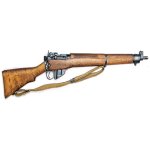
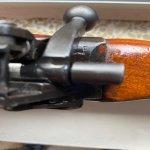
You asked where it has been cut? Should be a picture here, stolen from Internet, of a Lee Enfield No. 4 Mk. I - what it looked like in its original configuration. You can probably pick out all the differences between the one in this picture, and what you have there. From your last picture link in your first post, you have a Lee Enfield No. 4 Mk. I* - small differences - mostly how the bolt is held in and removed from the rifle.

10A858B4-B7DA-477A-934B-9305A170A322.jpeg
 

Attachments

  • 10A858B4-B7DA-477A-934B-9305A170A322.jpeg
    10A858B4-B7DA-477A-934B-9305A170A322.jpeg
    36.1 KB · Views: 416
Last edited:
Without looking to close because I am anyway no Expert in Lee Infields, looks to me like a usual LE as sold in the early 70s for 35 Bucks out of Sidney Robinso'ns Catalogue.
We still use a few of these almost indestructible Clubs with a 10 shot Clip.

At a Gunshow in 2018, I noticed all original (non "Sporterized") Vendors where asking 1900 to 2000 Bucks for them.

Cheers
 
You asked where it has been cut? Should be a picture here, stolen from Internet, of a Lee Enfield No. 4 Mk. I - what it looked like in its original configuration. You can probably pick out all the differences between the one in this picture, and what you have there. From you last picture link in your first post, you have a Lee Enfield No. 4 Mk. II - small differences - mostly how the bolt is held in and removed from the rifle.

View attachment 444732
'

Thanks! I was referring to the same pics of standard no4 Mark, but can't see where it was cut on my rifle - the wood shows no signs of work being done under / over barrel or stock. Looks to be factory to me, does this kind of make sense? or am I loosing it completely haha.
 
Forearm wood has been cut shorter and wood has been removed from the but reshaping it. As you can see from the picture above other wood bands and site protecter has been removed from yours. If no holes where drilled for a scope it’s worth about $200 if the rifling is good.
 
Your rifle's lower stock was sawed off near to / just behind the lower band. Receiver ring, lower and upper hand guards, lower band, upper band, sight protector removed and discarded. Your barrel was sawed off just in front of the front sight carrier and probably re-crowned, so your barrel is now shorter than original - since bayonet lugs are gone, not suitable for "re-storing". Sawed off area on the stock was worked to rounded shape with rasp, file, then sandpaper, and the entire stock given a coat of some sort of finish - perhaps a varnish.

A "one screw" rotatable sling swivel loop added at the front - very commonly seen on Parker Hale and similar conversions - probably very inexpensive at the time to replace the front sling loop that went away when the lower band was removed. An original Lee Enfield stock is simply soaked in linseed oil - periodically a few drops hand rubbed in by the soldier - resulted in smooth and "glowing" finish, but not shiny at all.

My Dad bought me one like yours, at local MacLeod's hardware store in small town Saskatchewan in 1968 or 1969 - $16.99 or $19.99, I forget now. He was making $2 per hour at the time, so 8 to 10 hours pay. Even then, they were considered very inexpensive, but the cartridge was fully adequate for deer, moose, bear and such.
 
Last edited:
Your comment about it looking to be "factory" - it is possible. Companies like Parker Hale, BSA and others had "factories" that converted the standard military rifles from WWII into sporters. SAKO was in that business - I think mostly the German mauser 98 rifles, though. I do not know how to identify others, but a rifle worked over by Parker Hale will have the letters "PH" stamped into the receiver, very close to where the bolt handle closes - with your right hand in shooting position, you would be able to put your thumb on that stamp, with the bolt open. Rifles were completely dismantled, cleaned - sometimes parts replaced, wood altered, then re-assembled for sale. Because your rifle still has the rear receiver bridge and original military rear sight, it would have been one of the lower grade conversions, if done by Parker Hale. Other "factories" or home-done ones had different objectives.

Also could have been done by most any decent wood workers across Canada - I am quite sure maybe 100's of thousands of those No. 4's, No. 1's, the P14's and M1917's were "done up" at kitchen tables from Newfoundland to British Columbia - varying from very nicely done to pretty crudely done, but they worked and took game for decades. My Dad "did up" his M1917 in 1948. The No. 4 that my Dad bought for me is in a scabbard on my brother's snowmobile North and West of Grande Cache, Alberta - his "survival" rifle, if he ever needs to walk out.
 
Last edited:
Apologies for misunderstanding - I thought you were interested in knowing what your rifle was - I see you have posted it for sale and simply linked to this thread to explain what it is. I did not see that coming. Good luck with your ad for sale. My comments are worth what you paid for them.
 
The S and also the flaming bomb means it is a U.S.A. military made Savage No.4 rifle. The cut stock ,if it was removed ,will probably show a matching serial number and an S.
Americans like these quite a bit because they made them for us during WW II . They sell in the U.S. for up to maybe 500.00 U.S. $ but you need to get it down there and the stock has been sporterized ( not full wood ).
 
Your comment about it looking to be "factory" - it is possible. Companies like Parker Hale, BSA and others had "factories" that converted the standard military rifles from WWII into sporters. SAKO was in that business - I think mostly the German mauser 98 rifles, though. I do not know how to identify others, but a rifle worked over by Parker Hale will have the letters "PH" stamped into the receiver, very close to where the bolt handle closes - with your right hand in shooting position, you would be able to put your thumb on that stamp, with the bolt open. Rifles were completely dismantled, cleaned - sometimes parts replaced, wood altered, then re-assembled for sale. Because your rifle still has the rear receiver bridge and original military rear sight, it would have been one of the lower grade conversions, if done by Parker Hale. Other "factories" or home-done ones had different objectives.

Also could have been done by most any decent wood workers across Canada - I am quite sure maybe 100's of thousands of those No. 4's, No. 1's, the P14's and M1917's were "done up" at kitchen tables from Newfoundland to British Columbia - varying from very nicely done to pretty crudely done, but they worked and took game for decades. My Dad "did up" his M1917 in 1948. The No. 4 that my Dad bought for me is in a scabbard on my brother's snowmobile North and West of Grande Cache, Alberta - his "survival" rifle, if he ever needs to walk out.

Wow, it does have the letter P stamped.
Also it has a B under the SN

IMG_1760.jpg
IMG_1759.jpg
 

Attachments

  • IMG_1760.jpg
    IMG_1760.jpg
    62.6 KB · Views: 90
  • IMG_1759.jpg
    IMG_1759.jpg
    113.1 KB · Views: 90
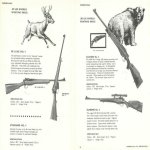
I am not sure what the "P" might signify - the Parker Hales I have worked on had "PH" stamped about there. Here is an ad from back in the day showing the four grades of conversion that Parker Hale offered for sale - yours looks similar to the "Standard" grade - military front and rear sights, etc.

None of your pictures or text show or mention a magazine - the Standard was the only Parker Hale with the original military 10-round magazine. The original magazines, from the WWII factory, did not get a serial number, but many did get a number to the receiver by unit armourers once the rifles were in service. If it is a Parker Hale, no assurance at all that the magazine is original to the rifle - may very well have miss-matching number, or no number. Once the feed lips are tuned, should function pretty much perfectly.

Parker-Hale_Lee-Enfield_No. 4 Sporting_Rifles-1.jpg
 

Attachments

  • Parker-Hale_Lee-Enfield_No. 4 Sporting_Rifles-1.jpg
    Parker-Hale_Lee-Enfield_No. 4 Sporting_Rifles-1.jpg
    141.8 KB · Views: 87
Last edited:
Its not a Parker Hale. Many sporters were made up right here in Canada, on a commercial scale. Yours is likely one of them. Hows the bore? Since you are selling it, it would be prudent to let people know in your ad.
 
Back
Top Bottom