Just wondering what the thoughts are on the importance of seated bullet runout with respect to accuracy . Shooting out to 700 yards with both .223 and .308 target / tactical style bolt guns . Is it worth fussing on the bench to get rounds consistently under .002 , or , where do you draw the line ? I seem to see more and more vids with guys shooting F Class and reloading on a Dillon and perfectly happy with .004 .













































You are using an out of date browser. It may not display this or other websites correctly.
You should upgrade or use an alternative browser.
You should upgrade or use an alternative browser.
Seated Bullet Runout
- Thread starter HondaVTEC
- Start date

You spin the case on the case body to check neck and bullet runout. But a full length resized case body does not touch the chamber walls and effect bullet alignment.
The case is supported in the rear by the recessed bolt face and the bullet in the throat. And the only part of the case that contacts the chamber is the case shoulder.
The late Jim Hull of the Sierra ballistic test lab had a favorite saying. "The cartridge should fit the chamber like a rat turd in a violin case". This humorous saying simply meant the case body has no guiding effect on the bullet in the throat with a full length resized case.
Bottom line the U.S. Military considers match grade ammunition to have .003 or less bullet runout.
Below the top image spins the cartridge on the bullet tip and the base of the case. (red Hornady gauge)
The bottom image spins the case on the case body like the majority of runout gauges. (silver RCBS case mastering gauge pictured)
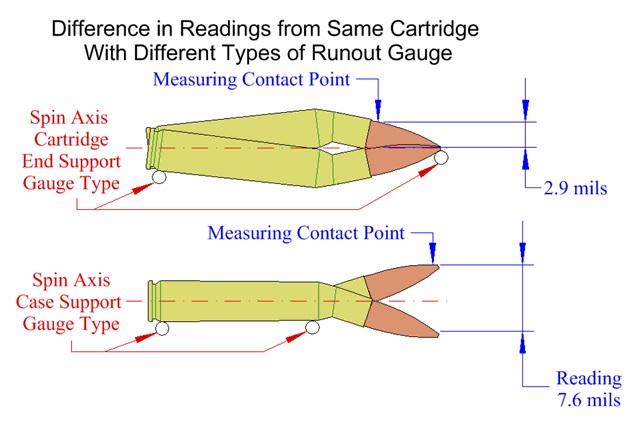
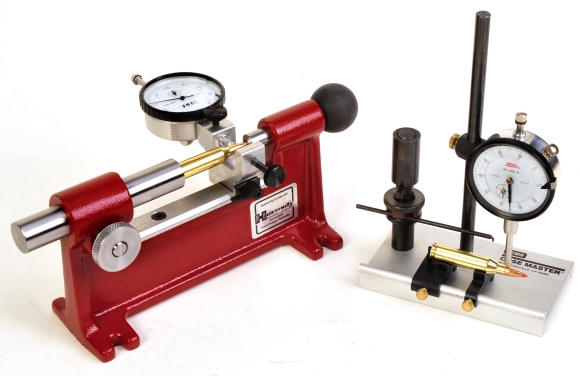
Below the bullet being held and centered in the throat and the base of the case held by the recessed bolt face. Meaning the case body is not steering or guiding the bullet in the throat. So .003 or less bullet runout means the case body is not touching the chamber walls and causing the bullet to tilt in the throat.
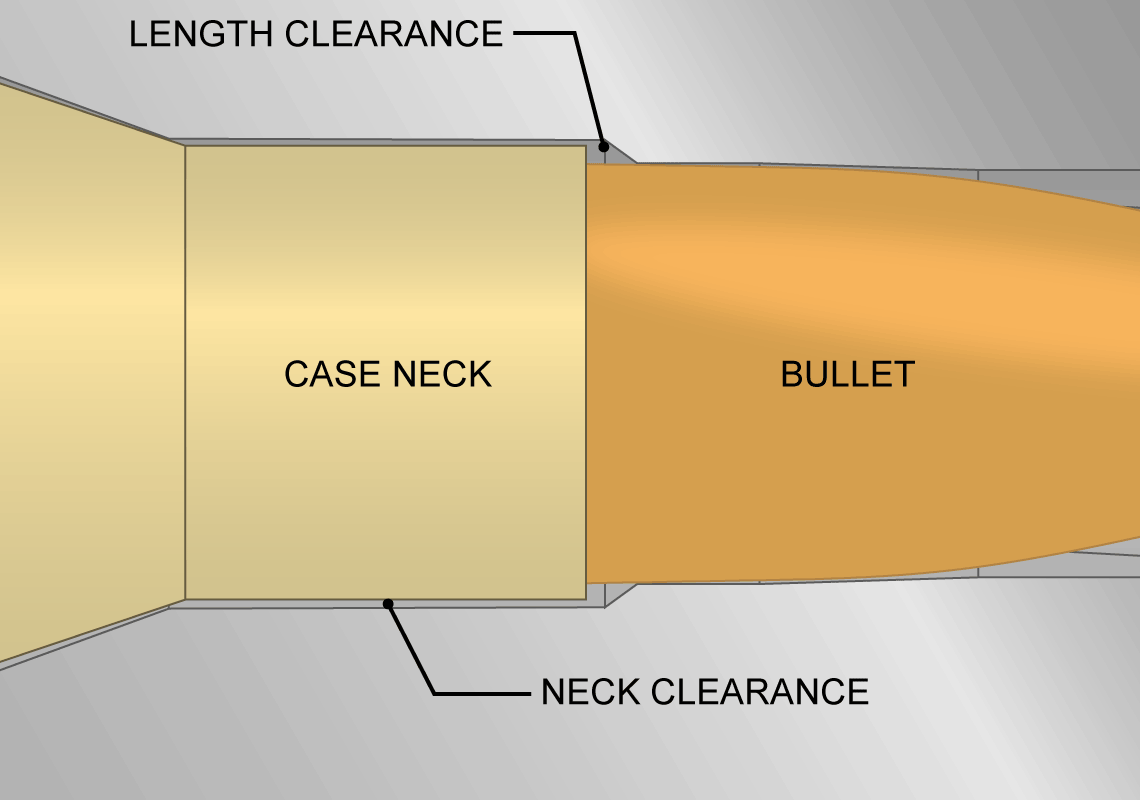
The case is supported in the rear by the recessed bolt face and the bullet in the throat. And the only part of the case that contacts the chamber is the case shoulder.
The late Jim Hull of the Sierra ballistic test lab had a favorite saying. "The cartridge should fit the chamber like a rat turd in a violin case". This humorous saying simply meant the case body has no guiding effect on the bullet in the throat with a full length resized case.
Bottom line the U.S. Military considers match grade ammunition to have .003 or less bullet runout.
Below the top image spins the cartridge on the bullet tip and the base of the case. (red Hornady gauge)
The bottom image spins the case on the case body like the majority of runout gauges. (silver RCBS case mastering gauge pictured)
Below the bullet being held and centered in the throat and the base of the case held by the recessed bolt face. Meaning the case body is not steering or guiding the bullet in the throat. So .003 or less bullet runout means the case body is not touching the chamber walls and causing the bullet to tilt in the throat.

Munkey1973
CGN frequent flyer
- Location
- Regina, SK
I compete regularly in F Class T/R.
I use a 21st Century Concentricity Gauge for measuring TIR and it very accurate as well as repeatable (unlike the RCBS Case GaugeMaster which is garbage - sold mine after 2 months).
My finished 308 loads are usually between 0.002 to 0.003. Not often do I test one and see it under 0.002... rather I am twice as likely to see one over 0.003 and in the 0.004 area.
Realistically, even at 1,000 yards I doubt there would be any significant difference with my skill level (or at some matches lack there of) from 0.002 to 0.004 or even 0.004 to 0.006.
Some of the best shooters we have in F T/R at Nokomis SK have probably never owned any kind of Concentricity Gauge... they are old guys who shoot nearly everyday on their farms or acreages.
Their logic is:
If they can not make the right wind call which can push them into the Magpie Ring (i.e. 3 MOA), then trying to tweak their loads and shave 1/8th of an MOA at 1,000 is highly inconsequential.
I use a 21st Century Concentricity Gauge for measuring TIR and it very accurate as well as repeatable (unlike the RCBS Case GaugeMaster which is garbage - sold mine after 2 months).
My finished 308 loads are usually between 0.002 to 0.003. Not often do I test one and see it under 0.002... rather I am twice as likely to see one over 0.003 and in the 0.004 area.
Realistically, even at 1,000 yards I doubt there would be any significant difference with my skill level (or at some matches lack there of) from 0.002 to 0.004 or even 0.004 to 0.006.
Some of the best shooters we have in F T/R at Nokomis SK have probably never owned any kind of Concentricity Gauge... they are old guys who shoot nearly everyday on their farms or acreages.
Their logic is:
If they can not make the right wind call which can push them into the Magpie Ring (i.e. 3 MOA), then trying to tweak their loads and shave 1/8th of an MOA at 1,000 is highly inconsequential.
Last edited:

I compete regularly in F Class T/R.
I use a 21st Century Concentricity Gauge for measuring TIR and it very accurate as well as repeatable (unlike the RCBS Case GaugeMaster which is garbage - sold mine after 2 months).
My finished 308 loads are usually between 0.002 to 0.003. Not often do I test one and see it under 0.002... rather I am twice as likely to see one over 0.003 and in the 0.004 area.
Realistically, even at 1,000 yards I doubt there would be any significant difference with my skill level (or lack there of) from 0.002 to 0.004 or even 0.004 to 0.006.
Some of the best shooters we have in F T/R at Nokomis SK have probably never owned any kind of Concentricity Gauge... they are old guys who shoot nearly everyday on their farms or acreages.
Their logic is:
If they can not make the right wind call which can push them into the Magpie Ring (i.e. 3 MOA), then trying to tweak their loads and shave 1/8th of an MOA at 1,000 is highly inconsequential.
Totally agree!
Cat
Munkey1973
CGN frequent flyer
- Location
- Regina, SK
Totally agree!
Cat
LMFAO ... judging by your signature, I can totally see why you agree.
For me its usually windage. Every once in a while a I will make a shot after a windage adj "and be oh SOB what the hell is going on here? ohhhh 2 minutes on my other left" LOL
Anything .005 and under is fine by my standards.
I would worry more about neck and throat tolerances than run out.
Back when I was still shooting Hunter Bench Rest, out to 300yds, our chambers were cut with custom reamers that wouldn't allow factory rounds or rounds that didn't have the necks turned for .0015 clearance to be chambered. We neck sized only, on Wilson dies with change out inserts for neck diameters, on small arbor presses.
We also jammed the bullets into the leade hard enough to slightly set the bullet back into the neck a few thou. This practice alleviated most run out issues, unless something was really awry.
If you're going to reload for fine precision work, you need precision reloading equipment and consistent components. Especially primers and bullet weights. Custom swaged bullets were the go to at the time and they had to be ordered from custom makers in the US. Today, some very good/consistent bullets can be purchased off the shelf, made by commercial builders at very reasonable prices.
Proper twist rates in the bore, for the bullets you're shooting are also a big factor. Bullet weights shouldn't vary more than 2 tenths of a grain and be sorted accordingly.
Then we get into purchasing large containers of powder for consistent ignition, or blending different lot numbers of small containers to get one large lot of consistent burn rate.
Bench Rest primers, such as CCI BR types are usually very consistent from lot to lot, but they still need to be checked out, when opening a new carton.
The list goes on and on, some people even claim they're anal about overall consistency.
I would worry more about neck and throat tolerances than run out.
Back when I was still shooting Hunter Bench Rest, out to 300yds, our chambers were cut with custom reamers that wouldn't allow factory rounds or rounds that didn't have the necks turned for .0015 clearance to be chambered. We neck sized only, on Wilson dies with change out inserts for neck diameters, on small arbor presses.
We also jammed the bullets into the leade hard enough to slightly set the bullet back into the neck a few thou. This practice alleviated most run out issues, unless something was really awry.
If you're going to reload for fine precision work, you need precision reloading equipment and consistent components. Especially primers and bullet weights. Custom swaged bullets were the go to at the time and they had to be ordered from custom makers in the US. Today, some very good/consistent bullets can be purchased off the shelf, made by commercial builders at very reasonable prices.
Proper twist rates in the bore, for the bullets you're shooting are also a big factor. Bullet weights shouldn't vary more than 2 tenths of a grain and be sorted accordingly.
Then we get into purchasing large containers of powder for consistent ignition, or blending different lot numbers of small containers to get one large lot of consistent burn rate.
Bench Rest primers, such as CCI BR types are usually very consistent from lot to lot, but they still need to be checked out, when opening a new carton.
The list goes on and on, some people even claim they're anal about overall consistency.
I've got pretty good reloading gear and have been reloading for 25 years or so . Co Ax press , Forster bushing dies / BR seaters , neck turners , Lapua brass etc . I used to really fuss over seated bullet runout and would work hard to get every single loaded round under .0015 and most were under .001 . I'm just not sure it really matters that much . At least in a factory barreled rifle . Just curious how others feel about it . There is no question that at distance , the shooters ability to read the wind has a HUGE impact on what happens . Especially with a .308 .
There are guys like Erik Cortina who will claim that runout does not matter. He also claims that you should always full length resize.
I don't agree with either point if we are after precision. Everything matters! Its just a matter of by how much.
Erik argues that you should FL resize so you don't have stiff bolt lift or a hard time closing the bolt. To this point I agree, but with a caveat.
You have to dig a bit to understand that Erik means shoulder bump when he says FL resize. So that's good advice, but not the best advice... if you are a precision long range shooter.
As a result of a shoulder bump, you need to realize the die is reducing the side wall diameter. What is the consequence of that?
The greater the clearance between any part of the case to the side wall of the chamber will cost energy from the powder charge to blow the brass out to fit the chamber.
The greater the space, the greater the variation in pressure will invariably be.
Bottom line... if you want low velocity spreads you need to make every effort to minimize side wall clearance... Myself.. I use custom sizing dies that I polished to minimize side wall resize.
As for runout... I can offer a few thoughts...
If you want low runout, then run a tight neck chamber, and neck turn your brass... Its as simple as that... but why?
Well, the more you move the brass, the more runout you will induce.
If you are reducing the fired case neck diameter by 0.015" how much runout do you think you COULD induce?
If you are reducing the fired case neck diameter by 0.002" how much runout do you think you COULD induce?
Remember a fired case has zero runout between the neck and body. It's the sizing process that creates the runout.
Next is the throat length and free bore diameter. The amount of bearing surface on the bullet that is exposed from the case, can be used to align the bullet to the rifling. If the chamber is short, too much of the bullet will be inside the case and the free bore has no influence over bullet alignment. The diameter of the freebore also has an effect... The tighter the better as long as it is not so tight that a bullet gets stuck in it,
Rounds like a 6BR are revered, not because of any particular magic other than the fact that it is so short that bullets are seated long and that allows the bullet to be aligned in the free bore... Hench accuracy is the result... but this can be done with any case.
Oh ya... Runout depends on the action design as well... For example... Suppose you have a Rem 700 or clone... The ejector spring can throw your brass into the side wall during ejection hard enough to put a dent in your necks. That dent messes up your runout. To counter this, target shooters will weaken the ejector spring. Sometimes they remove the ejector completely.
Some guys simply prefer actions with controlled round feeding specifically so there is no ejector spring. The round is ejected by a blade near the back of the action that bumped the rim of the case to toss it out.
I believe that bullets that don't start into the rifling straight will wobble in flight and as a result, will have a lower BC than bullets that fly perfectly. So there would be a vertical component that can be reduced.
Do I check for runout?
Only as a sanity check once in a while, but it is a waste of time since it is always under 0.001"
If you are running a sloppy neck factory chamber, I don't think it matters for you, so don't bother until you rebarrel it and chamber with a reamer that is designed for target grade accuracy.
I don't agree with either point if we are after precision. Everything matters! Its just a matter of by how much.
Erik argues that you should FL resize so you don't have stiff bolt lift or a hard time closing the bolt. To this point I agree, but with a caveat.
You have to dig a bit to understand that Erik means shoulder bump when he says FL resize. So that's good advice, but not the best advice... if you are a precision long range shooter.
As a result of a shoulder bump, you need to realize the die is reducing the side wall diameter. What is the consequence of that?
The greater the clearance between any part of the case to the side wall of the chamber will cost energy from the powder charge to blow the brass out to fit the chamber.
The greater the space, the greater the variation in pressure will invariably be.
Bottom line... if you want low velocity spreads you need to make every effort to minimize side wall clearance... Myself.. I use custom sizing dies that I polished to minimize side wall resize.
As for runout... I can offer a few thoughts...
If you want low runout, then run a tight neck chamber, and neck turn your brass... Its as simple as that... but why?
Well, the more you move the brass, the more runout you will induce.
If you are reducing the fired case neck diameter by 0.015" how much runout do you think you COULD induce?
If you are reducing the fired case neck diameter by 0.002" how much runout do you think you COULD induce?
Remember a fired case has zero runout between the neck and body. It's the sizing process that creates the runout.
Next is the throat length and free bore diameter. The amount of bearing surface on the bullet that is exposed from the case, can be used to align the bullet to the rifling. If the chamber is short, too much of the bullet will be inside the case and the free bore has no influence over bullet alignment. The diameter of the freebore also has an effect... The tighter the better as long as it is not so tight that a bullet gets stuck in it,
Rounds like a 6BR are revered, not because of any particular magic other than the fact that it is so short that bullets are seated long and that allows the bullet to be aligned in the free bore... Hench accuracy is the result... but this can be done with any case.
Oh ya... Runout depends on the action design as well... For example... Suppose you have a Rem 700 or clone... The ejector spring can throw your brass into the side wall during ejection hard enough to put a dent in your necks. That dent messes up your runout. To counter this, target shooters will weaken the ejector spring. Sometimes they remove the ejector completely.
Some guys simply prefer actions with controlled round feeding specifically so there is no ejector spring. The round is ejected by a blade near the back of the action that bumped the rim of the case to toss it out.
I believe that bullets that don't start into the rifling straight will wobble in flight and as a result, will have a lower BC than bullets that fly perfectly. So there would be a vertical component that can be reduced.
Do I check for runout?
Only as a sanity check once in a while, but it is a waste of time since it is always under 0.001"
If you are running a sloppy neck factory chamber, I don't think it matters for you, so don't bother until you rebarrel it and chamber with a reamer that is designed for target grade accuracy.
Last edited:
There are guys like Erik Cortina who will claim that runout does not matter. He also claims that you should always full length resize.
Yes, guys like Erik Cortina, Lou Murdica, Speedy Gonzales (the first to do it), David Tubb.....
I've got pretty good reloading gear and have been reloading for 25 years or so . Co Ax press , Forster bushing dies / BR seaters , neck turners , Lapua brass etc . I used to really fuss over seated bullet runout and would work hard to get every single loaded round under .0015 and most were under .001 . I'm just not sure it really matters that much . At least in a factory barreled rifle . Just curious how others feel about it . There is no question that at distance , the shooters ability to read the wind has a HUGE impact on what happens . Especially with a .308 .
Yup, unless you're shooting in a competition, .003-.005 run out isn't going to make much difference for the average, off the shelf commercial hunting rifle.
One trick that often makes a bit of difference, is to partial neck size. This allows the fireformed neck to fit snugly into the chamber and help keep things centered. You will have to make allowances to powder charges for the slightly reduced neck tension.
I try to keep the necks sized at least one caliber. I only do this with rifles that have sloppy chambers, but are otherwise acceptable, such as Ruger No1 factory rifles.
Yes, guys like Erik Cortina, Lou Murdica, Speedy Gonzales (the first to do it), David Tubb.....
Oh, for the record... I'm not an Erik Cortina fan... Agreed G David Tubbs is the real deal.
Just to put things into context , I am shooting factory rifles . A Savage Elite Precision .308 , A R700 Milspec Gen 2 5R .308 and a Savage LRPV fast twist .223 .
All three are shooting sub 1/2 MOA at 204 yards ( 5 shot groups ) . At 705 yards , The Elite and LRPV ( Gen 2 is new and untried at distance ) will hit a 7" x 7" plate without even trying hard off a crappy bipod .The .223 with 85.5 Berger Hybrids seems to be hitting at about 1/2 MOA in low wind . A 7" x 7" plate at 705 yards is a waste of good ammo . On the Co Ax press , seated bullet runout with Lapua LRP and FGMM brass is from .0001 - .0003 . If I use the Rock Chucker Supreme press for seating , it's .0001 - .0002 . I used to fuss about runout , striving for .00015 or less with every round . Not sure it's worth the effort . I use Forster bushing bump dies , RCBS FL die ( .308 ) and a Whidden bushing FL die for the .223 . As stated earlier , just curious what others are doing and what they consider "ok" for top accuracy .
All three are shooting sub 1/2 MOA at 204 yards ( 5 shot groups ) . At 705 yards , The Elite and LRPV ( Gen 2 is new and untried at distance ) will hit a 7" x 7" plate without even trying hard off a crappy bipod .The .223 with 85.5 Berger Hybrids seems to be hitting at about 1/2 MOA in low wind . A 7" x 7" plate at 705 yards is a waste of good ammo . On the Co Ax press , seated bullet runout with Lapua LRP and FGMM brass is from .0001 - .0003 . If I use the Rock Chucker Supreme press for seating , it's .0001 - .0002 . I used to fuss about runout , striving for .00015 or less with every round . Not sure it's worth the effort . I use Forster bushing bump dies , RCBS FL die ( .308 ) and a Whidden bushing FL die for the .223 . As stated earlier , just curious what others are doing and what they consider "ok" for top accuracy .
Oh, for the record... I'm not an Erik Cortina fan... Agreed G David Tubbs is the real deal.
And he is a full length resizer. Are the other two not the real deal?
Just to put things into context , I am shooting factory rifles . A Savage Elite Precision .308 , A R700 Milspec Gen 2 5R .308 and a Savage LRPV fast twist .223 .
All three are shooting sub 1/2 MOA at 204 yards ( 5 shot groups ) . At 705 yards , The Elite and LRPV ( Gen 2 is new and untried at distance ) will hit a 7" x 7" plate without even trying hard off a crappy bipod .The .223 with 85.5 Berger Hybrids seems to be hitting at about 1/2 MOA in low wind . A 7" x 7" plate at 705 yards is a waste of good ammo . On the Co Ax press , seated bullet runout with Lapua LRP and FGMM brass is from .0001 - .0003 . If I use the Rock Chucker Supreme press for seating , it's .0001 - .0002 . I used to fuss about runout , striving for .00015 or less with every round . Not sure it's worth the effort . I use Forster bushing bump dies , RCBS FL die ( .308 ) and a Whidden bushing FL die for the .223 . As stated earlier , just curious what others are doing and what they consider "ok" for top accuracy .
Are you sure about the decimal points?
Oops , one too many zero's
And here I thought you had some special super reloading system.
Even then, those tolerances are very tight.





















