You are using an out of date browser. It may not display this or other websites correctly.
You should upgrade or use an alternative browser.
You should upgrade or use an alternative browser.
Value of P-17 and 1903
- Thread starter bisonhd
- Start date

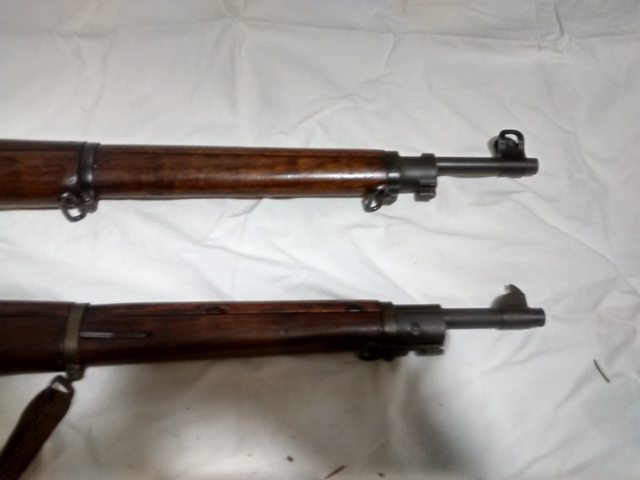
Gonna need a WHOLE lot more photos than that for valuation lol
Was simply looking for a ball park price range. Not for sale. (Yet)
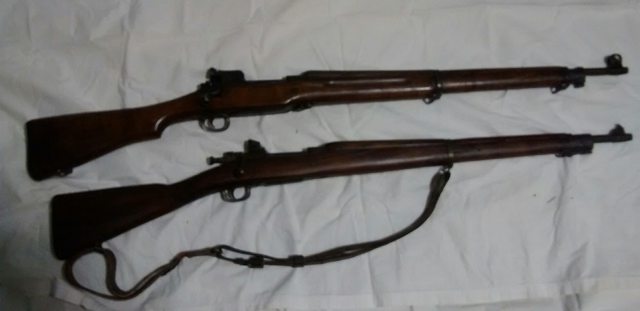
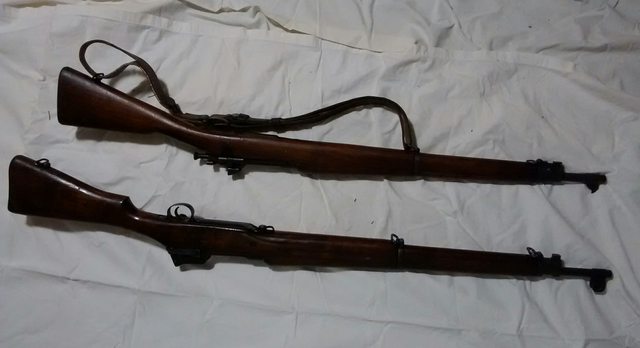
Look like all other P17's and 1903 to me. What pictures would be helpful. I could take some tonight.
Last edited:
- Location
- Western Manitoba
Neither looks extraordinarily "clean" in your picture; no mention of bore condition or whether you are able to evaluate that. A price range for each - so $500 if the wood pieces are all sound, not oil soaked or rotted, without cracks or missing pieces, on up to $2,000, perhaps, if they are in primo, correct, matching condition with "pristine" bores. I would think that $500 would be a good price for a used, complete wood set with all fittings on the M1917, but you have not identified which maker (of the original three) has done the wood, nor if any markings or cartouches are present. Those little details add to the dollars. M1917 wood was also produced for arsenal re-fits in WWII that was not "R", "E" or "W" marked, so all a bit of wildcard - hence the comment that you got in Post #2... I paid $470 mailed to me for a really nice 1903 wood set with hardware in Nov. 2020 - so maybe I am nuts and have no sense of value or price for these things...
Last edited:
- Location
- Western Manitoba
I am no help for the 1903 wood, but from my books here, for the M1917, there should be a letter stamped into the very front end of the stock - under the front sight. Also, should be some cartouches - some stampings - on the right side of the butt stock - at least for WWI produced M1917 wood. I do not know how to identify WWII produced wood stocks for an M1917. Original WWI stocks were only made by "E" for Eddystone, "R" for Remington and "W" for Winchester. I believe the WWI makers also stamped their letter inside the rear hand guard - I do not know how they marked their front hand guard, or if it was marked at all. I also do not know how to tell the difference between a P14 front hand guard and a M1917 hand guard. Knowing this stuff and knowing what your rifle has or does not have, all goes to the "price" that you might get for it, although there might be buyers who do not know or care about the details...
From a thread that I am in on another website forum, sounds like it is pretty easy in 2021 to spend $C 1,000 on reference books, just for the M1917 rifle. Some people are paying that kind of coin to know what it is they are buying or thinking to buy. Or, some are like my Dad, who bought his sporter M1917 in 1948 - to have a "real good gun" to shoot a moose. He got that part about right...
From a thread that I am in on another website forum, sounds like it is pretty easy in 2021 to spend $C 1,000 on reference books, just for the M1917 rifle. Some people are paying that kind of coin to know what it is they are buying or thinking to buy. Or, some are like my Dad, who bought his sporter M1917 in 1948 - to have a "real good gun" to shoot a moose. He got that part about right...
Last edited:
- Location
- Western Manitoba
Just to expand what the guy in Post #2 was getting at. I have an Eddystone receiver M1917 - the picture would be identical to what you are showing. It has a full length stock and hand guards - at the front end of the stock, under the front sight, it has the letter "R". So an Eddystone receiver in a Remington stock. Along the left side of the stock it also has a stamp or brand that is "AA (Omega symbol)" - that is the symbol for the USA arsenal that is or was in Augusta, Georgia during WWII. The barrel, behind the front sight, is marked "HS" - for High Standard - a WWII contractor that supplied barrels for WWII USA re-builds of the M1917's. Completely "normal" looking on the outside. Except the magazine has been altered and so has the bolt face. That rifle is chambered for 300 Weatherby Magnum. So not in any way "original" or authentic, yet I could post the very same picture of it as you have for yours above. There is a lot of "information" and therefore "price" in those "details"...
Last edited:


Mr. Dynamite
CGN Regular
- Location
- Northern Alberta
Any bonus points for red paint around end of the rifle?
Even worse than having yellow paint around the end!

Even worse than having yellow paint around the end!
Red paint shows that the rifle is chambered for 30.06 (Model of 1917). and not .303 (Pattern 14).
Having some difficulties downloading pics but here is some more info after inspecting these arms. Both have shiney bores. Looks like 4 lands. Other than dents and dings both stocks are intact, no cracks.
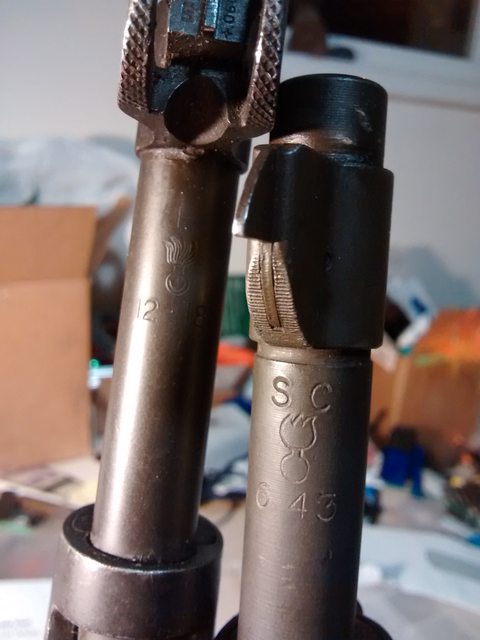
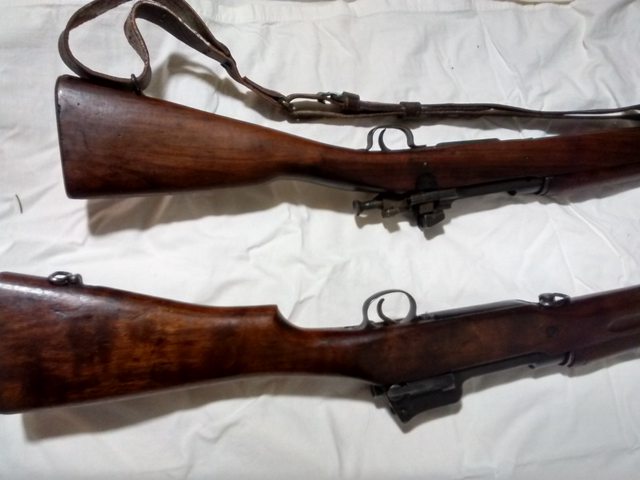
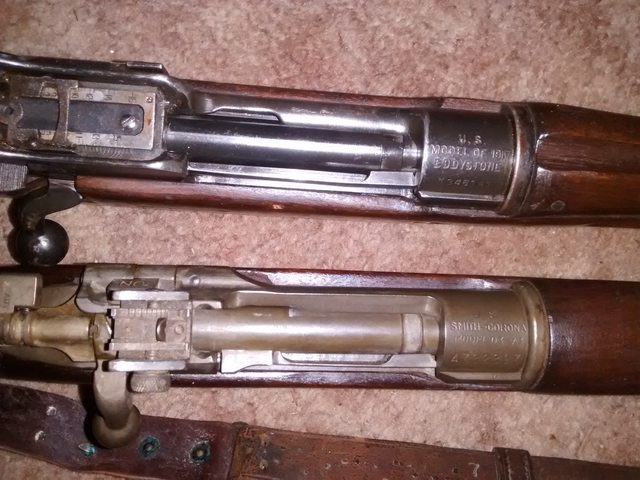
1903: near muzzle is tamped with the "bursting bomb," SC above, 6 43 below. On the bottom of the stock, in front of the magazine there is a faint mark that may be a stamping of two circles, on of which has a 1 in it. Bolt handle and cocking piece have tiny 'R' stamped. Receiver U.S., SMITH-CORONA, MODEL 03-A3, 473###X. Can't find much else.
1917: same bomb on barrel with E above, 12-18 under. Bolt parts have E or EN stamped on them, Bomb symbol on bolt handle and left side of receiver. A small indistinguishable symbol on the safety with a 51 and a reversed E. Same symbol stamped on the wood behind trigger guard with IS above and 58 below. Receiver stamped U.S., Model of 1917, Eddystone, 13###xx.
I'll try with the pic's again later. Looks like valuating these things is a bit of a can of worms. Looking forward to things opening up again so we can have gun shows etc. for in person inspections and dealings. Before I sell I'd like to try both of these rifles. If I can shoot either better than my K38 I'll be keeping one.
1903: near muzzle is tamped with the "bursting bomb," SC above, 6 43 below. On the bottom of the stock, in front of the magazine there is a faint mark that may be a stamping of two circles, on of which has a 1 in it. Bolt handle and cocking piece have tiny 'R' stamped. Receiver U.S., SMITH-CORONA, MODEL 03-A3, 473###X. Can't find much else.
1917: same bomb on barrel with E above, 12-18 under. Bolt parts have E or EN stamped on them, Bomb symbol on bolt handle and left side of receiver. A small indistinguishable symbol on the safety with a 51 and a reversed E. Same symbol stamped on the wood behind trigger guard with IS above and 58 below. Receiver stamped U.S., Model of 1917, Eddystone, 13###xx.
I'll try with the pic's again later. Looks like valuating these things is a bit of a can of worms. Looking forward to things opening up again so we can have gun shows etc. for in person inspections and dealings. Before I sell I'd like to try both of these rifles. If I can shoot either better than my K38 I'll be keeping one.
- Location
- Western Manitoba
Shooting them. Again, more so the M1917 as I have no experience with 1903. The M1917 should have some "up" pressure on the barrel, from the very front end of the wood stock. For the rest of the barrel right back to the chamber, the stock should not touch the barrel. Neither should the hand guards. Sometimes a bit of commotion to figure out how to determine that. But that is the way it was designed and set up by US military back in the day.
They would have also periodically "fed" that wood stock with linseed oil - so that may not have been happening since it was sold for surplus - late 1940's? As a result, sometimes the wood can dry out, twist, or warp and the rifle no longer has the "bedding" that it had when in service. A thing to go looking for if it does not shoot well for you.
Also, the ammo can be another issue - read up what loads the rifle was designed for, and especially note the velocities - much slower than "commercial" ammo that we buy today - do not expect the sight marking to match up to commercial hunting ammunition, if that is what you chose to use. The rifle was also designed to work well with pointy FMJ ammo, so may not feed well with round nose hunting ammo. The rifle was part of a system - a soldier's training plus the ammo used were all part of it.
The trigger pull should be a smooth, but distinct two stage - a longer, lighter pull as first stage - to a distinct "stop" - break through the stop is the second stage and the rifle should fire. Should not be much, if any movement, after the break. Grunge, dirt, rusty surfaces, dried grease and oils can all affect that. Do not overlook some fresh lube in the trigger and sear pins.
They would have also periodically "fed" that wood stock with linseed oil - so that may not have been happening since it was sold for surplus - late 1940's? As a result, sometimes the wood can dry out, twist, or warp and the rifle no longer has the "bedding" that it had when in service. A thing to go looking for if it does not shoot well for you.
Also, the ammo can be another issue - read up what loads the rifle was designed for, and especially note the velocities - much slower than "commercial" ammo that we buy today - do not expect the sight marking to match up to commercial hunting ammunition, if that is what you chose to use. The rifle was also designed to work well with pointy FMJ ammo, so may not feed well with round nose hunting ammo. The rifle was part of a system - a soldier's training plus the ammo used were all part of it.
The trigger pull should be a smooth, but distinct two stage - a longer, lighter pull as first stage - to a distinct "stop" - break through the stop is the second stage and the rifle should fire. Should not be much, if any movement, after the break. Grunge, dirt, rusty surfaces, dried grease and oils can all affect that. Do not overlook some fresh lube in the trigger and sear pins.
Having some difficulties downloading pics but here is some more info after inspecting these arms. Both have shiney bores. Looks like 4 lands. Other than dents and dings both stocks are intact, no cracks.
1903: near muzzle is tamped with the "bursting bomb," SC above, 6 43 below. On the bottom of the stock, in front of the magazine there is a faint mark that may be a stamping of two circles, on of which has a 1 in it. Bolt handle and cocking piece have tiny 'R' stamped. Receiver U.S., SMITH-CORONA, MODEL 03-A3, 473###X. Can't find much else.
1917: same bomb on barrel with E above, 12-18 under. Bolt parts have E or EN stamped on them, Bomb symbol on bolt handle and left side of receiver. A small indistinguishable symbol on the safety with a 51 and a reversed E. Same symbol stamped on the wood behind trigger guard with IS above and 58 below. Receiver stamped U.S., Model of 1917, Eddystone, 13###xx.
I'll try with the pic's again later. Looks like valuating these things is a bit of a can of worms. Looking forward to things opening up again so we can have gun shows etc. for in person inspections and dealings. Before I sell I'd like to try both of these rifles. If I can shoot either better than my K38 I'll be keeping one.
An "R" stamp on any M1903 part indicates that the part was made by Remington, and would be a replacement on a SC made 03-A3 rifle. The barrel is original.
There are many ways to distinguish SC and Remington made parts on an 03A3. The easiest is the "R" marking on most Remington made parts. SC rifles generally have an "X" marking on the top of the bolt handle. The buttplate checkering pattern is also different, as is the appearance of the bottom of the trigger guard.
Collectors look for originality and condition. Its virtually impossible to find and SC barrel, whereas Remington 03A3 barrels are fairly available in new, un-issued condition. I 've done restorations on 2 SC rifles using all SC parts, except for the new barrels which are Remington.
I've owned many M1903s and 03A3s. Barrels are usually well worn and pitted from heavy use and firing wartime ammo with corrosive priming. There are exceptions though.
Last edited: