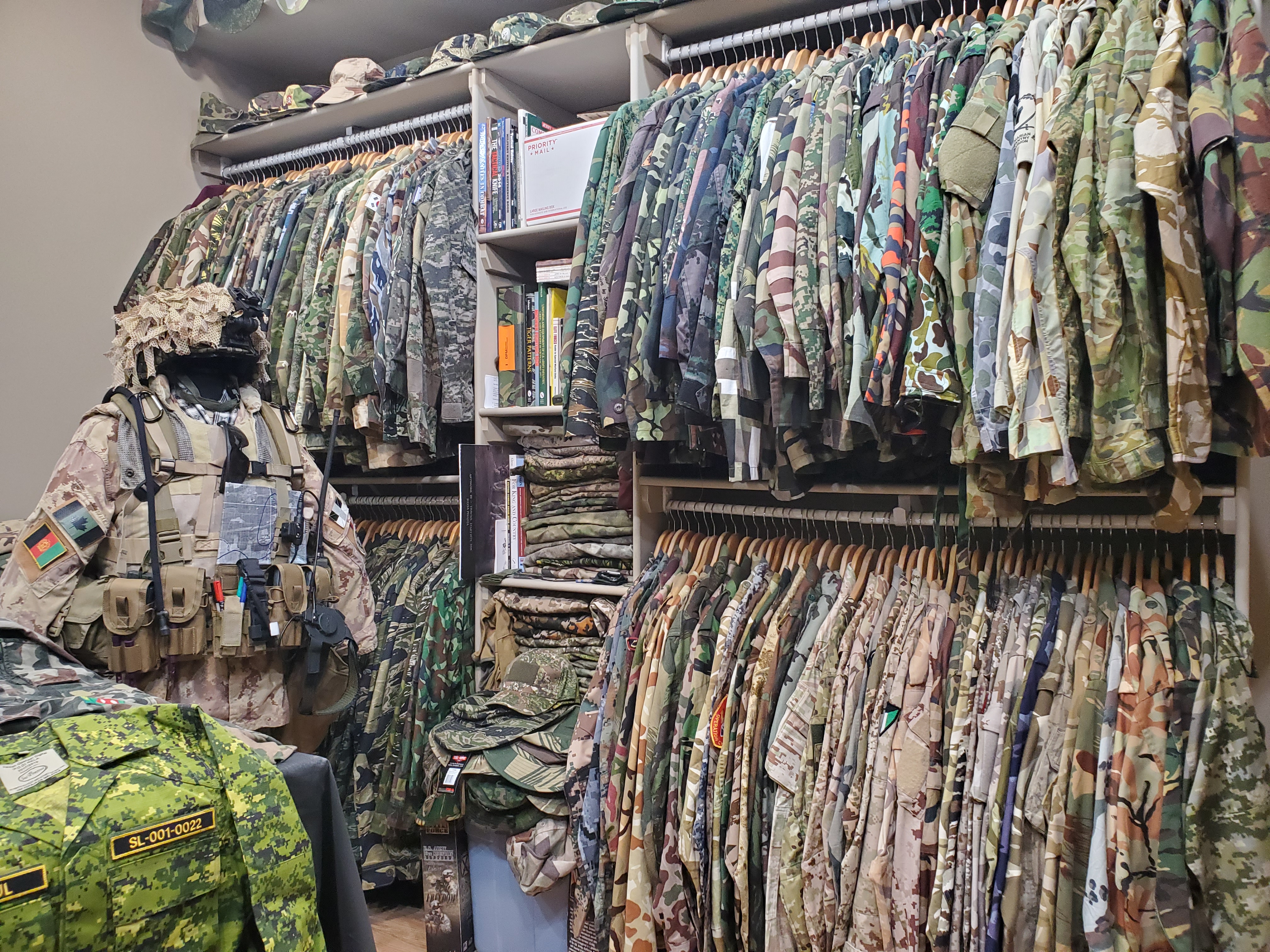
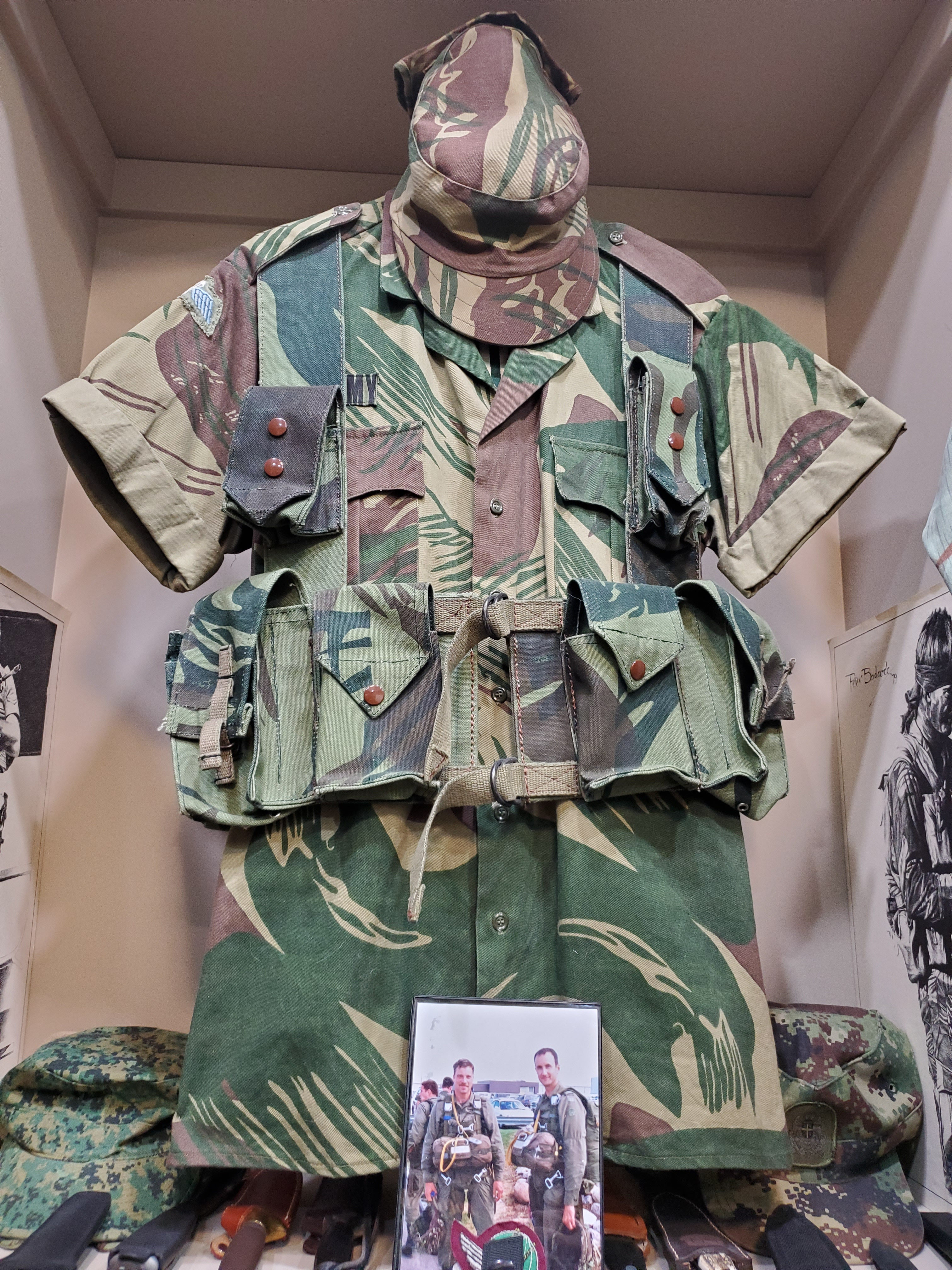
Great camo collection Bartok5! Would you happen to have the Canadian mid 1980's experimental woodland camo set?
Yes, I have all 4 distinctive patterns trialled in the early 1980's. Here they are in no particular order:
Disruptive Pattern Material (DPM) - this derivative of the British DPM pattern was the utimate winner of the Canadian Camouflage Trials conducted in the early 1980s. It was down-selected for large-scale troop trials with 4 CMBG in Germany and 5 CMBG in Canada. Unfortunately, it was found that Canadian textile manufacturing was insufficiently advanced to properly print the camouflage pattern. The problem was getting the dyes to properly set and adhere to the distinctive Canadian 50/50 NYCO material, with the result that the uniforms faded very quickly to an overall Brown/Orange tint. The Canadian DPM combat uniforms were produced en-mass by Peerless Garments in Winnipeg, not just for the troop trials, but also as part of a large contract to equip the Tanzanian Army. As a result, Canadian surplus shops were full of the Canadian DPM combat uniform in the early to mid-1980s due to the trials and Tanzanian contract over-runs.
Green DPM - This pattern was a predominately Green variant of the British DPM pattern, intended for Canada's Boreal forest. Of interest is the fact that the colours in this pattern are nearly identical to the same 4 colours later used in the 1996-onwards CADPAT Digital Camouflage pattern. The colours were selected by "eyeball" for the Green DPM pattern in 1980-ish, whereas the much later CADPAT colour selection involved multi-spectral photography of Northern forest lands all around the Northern Hemisphere, computer algorithms, and so-on to come up with the exact same 4 colours (Dark Green, Light Green, Black and Brown). Talk about coincidence!
Barracuda Balls - This pattern was developed by SAAB Barracuda of Sweden and adapted for the Canadian Trials through use of the same 4 colours that would eventually be developed and adopted for CADPAT. Note that this uniform was produced from 100% White cotton material so that the dye would remain colour-fast. This uniform and the next were rejected due to the White interior of the material, which showed when sleeves were rolled-up.
Woodland - This uniquely Canadian pattern was actually quite effective. Again using the same 4 "CADPAT" colours, this pattern used random, stretched shapes to produce a "woodland with shadows" effect. Printed on the White, 100% Cotton material.
As an added bonus, here is a shot of the "CADPAT Prototype J" pattern that was most recenty trialled for the CADPAT update project. This pattern saw large-scale trials by 2 CMBG in Petawawa last year and into early this year. The Proto J was one of two patterns down-selected for the CADPAT update project. At the end of the day, a 5-colour pattern known as "CADPAT - Multi-Terrain" won the competition with the 4-colour "Proto J" relegated to the history books. I am very fortunate to have a complete, slightly-worn set of pthe Proto J within my collection for posterity, given that very few examples of this experimental Canadian pattern will have survived the field trials. Quite literally priceless on the international collector market.