Bullet runout with a rem 222

Sydney1942

Member
Rating - 100%
59   0   0
Hi i am using the following equipment and the runout is
at times 4 to 5 th
--Hollywood press -the shell holder has some float-not jammed
--Lee collet die
--Forster ultra seating die-seating the bullet part way then
rotating 1/2 way then complete seating
--Lapua brass -not turned but neck thickness very close
--Help is needed
Thanks Sydney
 
TIR (total indicator run out)is .004"-.005" thousandths?

If so,your run out is 1/2 of the TIR.

Tram in your Forster & Lee dies to the ram/shell holder & then lock them.


Lee & Forster have never been in my reloading equipment inventory.....for various reasons.
 
Most guys assume runout is caused by a weakness in their resizing process and that is most likely not the problem.

The problem starts in your chamber. If you measure the neck diameter of a loaded round and compare that to the neck diameter of the fired case, you will get an idea of how much neck resizing you are actually doing.

In addition to that, there is a certain amount of spring back so you have to over resize the neck to compensate for that, plus you need a couple thousandths of neck tension.

When you add it all up, you are probably reducing the neck diameter by at least 0.012 and maybe as much as 0.014.

If you are reducing the neck diameter by that much, how can anyone reasonably expect the neck not to drift off in one direction or another?

The best solution to getting consistently tight runout is with a tight neck chamber that allows you to control how much resizing you will need to do.

The less you need to resize the neck, the less opportunity you will be creating to induce runout.

It is mechanically impossible to create 0.005" runout if you are only resizing by 0.003".

So as for the current problem with the current 222 rifle, maybe its not a problem in the sense that it is what it is and you need to live with it... or find brass with the thickest necks you can find to offset the neck clearances.
 
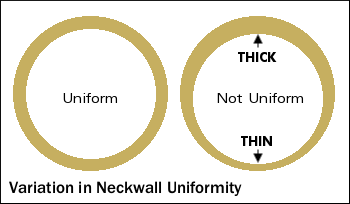
You are using a Lee collet die that only sizes the neck, and does not size the case body. If the case body does not have even wall thickness the thin side will expand more and become egg shaped.
You then spin the egg shaped case body and it indicates neck runout because the case body is not perfectly round.

Another possibility is the Lee die or the shell holder is allowing the case to tilt during sizing inducing the runout.

I would check the case neck runout before and after using the Lee collet die. This will tell you if the sizing operation is causing the neck runout.

If you have no case neck runout after sizing then your runout happens during seating.

The runout comes from either the brass, the sizing or seating operations and you need to isolate the problem and see where it is comming from.

I prefer using a non-bushing full length die, this ensures the case body and neck are held in alignment. I use Forster sizing and seating dies and have very little runout.

Below a case with uneven case wall and neck thickness will cause runout.

NlyA8oI.png


Tech Line & Tips (FAQs)
https://www.redding-reloading.com/tech-line-a-tips-faqs/146-concentricity-problems
Concentricity Problems
a.k.a Neck Runout With Bottleneck Cases

We have conducted many tests over the years on the various factors contributing to concentricity problems with bottleneck cases. We have repeatedly found a definite correlation between the uniformity of the brass (or lack of it) and the resulting concentricity of the neck to the body of the case.

An interesting experiment also revealed that neck turning of brass that was intentionally sorted as non-uniform, showed little or no concentricity improvement when used in standard S.A.A.M.I. spec chambers. Conversely brass that was sorted and selected for uniformity remained uniform and concentric with or without a neck turning operation.
 
Sort your ammo and select a pile of the very best for straightness and another of the worst. Shoot them against each other for group, then decide whether you're wasting your time.
 
I agree with Chuck but your brass all ready says Lapua.

You likely have a donut problem.

Have some brass with thick and thin necks that is still very straight no where near 5 tho run out. But have seen donuts make for that much and more.
 
The problem is your brass. If it does not say Lapua, Peterson, or ADG on the label, you are going to be doing a lot of farting around.

The OP is using Lapua brass "and the runout is at times 4 to 5 th" (see his first posting)

The OP needs to check neck runout after neck sizing and then bullet runout after seating and find out where the runout is coming from.

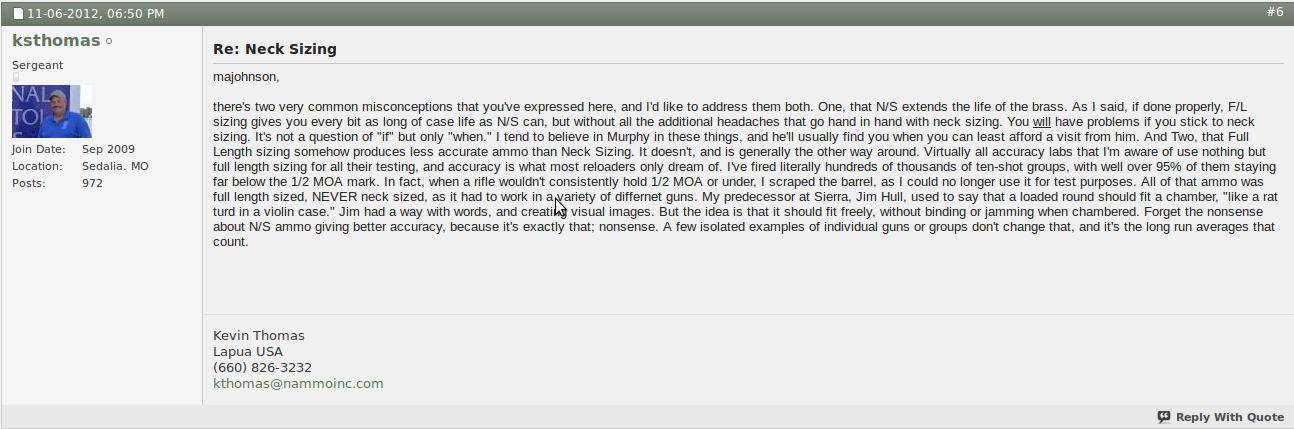
A full length resized case has more clearance around the case body when chambered and less affected by runout. The cartridge is supported by the recessed bolt face in the rear and by the bullet in the throat. And the case body should not have any effect on bullet alignment in the throat. This is why the late Jim Hull of Sierra bullets below said "The cartridge should fit the chamber like a rat turd in a violin case."


Y3IiYL5.jpg
 
The OP is using Lapua brass "and the runout is at times 4 to 5 th" (see his first posting)

The OP needs to check neck runout after neck sizing and then bullet runout after seating and find out where the runout is coming from.

A full length resized case has more clearance around the case body when chambered and less affected by runout. The cartridge is supported by the recessed bolt face in the rear and by the bullet in the throat. And the case body should not have any effect on bullet alignment in the throat. This is why the late Jim Hull of Sierra bullets below said "The cartridge should fit the chamber like a rat turd in a violin case."


Y3IiYL5.jpg

I find it interesting to read such a post even if I don't agree with it. It is actually full of revealing projections that are not founded in fact or in any way supported by presented facts.

Making arbitrary statements suggesting that since "they" don't use neck only resized brass, that it must by default be stupid.

If you are testing factory ammo, why on earth would you be testing anything other than a factory relationship between the barrel and chamber?

It is not in a factories interest to be concerned with such things.

If the rat turd in a violin case statement was founded in fact, you would be hard pressed to find a target shooter who shoulder bumped, yet most everyone does.

Take that to an extreme and any cartridge that fit a larger chamber should shoot just fine right? How about a 308 in a 30-06? Obviously not.

What is factual is that it takes energy to expand the side walls of the brass to fit the chamber. If the brass already fits the chamber, it will require less energy than something that is well cleared. The difference equates to variations in muzzle velocity. Since the test lab is likely not more than 100 yards, this would not be relevant data to the short range accuracy test lab.

Propagating such opinion as though it is fact is counter productive.

Here's the lowest rung on the ladder, and an excuse for the lazy and insightful to justify staying there.

Advice is put fourth through the lens of ones own experiences, clearly the advice put fourth by Kevin Thomas here is one of limited long range "precision" interests. I am quick to accept that he was not an F Class or 1000 yard bench rest shooter.
 
Last edited:
The problem is your brass. If it does not say Lapua, Peterson, or ADG on the label, you are going to be doing a lot of farting around.

This premium brass thing is an expensive way to compensate for missing a little bit of common sense.

Sure, certain brands of brass are more consistent than others in any given box of brass. But what about over 10 boxes, or 20 or 30?

What happens when you buy 1000 rounds of brass and weight sort them all into the closest in weight per 100 rounds?

Now factor in the cost of these various brands of brass.

How many of the cheap and easily dismissed cases can you buy for the cost of 3 or 400 Lapuas?

No matter how close that Lapua may be, I can guarantee that I can buy 3000 rounds of once fired military cases for the cost of 300 Lapua and that once segregated into those closest 100 in weight are more consistent than Lapua can ever be in a box of 100.

Sure its nice to have fancy things, but ammo is one of practicality and I know lots of really great long range shooters that have thrown in the towel on chasing expensive brass.
 
Sort your ammo and select a pile of the very best for straightness and another of the worst. Shoot them against each other for group, then decide whether you're wasting your time.

I have a shooting buddy whom used to as a hobby built rifles from Mausers then started building his rifles from Savage actions some years later.
He owns maybe one shotgun but many rifles.
His downstairs gun/reloading room is almost laboratory clean.

He is very particular about his hand loads as well.
He tried this runout thing and soon gave up because he discovered too many uncontrollable variances that the lay man cannot possibly control.
 
First thing I would do is check the stem in the resizing die, to assure that it is not bent and centered perfectly inside of the die. Second, I would seat the bullet 3/4 into the neck, turn 1/4 and seat, repeat the 1/4 turn twice more. If you cannot find any other solution, purchase good quality dies, such as Redding and RCBS. I'm dubious that the Lapua brass is at fault.
 
I find it interesting to read such a post even if I don't agree with it. It is actually full of revealing projections that are not founded in fact or in any way supported by presented facts.

Making arbitrary statements suggesting that since "they" don't use neck only resized brass, that it must by default be stupid.

If you are testing factory ammo, why on earth would you be testing anything other than a factory relationship between the barrel and chamber?

It is not in a factories interest to be concerned with such things.

If the rat turd in a violin case statement was founded in fact, you would be hard pressed to find a target shooter who shoulder bumped, yet most everyone does.

Take that to an extreme and any cartridge that fit a larger chamber should shoot just fine right? How about a 308 in a 30-06? Obviously not.

What is factual is that it takes energy to expand the side walls of the brass to fit the chamber. If the brass already fits the chamber, it will require less energy than something that is well cleared. The difference equates to variations in muzzle velocity. Since the test lab is likely not more than 100 yards, this would not be relevant data to the short range accuracy test lab.

Propagating such opinion as though it is fact is counter productive.

Here's the lowest rung on the ladder, and an excuse for the lazy and insightful to justify staying there.

Advice is put fourth through the lens of ones own experiences, clearly the advice put fourth by Kevin Thomas here is one of limited long range "precision" interests. I am quick to accept that he was not an F Class or 1000 yard bench rest shooter.

Kevin Thomas

Spending his early years in Southern California, Kevin Thomas has been an avid shooter and student of firearms as far back as he can remember. Enlisting in the military immediately after high school, Kevin served four years in the U.S. Army, assigned to an Infantry Company with the 101st Airborne Division. His interest in marksmanship was noted by his commanding officer, and he was sent to and graduated from one of the first sniper schools to be taught by the division since the Vietnam war had ended. During that time, he also received his first exposure to for- Kevin Thomas mal competitive shooting, eventually spending nearly three years assigned to the 101st Marksmanship Training Unit (MTU). As part of his “duties” he engaged in NRA HighPower and Long Range competition, in which he holds a Master classification. After his military service, Kevin returned to Southern California, where he became a police officer in Los Angeles County. Combat Pistol IPSC/USPSA competition became Kevin’s primary competitive interest at that time, although he continued to shoot regularly at many of the area’s HighPower rifle matches. Frequently giving testimony or consultation on many criminal and civil court cases, Kevin became a court-accepted expert in the field of firearms and ballistics. He left law enforcement after six years, starting with Sierra in 1987 in the production department. Working with Sierra’s Chief Ballistician Martin (Jim) Hull, Kevin was one of the first technicians answering calls on the newly formed “tech-line.” Kevin took over as Manager of the Ballistic Service upon Hull’s retirement in 1989 and was promoted to Chief Ballistician in 1992. Since relocating to Missouri, he has continued to shoot a wide variety of disciplines, including HighPower, Rifle and Handgun Silhouette, USPSA Practical pistol and NRA Action pistol. At this writing, Kevin holds current classifications in at least eight different competitive disciplines (both rifle and pistol), and is a life member of both the NRA and the USPSA.

 
Kevin Thomas

Spending his early years in Southern California, Kevin Thomas has been an avid shooter and student of firearms as far back as he can remember. Enlisting in the military immediately after high school, Kevin served four years in the U.S. Army, assigned to an Infantry Company with the 101st Airborne Division. His interest in marksmanship was noted by his commanding officer, and he was sent to and graduated from one of the first sniper schools to be taught by the division since the Vietnam war had ended. During that time, he also received his first exposure to for- Kevin Thomas mal competitive shooting, eventually spending nearly three years assigned to the 101st Marksmanship Training Unit (MTU). As part of his “duties” he engaged in NRA HighPower and Long Range competition, in which he holds a Master classification. After his military service, Kevin returned to Southern California, where he became a police officer in Los Angeles County. Combat Pistol IPSC/USPSA competition became Kevin’s primary competitive interest at that time, although he continued to shoot regularly at many of the area’s HighPower rifle matches. Frequently giving testimony or consultation on many criminal and civil court cases, Kevin became a court-accepted expert in the field of firearms and ballistics. He left law enforcement after six years, starting with Sierra in 1987 in the production department. Working with Sierra’s Chief Ballistician Martin (Jim) Hull, Kevin was one of the first technicians answering calls on the newly formed “tech-line.” Kevin took over as Manager of the Ballistic Service upon Hull’s retirement in 1989 and was promoted to Chief Ballistician in 1992. Since relocating to Missouri, he has continued to shoot a wide variety of disciplines, including HighPower, Rifle and Handgun Silhouette, USPSA Practical pistol and NRA Action pistol. At this writing, Kevin holds current classifications in at least eight different competitive disciplines (both rifle and pistol), and is a life member of both the NRA and the USPSA.


It is amazing how some people cling to their beliefs and make assumptions and false accusations about people with different ideas. Kevin Thomas suggested that the idea that NS brass produces more accurate ammunition is nonsense and is accused of saying that Neck sizing is "stupid"!!! Kevin is right in saying that brass will last almost as long when "properly neck sized " as neck sized brass. Most competitive shooters have long since given up neck sizing for "Shoulder bumping" which in reality is just Full Length Sizing done with a custom Die. The idea that some brass is far superior to others is one that I got to put to the test with my 20-223 Prototype that I call the 20 PHC (Predator Hunter Cartridge) that I made by running my 20 EXTREME Reamer 0.170" deeper into my first 20 EXTREME barrel that had about 8500 rounds through it. Guess I use a Hybrid method of sizing as I FL size the neck and shoulder and the last 0.170" is left to fireform to the chamber which is half way between a 223 Saami Minimum and Maximum Chamber at the 0.200" datum. With the 40 V-Max traveling at about 3668 fps both the Lapua and Winchester 223 brass fireform to about 0.0015" from the chamber, at that point, after about 3 firings, and seem to remain there. The shoulder diameter maintains 0.001", clearance with "no shoulder bump' and fits the chamber as described by Kevin.

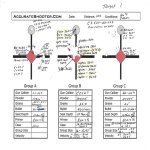
Once Fireformed at the base there is not much difference in the groups shot with the Lapua or Winchester new brass or the Winchester Range Pickup brass for that matter. The Winchester brass has consistently shot slightly better groups than the Lapua Brass and this appears to be due to the fact that base datum expansion is more consistent while fireforming. Runout with the 40 V-Maxis nearly the same for the Lapua and Winchester brass at about 0.0005" to 0.0025" in spite of the Lapua brass being neck turned so it would fit the chamber. I used Hornady Custom Grade dies for both Sizing and seating. I did extensive testing of runout and found that the practice of partially seating bullet then turning 1/2 turn and fully seating did not reduce runout by much and that runout always remained in the same orientation which was determined by different thickness in neck wall. Turning necks did mitigate runout but did not eliminate it or change the orientation.

Targets  1, 14 & 15 40 Vmax.jpg

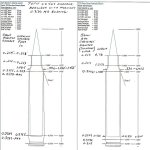
I had the opportunity to compare 16 different 223 brass, mostly once fired range pickup, plus some new brass and found quite a variation in Weight , Case Capacity and Web thickness. One thing that once fired factory ammunition had in common was that the 0.200" base datum did not come close to being fireformed to Saami Minimum Chamber dimension of 0.3769". In fact pressures were not sufficient to stretch the brass to within 0.0015" of the Saami Maximum Cartridge dimension of 0.3759". Sako cases being heavier , with less case capacity, got over 3700 fps with the same load that got around 3600 fps with other new cases. Once the Winchester and Lapua cases fireformed to within 0.001" of the chamber at the base datum the velocities increased by about 50 fps with the same load which may explain the belief that barrels speed up once a few rounds have been fired through them.

223 case Capacities.jpg

Actually the Hornady brass proved to be the toughest brass in spite of having the smallest base datum dimension of 0.371" it had the least expansion, on first firing, and had initial velocities similar to Fireformed Lapua and Winchester at 3650 fps compared to around 3600 fps. It had a much thicker web at 0.115" compared to 0.069".

223 capacoties and dimensions including Web thickness.jpg

Hornady 223 new brass dimensions compared to once fired in an unknown chamber and FL sixed to fit CZ 527 chamber:

223 Rem FL sizing brass.jpg

16 different 223 brass, formed to 20 PHC (20-223), fireformed to chamber, loaded with 25 grains H 4895 ahead of a 40 V-Max shot this sub MOA group. Individually they all shot 5 shot groups much the same.

16 different brass.jpg
 

Attachments

  • Targets  1, 14 & 15 40 Vmax.jpg
    Targets 1, 14 & 15 40 Vmax.jpg
    76.7 KB · Views: 42
  • 223 case Capacities.jpg
    223 case Capacities.jpg
    154.4 KB · Views: 24
  • 223 capacoties and dimensions including Web thickness.jpg
    223 capacoties and dimensions including Web thickness.jpg
    103 KB · Views: 24
  • 223 Rem FL sizing brass.jpg
    223 Rem FL sizing brass.jpg
    102.8 KB · Views: 24
  • 16 different brass.jpg
    16 different brass.jpg
    81.9 KB · Views: 24
Last edited:
Back
Top Bottom