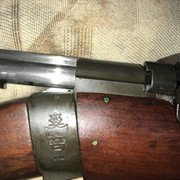
Lithgow SMLE Hard contact between fore stock and butt socket serious issue??

KanadianShooter

CGN Regular
Rating - 0%
0   0   0
I recently bought a Lithgow SMLE from 1917 which was thoroughly refurbished during ww2 with a new barrel and "coach wood" stock. On the left side of the gun there is a hard contact between the fore stock and the butt socket, I cannot get a piece of paper between the stock and receiver. Apparently this can be an issue, although one my buddies told me not to worry. Should I get this addressed by a gunsmith and is it a significant issue? Thanks.

Click on picture to see the enlarged photo below:


H
IMG-6952.jpg
[/url][/IMG]
 
Last edited:
Others may correct me, but my understanding of the bedding in the ones I've set up for accuracy, you either want a small gap all the way around, or, full contact. if only one side or the other contacts the socket the rifle may throw fliers occasionally. This is way less of an issue for accuracy as long as the draws themselves are in good condition. Being an Australian refurb, i would guess it has brass plates added to the draws as the coachwood wasn't as hard and tended to wear quicker
 
Others may correct me, but my understanding of the bedding in the ones I've set up for accuracy, you either want a small gap all the way around, or, full contact. if only one side or the other contacts the socket the rifle may throw fliers occasionally. This is way less of an issue for accuracy as long as the draws themselves are in good condition. Being an Australian refurb, i would guess it has brass plates added to the draws as the coachwood wasn't as hard and tended to wear quicker

So it won't chew up the wood over time? There is only a very small gap on the right side and the rifle is very tight overall.
 
What will cause the most damage is if the draws are no longer making good contact to the receiver. if you take the trigger guard and nose cap off as well as the mid band screw, there should be no forward/backward play in the fore wood. if there is, it will damage the stock and split just in front of the main action screw. otherwise, if there is no movement i would suggest not to worry about it
 
What will cause the most damage is if the draws are no longer making good contact to the receiver. if you take the trigger guard and nose cap off as well as the mid band screw, there should be no forward/backward play in the fore wood. if there is, it will damage the stock and split just in front of the main action screw. otherwise, if there is no movement i would suggest not to worry about it

According to Bloke on the Range hard contact can cause the stock to twist..... go to 11:28

https://www.youtube.com/watch?v=NaafRf0uDR4&t=737s&ab_channel=TFBTV
 
According to Bloke on the Range hard contact can cause the stock to twist..... go to 11:28

https://www.youtube.com/watch?v=NaafRf0uDR4&t=737s&ab_channel=TFBTV

Wow- that's probably the poorest understanding of Lee Enfield bedding ever captured on video. As anyone who has ever worked with these is well aware, the ideal is having zero clearance on the entire contact between forend and butt-socket. A good one will be so tight you can't fit a 0.001 feeler anywhere at the contact. Since this is difficult to achieve in re-stocking a rifle (it requires skill) the job is considered acceptable if there is solid contact over a significant portion of the area (and equal on both sides). Surest sign of a poorly de-sporterized rifle is a gap like the one "the Bloke" highlights on his rifle.

milsurpo
 
Wow- that's probably the poorest understanding of Lee Enfield bedding ever captured on video. As anyone who has ever worked with these is well aware, the ideal is having zero clearance on the entire contact between forend and butt-socket. A good one will be so tight you can't fit a 0.001 feeler anywhere at the contact. Since this is difficult to achieve in re-stocking a rifle (it requires skill) the job is considered acceptable if there is solid contact over a significant portion of the area (and equal on both sides). Surest sign of a poorly de-sporterized rifle is a gap like the one "the Bloke" highlights on his rifle.

milsurpo

What about if I have hard contact on one side and no contact on the other (although the gap is really small)???


vs

Side in first post.
 
What about if I have hard contact on one side and no contact on the other (although the gap is really small)???

May not be ideal but also not unusual and probably nothing to worry about. Are you sure there's absolutely no contact between wood and metal on the entire right side? If it were mine I'd also carefully check for proper fit at the "draws". A poor fit there can draw the forend back off-line and affect the bearing on the butt-socket. If yours was re-fitted in Australia during WW2 it probably has small metal plates inletted into the draws and you should see the impression of the sear lug squeezed into each side. If you haven't disassembled one be very careful removing the forend- pull it straight down from the rear, never pull the forend down at the muzzle (and don't remove the buttstock). So- question 1: Is the forend held tightly with the rifle stripped (ie with nosecap, bands, triggerguard, etc, removed). Question 2: Are the draws in good shape with evidence of even clamping on both sides? As long as the answer to #1 is Yes you should be able to use it. If there are serious issues with the draws be aware that repairs require help from someone that has a lot of experience with Lee Enfield repairs.

milsurpo
 
What about if I have hard contact on one side and no contact on the other (although the gap is really small)???
....

I think the answer is that you fire it to see if there is an issue, so long as nothing else discovered to make you suspect is not safe to fire? Remember - it is not and never was meant to be a high precision "f" class target rifle - it was to be "good enough" - which meant sort of 3 MOA during WWII, with military standard ammo. I think you will find on milsurp site some writings by Peter Laidler - I think he wrote that the ones that he fitted were done "tight", but that the British military had a tolerance of up to .010" clearance for the Lee Enfield No. 4's. No doubt Australia had similar standards for the No. 1 and SMLE, but I do not know what they were...

Following WWII there were improvements discovered (mostly involving bedding) and used by target shooter's - some of those techniques adopted by some militaries for some of their Lee Enfield rifles - so no doubt some rifles could be made to shoot better than WWII "standard". Look up the performance standard - something like 1" wide by 1.5" high at 33 yards (100 Feet) - if it could do that, off to war it went - was "good enough"...
 
Last edited:
Butt stocks should be fitted evenly, in the case of your stock the gapped side should have material removed to fit it tightly. Originally fitting was done by removing wood or applying layers of damp paper to the tenon of the butt, until the stock is even and the butt tapped into place with a wooden mallet. If this isn't done, the rifle will throw shots to the side with the gap and be difficult, or impossible to zero.
 
So, to get back to the OP: "hard contact" between rear of forend and butt-socket is what you want to see. Ideally a perfect fit on both sides but, often, with only partial contact. It was pointed out that a wartime relaxation of standards allowed for a small gap on No. 4 rifles- when there simply wasn't time to do it properly. With correct standard bedding both No. 1 and No. 4 rifles were used in long range (1000 yard) target shooting for many years. Problems in the bedding at the rear of the forend can result in very large groups.

milsurpo
 
Thanks for all the helpful comments guys! I will be checking out the draws and not worry too much about the differences between each side.
 
Back
Top Bottom