How to use the micrometer peep sight on an enfield No.4 MK I

Leigh

Regular
EE Expired
Rating - 100%
1   0   0
Location
Vancouver, BC
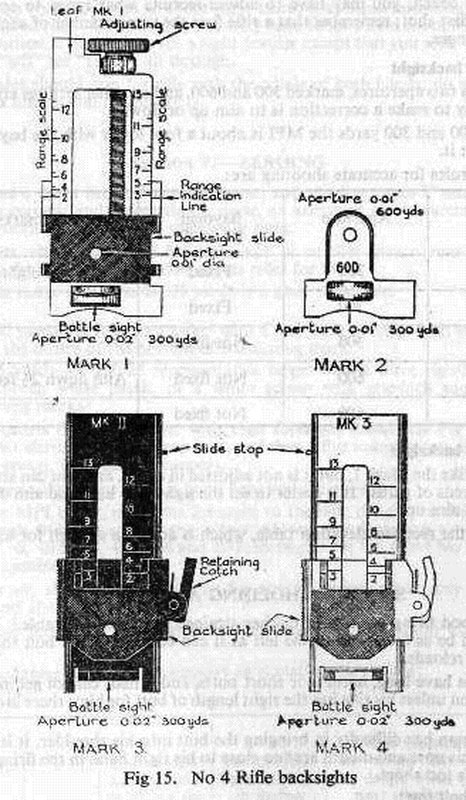
Alright, well I got a No. 4 MK I long branch recently (yes its sportered of course) but anyway naturally I've been playing around with it for the last few days, and I'm seriously annoyed at the fact that all I can do with the micrometer aperture sight is #### around with it and make it go up and down. So I decided to ask on here, what exactly to the numbers stamped on the adjustment refer to?

at the very top of the flip up part, MK 3 is stamped in it, if that helps.
 
"...the numbers stamped on..." Elevation using issue military ball ammo. The theory being that once you've sighted in, you can just raise the sight to whatever distance you're shooting at and be on target at that distance. It assumes the windage has been set when the rifle was sighted in.
 
I haven't shot Enfields much but I've found they seem to hit about 8" above sight plane. I have been told this was because they were sighted to hit the center of a 16" black bull with the front sight placed at the bottom of the bull.

Is this true or just another good story?
 
Alright, well I got a No. 4 MK I long branch recently (yes its sportered of course) but anyway naturally I've been playing around with it for the last few days, and I'm seriously annoyed at the fact that all I can do with the micrometer aperture sight is #### around with it and make it go up and down. So I decided to ask on here, what exactly to the numbers stamped on the adjustment refer to?

at the very top of the flip up part, MK 3 is stamped in it, if that helps.

Those numbers are yards of course. The Mk III sight was used from about 42 to 45, alternating with Mk II two aperture flip sights. The 1949 and 1950 Long Branch rifles used the Cmk3 sight which is basically the same as the Mk III but with a different numbering system.
I have read that it was intended the rifle be fired with the bayonet attached, not sure about that but it would of course affect the point of impact.

The best sight of course is the Mk I click adjustable machined sight, the Mk III was a cheaper stamped version. Some on here (Stevo) have complained that the battle peep and flip up aperture do not hit to the same point of impact, thus the manufacturing QC of these sights may have been less than sterling.
 
Those numbers are yards of course. The Mk III sight was used from about 42 to 45, alternating with Mk II two aperture flip sights. The 1949 and 1950 Long Branch rifles used the Cmk3 sight which is basically the same as the Mk III but with a different numbering system.
I have read that it was intended the rifle be fired with the bayonet attached, not sure about that but it would of course affect the point of impact.

The best sight of course is the Mk I click adjustable machined sight, the Mk III was a cheaper stamped version. Some on here (Stevo) have complained that the battle peep and flip up aperture do not hit to the same point of impact, thus the manufacturing QC of these sights may have been less than sterling.

I had an old manual that stated the battle sight was to be sighted with bayonet mounted. The flip up sight was not. Hence the differences in zero.
 
no, I can read, there isn't a C stamped on it. And I am a member..........

Thanks ... :)

Just to clarifiy....

When you refer to it as a "micrometer aperture sight", do you mean it has a little wheel on top right hand side that you can rotate and "click" the aperture up and down?

... or, does it just have a pressure release and lock type slide mechanism on the right hand side of the sight frame?

Regards,
Badger
 
The C arrow ( Canadian Govt.) stamp may be on the back of the Mklll sight . It will be quite small.( Thats where it is on mine )
The numbers are for yards ( lowest setting is 300yd ) so if your shooting at 100yd your gonna hit high , even with the sight down.

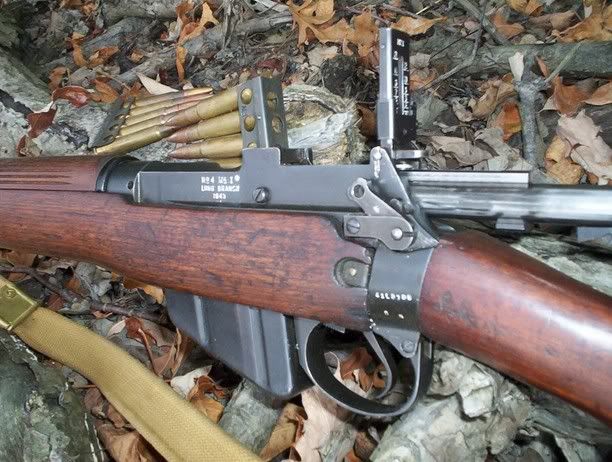
Mklll sight on a '43 Longbranch
Longbranchleft.jpg


Back side of the sight showing the small C arrow stamp
es2.jpg


The Mkl ( micrometer) left , compared to the Mklll sight
es1.jpg
 
Last edited:
And yes, as mentioned above, Lee Enfields (and, I think, all aperture sighted Commonwealth military rifles) were designed for a "6 o'clock hold" on the target... Or, as simplified by one Enfield nut to his young daughter on the range "Put the lollipop on the stick"; The top of the foresight should be centered in the aperture, with the entire circle of the black bull sitting on the top of the foresight tip.

I hope that helps... I'm only on my first cup of coffee....

:)

Neal
 
And yes, as mentioned above, Lee Enfields (and, I think, all aperture sighted Commonwealth military rifles) were designed for a "6 o'clock hold" on the target... Or, as simplified by one Enfield nut to his young daughter on the range "Put the lollipop on the stick"; The top of the foresight should be centered in the aperture, with the entire circle of the black bull sitting on the top of the foresight tip.

I hope that helps... I'm only on my first cup of coffee....

:)

Neal

Hmmm, I never knew that. They're intended to be aimed below the target?
 
The C arrow ( Canadian Govt.) stamp may be on the back of the Mklll sight . It will be quite small.( Thats where it is on mine )
The numbers are for yards ( lowest setting is 300yd ) so if your shooting at 100yd your gonna hit high , even with the sight down.

Mklll sight on a '43 Longbranch
Longbranchleft.jpg


Forgive me as I'm also on one cup of coffee so far. :p

So... OK let me get this straight, with sight flipped up as in the picture above use a 6 o'clock hold on the target as per the range that is dialed in on the slide...ie 100 yards will be the lowest setting on the gauge (marked 100).

And also use a 6 o'clock hold with the sight flipped down for 300 yards only?
Correct? :confused:

Nice rifle BTW. :)
 
Yes, much more accurate when you are not covering your target with the front sight. This way you can see what you are shooting at......:)


Nelly and Hitzy are dead on ... :)

Six o'clock hold....

One of the best books I've ever read (and trained with) on shooting the Enfield rifle is available in electronic format, professionally scanned (thanks to Ian Robertson), in the forum for Technical Articles for Milsurp Collectors and Re-loaders (click here)http://www.milsurps.com/forumdisplay.php?f=25

"Shoot-to-Live" - 1945 (click here)

Presenting the Johnson Method of Musketry Coaching As Adopted By the Canadian Army, Ottawa, Chief of the General Staff.


This is an excellent Canadian Government issued training manual. If you are specifically a collector and shooter of Lee Enfield rifles, you'll find this to be an outstanding reference work and it contains a wealth of information on how to properly shoot the No.4 Mk1 Enfield, although much of the content is applicable to any bolt action rifle. I remember being issued this manual as part of our regimental rifle team, when I was a little younger back in the early 60's. ;)

Regards,
Badger
 
And yes, as mentioned above, Lee Enfields (and, I think, all aperture sighted Commonwealth military rifles) were designed for a "6 o'clock hold" on the target... Or, as simplified by one Enfield nut to his young daughter on the range "Put the lollipop on the stick"; The top of the foresight should be centered in the aperture, with the entire circle of the black bull sitting on the top of the foresight tip.

I hope that helps... I'm only on my first cup of coffee....

:)

Neal

Is this true with the earlier SMLE as well?
 
It is actually the proper way to shoot all metallic sights.

By aiming with the top of the front sight, whether it is a flat post or a bead, you are able to see the target, rather than blotting it out and hoping you are on target as already pointed out by Hitzy. This becomes more important and more effective as range increases.

I was fortunate to be taught this when I was first starting out with a 22, more than fifty years ago, and these tired old eyes can still do a pretty good job with irons by aiming this wasy.

Ted
 
Last edited:
Back
Top Bottom