












































You are using an out of date browser. It may not display this or other websites correctly.
You should upgrade or use an alternative browser.
You should upgrade or use an alternative browser.
Primer troubles CCI small pistol PLOT TWIST on post 20.
- Thread starter ipscgraz
- Start date


I have 50 years of loading and re-loading experience.
If you are re-loading a case with an already fired primer, your pistol probably lacks enough hammer energy to fire that round.
I use Dillon presses, but not Dillon dies. Is it possible to adjust the decapper pin down a bit more?
If you are re-loading a case with an already fired primer, your pistol probably lacks enough hammer energy to fire that round.
I use Dillon presses, but not Dillon dies. Is it possible to adjust the decapper pin down a bit more?

I use a Shockbottle case gauge on all the rounds I reload(100 at a time). You can spot imperfections very easily this way as you can compare all the primers at the same time - same with bullets on the other end - as well as seating properly.

ipscgraz
CGN Ultra frequent flyer
Dillon dies? The spring loaded sizing/decapping die is both a blessing and a curse.
Yup; Dillon dies.
I have 50 years of loading and re-loading experience.
If you are re-loading a case with an already fired primer, your pistol probably lacks enough hammer energy to fire that round.
I use Dillon presses, but not Dillon dies. Is it possible to adjust the decapper pin down a bit more?
I'm an old guy too, and been reloading for about 45 years. I believe your depth of knowledge from previous employment trumps anything I will ever hope to attain. However, I'm not sure but if a primer has already been fired, no pistol in the world will make it fire again, lol.


I will pull the die apart and see if I can make the decapping pin push a little bit deeper.


Ok; so after all this, I loaded up some 9MM last night, very conscious of making sure the primer was fully seated.
Part way through the run, one primer didn't feel quite right. Stopped and pulled the brass out of Station 2 (priming/charging on a Dillon 650). The OLD primer was still in the brass case...even though it had gone through the sizer die fully.
Toss the brass back in the hopper, and it happens again; old primer in the case and the new primer sitting all sad and lonely on the priming stud. I pulled this piece out and marked it with a felt marker, and dropped it into the feed tube. Sure enough, that piece of brass eventually shows up in Station one, and the priming stroke is almost zero force required. Pull that same piece of brass out of Station 2, and sure enough, the felt marker ink was there, and so was the old primer. This little surprise happened about 5 times over 175 rounds loaded.
I suspected the decapping pin was pushing the old primer +almost+ out of the primer pocket, and when that piece of brass rotated into the priming station, the old primer was pushed back into place by the new primer sitting on the priming stud. I Measured the decapping pin protrusion at 0.278". Measured the other decapping pins on other caliber tool heads and they vary from 0.300" to 0.340".
Oddly enough, this was only with Winchester brass. Even more odd, the force required to push the old primer back into the pocket was very similar to the force required to seat a new primer. Huh...
In the pics you can see the fired primer sitting fully re-inserted in the primer pocket, with the exception of one that I caught in station 1 before the priming stud and new primer pushed it back into place.
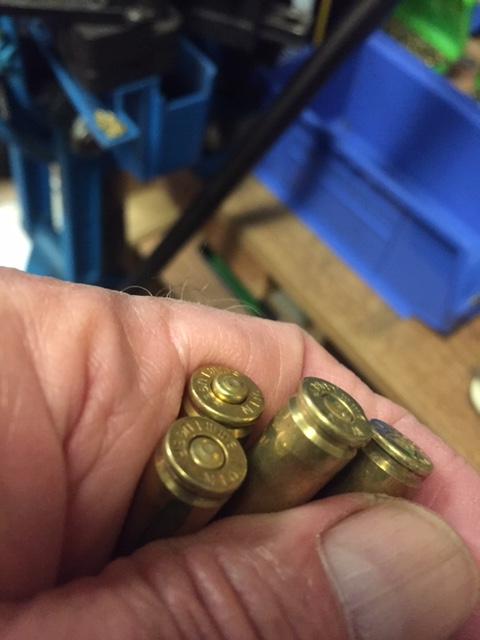
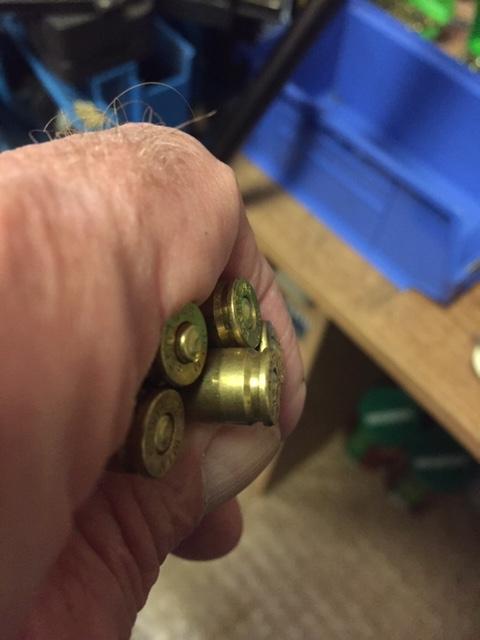
And here I was blaming CCI...
RCBS has a decapping rod called Pow'r Punch Decap Rod. The pin is spring-loaded, it will completely eliminate this issue...

.30/06 FTW
CGN Ultra frequent flyer
- Location
- Thunder Bay, Ontario
I find winchester brass are tighter too like s&b
The flash holes on the Winchesters are horrible. I deprime everything by hand and almost always the Winchesters get stuck on the decapping pin. You look and the metal is all jagged around the flash hole. Not that other brands aren’t like that sometimes, but the Winchesters are on average far worse.
fingers284
CGN Ultra frequent flyer
- Location
- Alberta Cowboy Ranges
Probably wont make a difference to change the primer punch rod if it is punching all the other primers out.
I have had the same phenomenon happen lots of times during a reload session of .38 sp that have been fired unknown times. Not very much since i started using Dillon dies withy the spring loaded primer punch, What happens is the primer , for some reason or another gets jammed/stuck to the end of the punch and when the press pulls the case away from the die, the if the primer pocket is a bit worn/loose the primer is drawn back up into the case....seems almost impossible that that could happen but sometimes the stars just align and $hit happens.
The spring loaded "detent snap" of the primer punch in Dillon dies is specifically supposed to eliminate this by jarring the old primer loose but once in a blue moon that old primer must really jam/pinch itself to the punch because it still happens although very rarely.
That case/old primer of yours must have a very peculiar bur that holds it to the punch over & over again.
I have had the same phenomenon happen lots of times during a reload session of .38 sp that have been fired unknown times. Not very much since i started using Dillon dies withy the spring loaded primer punch, What happens is the primer , for some reason or another gets jammed/stuck to the end of the punch and when the press pulls the case away from the die, the if the primer pocket is a bit worn/loose the primer is drawn back up into the case....seems almost impossible that that could happen but sometimes the stars just align and $hit happens.
The spring loaded "detent snap" of the primer punch in Dillon dies is specifically supposed to eliminate this by jarring the old primer loose but once in a blue moon that old primer must really jam/pinch itself to the punch because it still happens although very rarely.
That case/old primer of yours must have a very peculiar bur that holds it to the punch over & over again.
I've been reloading 9mm on a single stage RCBS. I find this situation happens about 1 in 10 pieces of brass. Doesn't seem to matter how deep I set the decapping pin. I think the pin is getting stuck in the centre of the primer anvil. Then on the down stroke of the ram, it partially re-seats the primer. I can always tell right away because the spent primer is partially seat ed and protruding through the centre of the shell holder and I can't slide the case out of the shell holder. Sometimes it takes an additional few strokes of the ram to get the darn deprimed. It's quite annoying.
If you're working in a quiet enough room you should hear the old primer go ploink in the used-primer catcher, and when you move the press lever to seat the new primer you should feel the bit of resistance as it seats. A reloading press tells you a lot if you're paying attention!
ipscgraz
CGN Ultra frequent flyer
If you're working in a quiet enough room you should hear the old primer go ploink in the used-primer catcher, and when you move the press lever to seat the new primer you should feel the bit of resistance as it seats. A reloading press tells you a lot if you're paying attention!
I find that once the primer catch bin is partially full it is hard to hear the spent primer drop. And as mentioned pushing the old primer back into place feels a lot like inserting a shiny new primer.
I removed the sizing die and looked at everything and reinstalled it. I don’t think this was a sizer die depth problem but we will see when I load some more.

A good post-reloading check is to put the ammo in an ammo case nose-down, visually scan that the primers look right and they're all standing up equally high (overall length), then run a finger across each row and feel for primers standing out of their case heads. Also helps keep track of rounds when you know each box is 50 or 100.
There's a chance some folk just take the loose ammo from the reloading press catch bin straight to the range and might miss doing that basic primer inspection, then a spent, flipped, sideways, or double primer can slip by.
There's a chance some folk just take the loose ammo from the reloading press catch bin straight to the range and might miss doing that basic primer inspection, then a spent, flipped, sideways, or double primer can slip by.
ipscgraz
CGN Ultra frequent flyer
A good post-reloading check is to put the ammo in an ammo case nose-down, visually scan that the primers look right and they're all standing up equally high (overall length), then run a finger across each row and feel for primers standing out of their case heads. Also helps keep track of rounds when you know each box is 50 or 100.
There's a chance some folk just take the loose ammo from the reloading press catch bin straight to the range and might miss doing that basic primer inspection, then a spent, flipped, sideways, or double primer can slip by.
Yup.
Match ammo is boxed, specifically because it forces you to look at the primers, along with giving a visual check of 10 rounds./mag.
Practice ammo is dumped into an ammo can.
Yup.
Match ammo is boxed, specifically because it forces you to look at the primers, along with giving a visual check of 10 rounds./mag.
Practice ammo is dumped into an ammo can.
Practice ammo may improve your ability to quickly deal with stoppages. Tap, rack, bang!
But match ammo ideally never makes use of that skill.

During the 39 years of reloading I had done myself a big favour, I switched from CCI to Federal primers. The main purposes were misfires, plus cold temperatures during hunting adds reassurances of a hotter ignition from Federal.






















