22-250

I have. In fact out of about 10 1/14 twist barrels (222, 222 mag, 22-250) 40's always shoot best. I read about people having good success with 55's but maybe I'm too fussy on group size for coyote loads.
 
Funny my 788 shoots the 55gr into one hole. Speed makes up for a slow twist to a point. Try 34gr-IMR4895 or IMR3031 in Win or Lapua cases with a Fed LRM primer under a 55gr SP
 
Your problem is bullet length not powder choice. If you're shooting boat-tail bullets switch to flat base, if you're already shooting FB bullets switch to 50 gr FB bullets. Shoot a few rounds at a 25 yard target and look for out of round bullet holes indicating yaw before you settle on your bullet. A pal of mine got decent results with his 1:14 twist .22-250 using 55 gr Remington bulk bullets, which measure .685" long; by comparison, a 50 gr V- Max is .769" long
 
My 222 Remington [also a 14" twist] shoots the 55 grain Hornady FBSP in to ½ moa consistently.
Velocity is, by necessity, lower than optimal, but it works fine.
Boomer has already mentioned the critical factor: Bullet length. A shorter 55 grain bullet, like
a flat based one, is more likely to shoot well than the longer Boattails. Dave.
 
Your problem is bullet length not powder choice. If you're shooting boat-tail bullets switch to flat base, if you're already shooting FB bullets switch to 50 gr FB bullets. Shoot a few rounds at a 25 yard target and look for out of round bullet holes indicating yaw before you settle on your bullet. A pal of mine got decent results with his 1:14 twist .22-250 using 55 gr Remington bulk bullets, which measure .685" long; by comparison, a 50 gr V- Max is .769" long

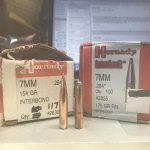
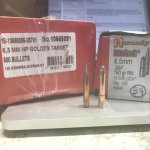
Boomer has it, I think. Twist rate is related to bullet LENGTH, not bullet weight. I have several bullets here in various calibers were the lighter bullet is much longer than the heavier bullet - Hornady 7mm 154 Interbond versus Hornady 7mm 175 RN for example, or Norma 6.5 130 grain "Golden Target" much longer than Hornady 6.5 160 grain Round Nose. If the twist rate is actually your issue. I just took delivery of new-to-me 22-250 with 1-14" twist - have not even cleaned it yet, so never fired it - but same deal - I have 55 grain V-Max that do very well in the PC10 in 223 Rem - hoping they will work in 22-250, but will be "iffy", I think - too long. So, I have ordered some flat base 52 grain HP Speer, which should be shorter, I hope. For a couple reasons, I plan to try IMR 3031 powder first - do not know how that will work, but at least one correspondent has had very good luck in his 22-250 with that. "Plan B" is Varget powder, if I can not get IMR 3031 to work out - at this point, I don't really have a "Plan C".

AB784BDA-15EB-4BE4-BFBD-1A6038186AF3.jpg

2CB0AC56-CBF3-49A0-AD4F-1557BEAF6DCD.jpg
 

Attachments

  • AB784BDA-15EB-4BE4-BFBD-1A6038186AF3.jpg
    AB784BDA-15EB-4BE4-BFBD-1A6038186AF3.jpg
    54.4 KB · Views: 245
  • 2CB0AC56-CBF3-49A0-AD4F-1557BEAF6DCD.jpg
    2CB0AC56-CBF3-49A0-AD4F-1557BEAF6DCD.jpg
    61.8 KB · Views: 241
Last edited:

When the US first made up their AR rifles, they used 55 grain bullets, with a semi boat tail bullet, designed specifically to barely stabilize in 1-14 twist rate barrels.

In most cases these bullets were very accurate in those rifles at appx 3200fps. One of the issues with this load was that the bullets had a tendency to tumble on impact or when going through relatively thin obstructions, such as heavy leaves. There was quite a controversy at the time, because of the horrendous would channels

I have a Remington Mod 700 that's close to 50 years old. It has a heavy barrel with a 1-14 twist rate.

It really shines with boat tail bullets 50-52 grains but does get the odd flier if the ogives are to long.

I bought a couple of thousand 50 grain Hornady SPFBHP bullets specifically for this rifle. It shoots them like lazers.

Strangely, this rifle, doesn't seem to do well with 35-40 grain bullets of any shape or length. That's just the way some rifles are.

OP, if you push those longer bullets faster, you might get away with using them successfully.
 
I can not really claim to know, but how I think about it - any particular bullet shape is going to need a certain rate of spin - in rpm's - to stay front end forward in flight in air. Those guys really rotate!!! Take a 1:12" twist barrel - if muzzle velocity is 2,400 fps, that bullet left that muzzle spinning at 144,000 rpm. If that bullet's shape needs 150,000 rpm to stay stable, not likely to do so, from that barrel, at 2,400 fps. But another barrel with a faster twist rate - at same muzzle velocity, or this barrel driving that bullet faster - might get 155,000 rpm - that hypothetical bullet will fly happy - its shape wanted at least 150,000 rpm to stay front end forward. That bullet in that 1:12 twist barrel, exiting the muzzle at 2,584 fps, it will be spinning 155,040 rpm. Would think there would be a reference somewhere that says bullet X needs Y rpm to stay stable in air (front end forward), but I can not find such a reference.

I think that I understand that drag on the bullet slows its forward speed when flying forward in air. Gravity pulls it downward. But not much, other than air friction on bullet skin and rifling engraving, to slow down rotation. For all I know, maybe the sonic wave from the bullet tip is shielding the bullet skin from that air friction. Hence, I think the rpm's stay way high, even though the bullets velocity slows down after travelling though air.

And, I have found several references that what is required to stay flying stable in air, is very different than what is required to stay flying stable in a more dense fluid. Probably why WWI era 303 British hard point military bullets were such wicked killers on game - they flew in air very well, but they tumbled after impact like crazy. Did not expand, but wrecked havoc, I think. Completely compliant with Britain's commitments to the Hague Conventions, about not using expanding bullets in military ammo.
 
Last edited:

I can not really claim to know, but how I think about it - any particular bullet shape is going to need a certain rate of spin - in rpm's - to stay front end forward in flight in air. Those guys really rotate!!! Take a 1:12" twist barrel - if muzzle velocity is 2,400 fps, that bullet left that muzzle spinning at 144,000 rpm. If that bullet's shape needs 150,000 rpm to stay stable, not likely to do so, from that barrel, at 2,400 fps. But another barrel with a faster twist rate - at same muzzle velocity, or this barrel driving that bullet faster - might get 155,000 rpm - bullet will fly happy. Would think there would be a reference somewhere that says bullet X needs Y rpm to stay stable in air (front end forward), but I can not find such a reference.

And, I have found several references that what is required to stay flying stable in air, is very different than what is required to stay flying stable in a more dense fluid. Probably why WWI era hard point military bullets were such wicked killers on game - they tumbled after impact like crazy. Did not expand, but wrecked havoc, I think. Completely compliant with Britain's commitments to the Hague Conventions, about not using expanding bullets in military ammo.


and then there is the difference in stability between subsonic and supersonic


I use 55 grn flat base bullets and H380 in my 22-250
 
Check and see what the twist rate actually is. Could be 14.5, 13.5 etc.

Im using cci br2 primers, And normally try to use imr 4064 35.5g with a 55gr nosler ballistic tip and will shoot the 60gr decent as well. Doesnt shoot any hornady stuff even remotely decent.This is out of a rebarreled mauser with a 14 twist barrel.
 
Back
Top Bottom