Mg 51 – Swiss Heritage
BY ALFRED PUBLISHED FEBRUARY 6, 2022 · UPDATED FEBRUARY 6, 2022
Anyone who goes to a museum on the subject of ethnology, be it about the Egyptians, Romans or the Helvetians, in this case our state museum in Zurich, will hardly be able to avoid the topic of weapons. Weapons are an important part of our cultural history.
For many in Switzerland, the weapon I am about to present also has something to do with their personal history. You were a fellow soldier, grenadier, reconnaissance officer, tank or fortress soldier and know this weapon only too well. The 1951 machine gun, Mg 51 for short, is a piece of history for Switzerland and for many people in this country.
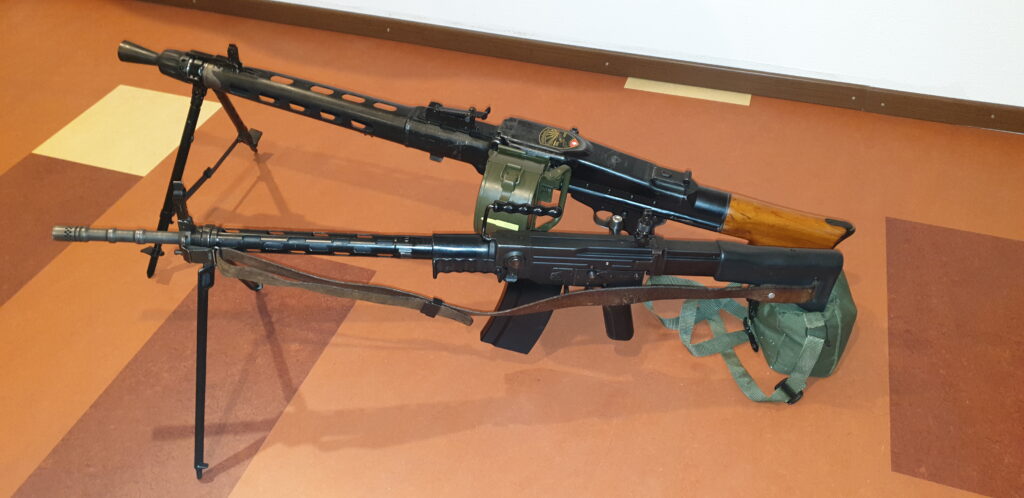
Two contemporary witnesses, the assault rifle 57 (front) and the machine gun 51 (rear)
It was 1943, the Second World War was raging in Europe, and the Swiss Army was securing our borders. At the time, infantry armament was characterized by the 31 carbine , 25 light machine gun and 11 machine gun. A major conversion was pending, both the machine gun and the armament of the soldiers had to be improved. And so the Swiss Army tested the Mg 42, a weapon that had already made a name for itself on the eastern and western fronts. But the Mg 42 was not popular, especially the safety of their own troops due to occasional short shots of the Mg 42 was an issue. It is often said that the roller closure of the German Mg's was not to your liking, but another circumstance was probably the reason, which I will come to later.
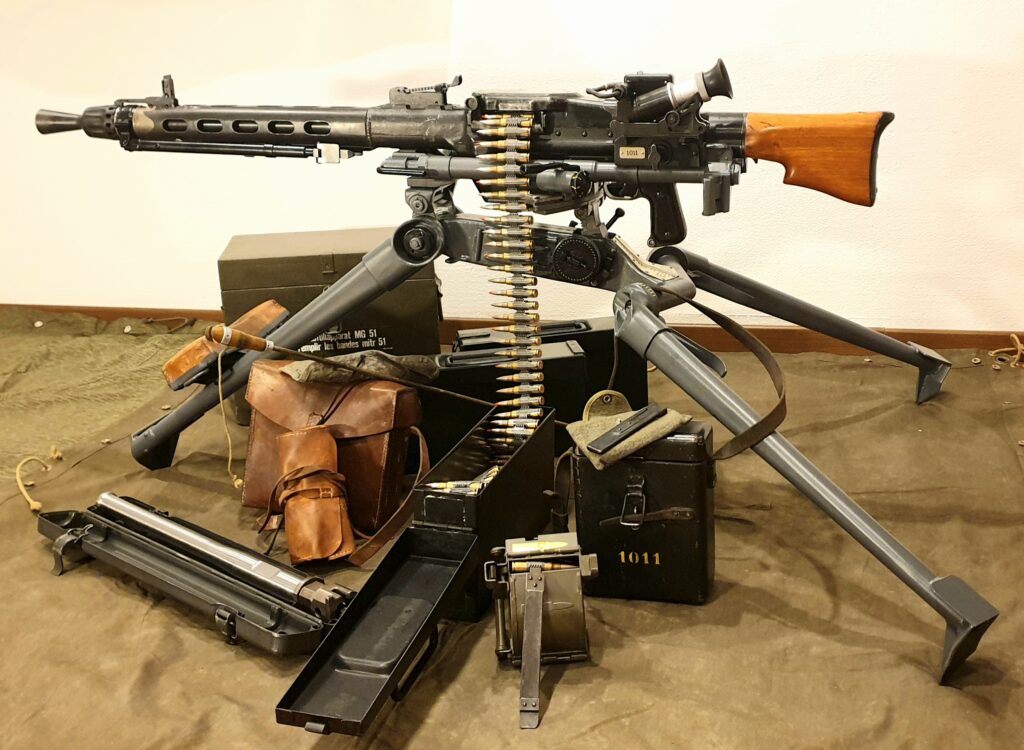
General overview of the original Mg 51 system
In this report, I will not go into too much detail on data and facts that can be found on the Internet one way or the other. I want to present the slightly different side of the Mg 51, the incredible details of this weapon and the little stories behind it. That's why I refrain from pictures of that time, but show mainly new pictures of the weapon, because beautiful and detailed pictures of the Mg 51 are hard to find.
To start with, some information about the weapon:
Military Designation: Machine Gun 1951 (Mg 51)
Developer/manufacturer: Waffenfabrik Bern (Switzerland)
Production time: since 1951 (still in use)
Caliber: 7.5 mm (7.5×55 Swiss / Gw Pat 11 or GP 11)
Ammo feed: belt (202 cartridges), drum magazine (52 cartridges)
Cadence: 1000 rounds/min (later also versions with 1000/600)
Types of fire: Series fire (no semi-auto versions)
Closure: support flap latch
Loading principle: recoil loading
Weapon weight: 16.6kg
Weight carriage: 26kg (incl. replacement lock in the storage compartment of the carriage)
Barrel length: 563mm (including bolt housing)
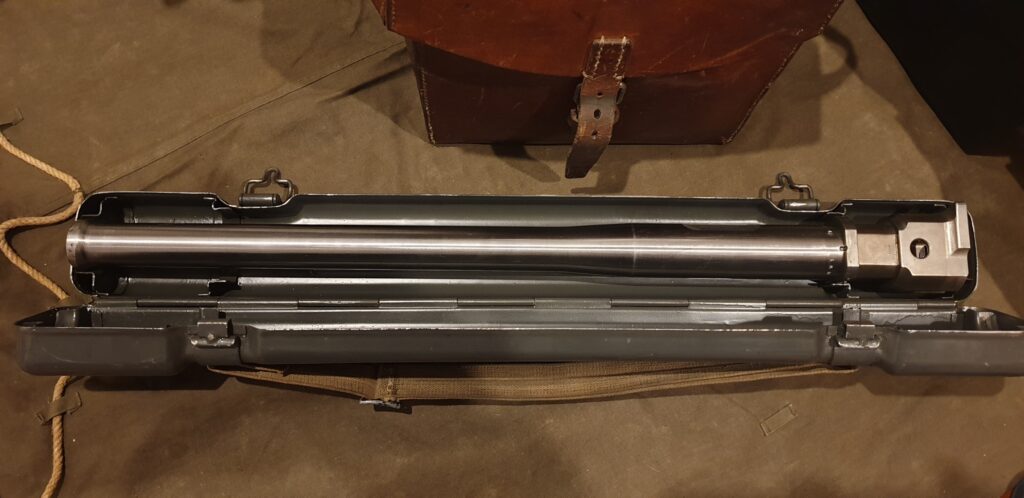
Barrel E in case (container)
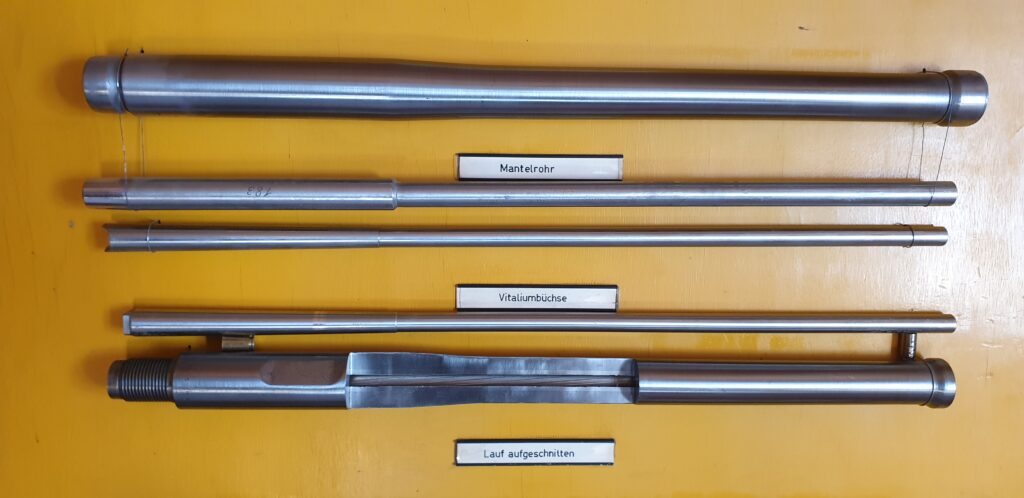
A core element is the barrel, whose liner was made of Vitalium (GPR-CoCr28Mo) and survived 177,004 shots in a long-term test without complaint! Even then, a run cost 1,328 Swiss francs, which is more than 8,000 Swiss francs/euro today, adjusted for inflation! The MG was delivered to the troops with a total of 6 barrels, barrels A, B, C, D (ribbed) from the first production phase for drills, and barrels E and F for use, which are used for larger fire series (multiple 200 shot) were designed. Since the material was very difficult to cast, the barrel bore blank was made of three pieces and welded to the barrel jacket. The finished barrel then consists of one solid piece, but it was made from four individual parts. Nobody would go to such lengths today. The barrel weight of the E/F barrel is 3.4kg.
Diagram of barrel construction
As with the Mg 42, the barrel could be swiveled out and changed within a few seconds, with heat-resistant gloves being mandatory after the first belt. It is also he who is responsible for the charging process. In contrast to a gas pressure charger, the barrel pushes backwards and transmits the impulse to the breech.
open barrel change flap with F-barrel
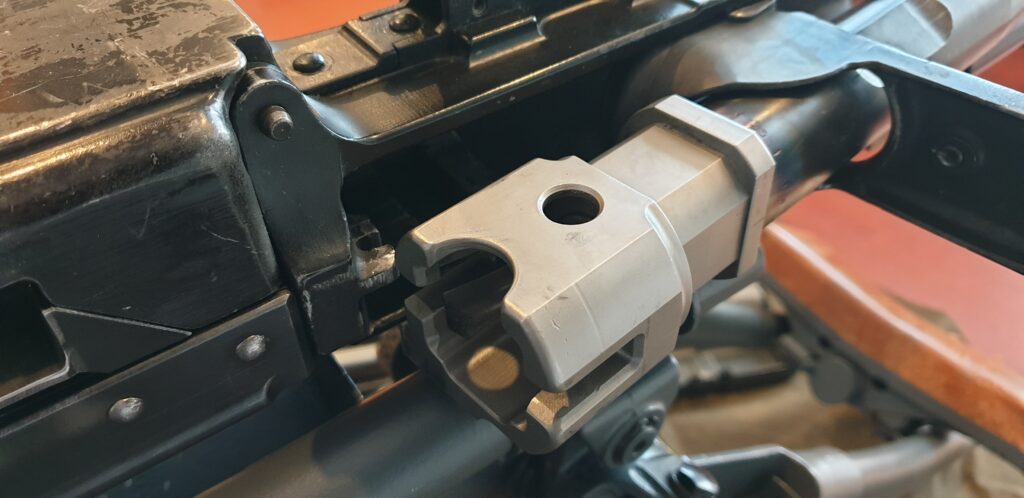
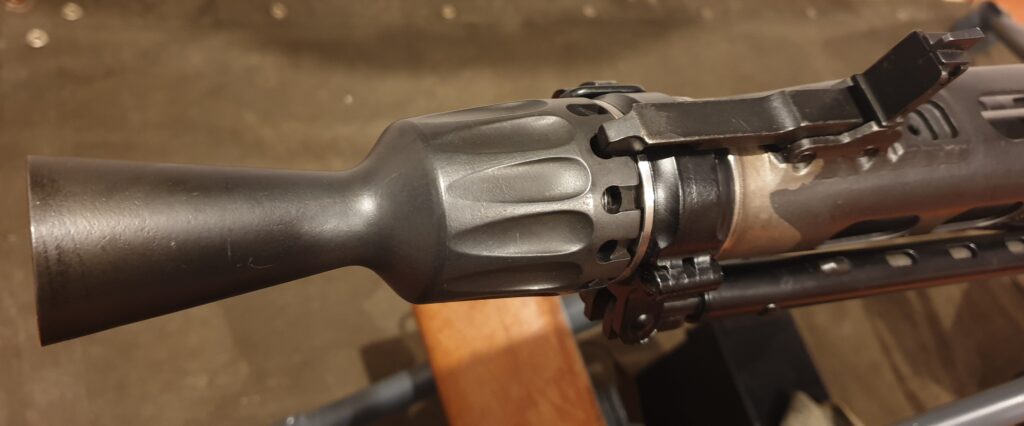
The pressure required for this is built up at the front inside the firelight suppressor. From the outside you can see 6 pressure relief holes, and at first glance you might think that the pressure can also be adjusted here, analogous to modern fully and semi-automatic machines, in order to counteract loading problems or summer/winter effects. But that's not the case, the flashlight damper should always be turned all the way in and then latched on the last or second to last notch.
Flashlight damper with safety pawl and front sight carrier with front sight - almost a work of art
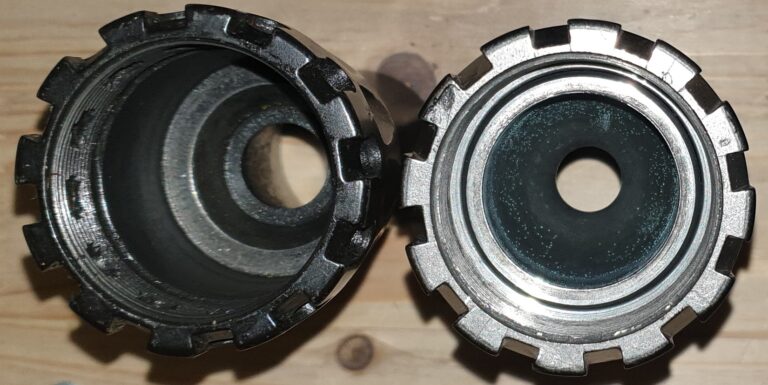
Inside the flash suppressor is the nozzle, a small metal bell with a 12.5mm opening through which the bullet flies. The moment the bullet passes through this opening, it partially closes this hole, the inflowing gases increase the pressure and the barrel is pushed back. This area is also largely responsible for the rate of 1,000 rounds per minute. This rate of fire is significantly lower than that of the Mg 42 with around 1,500 rounds. Today's modern .308 caliber systems often have cadences of around 800 rounds and lower to optimize ammunition consumption. With the development of the Mg 51/80 variant for the fortifications, these relief bores were not wanted to prevent gases from flowing into the interior of the fortification, and the flashlight suppressor was therefore revised. Gases are pouring into the interior of the fortress, and as a result, the firelight suppressor has been reworked. In order for the gun to keep the cadence and load cleanly, the bore in the nozzle had to be enlarged to 13mm.
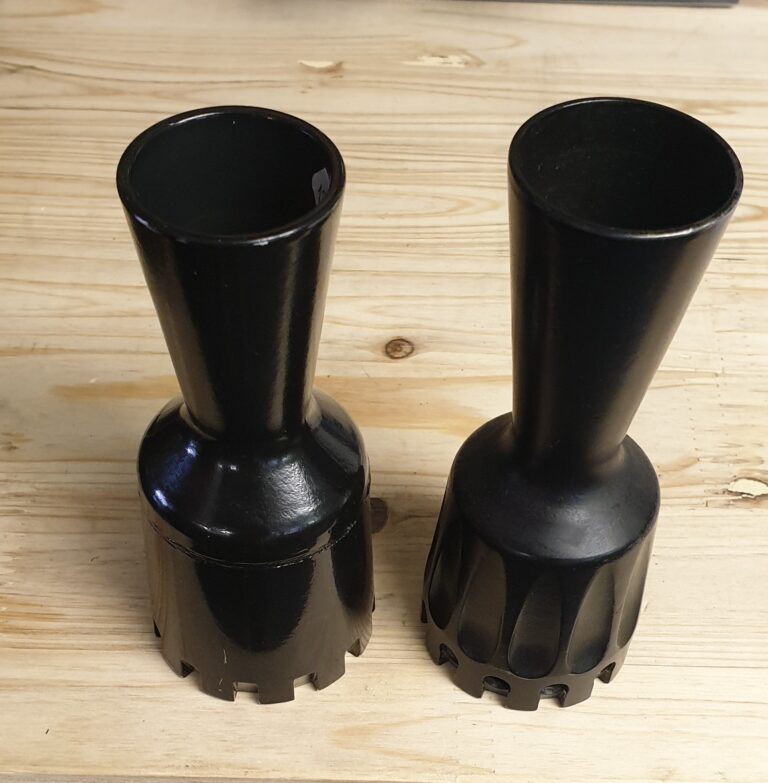
Flash suppressor of the Mg 51/80 variant on the left and the original Mg 51 variant on the right
On the right you can see the nozzle (bell) inside the firelight suppressor
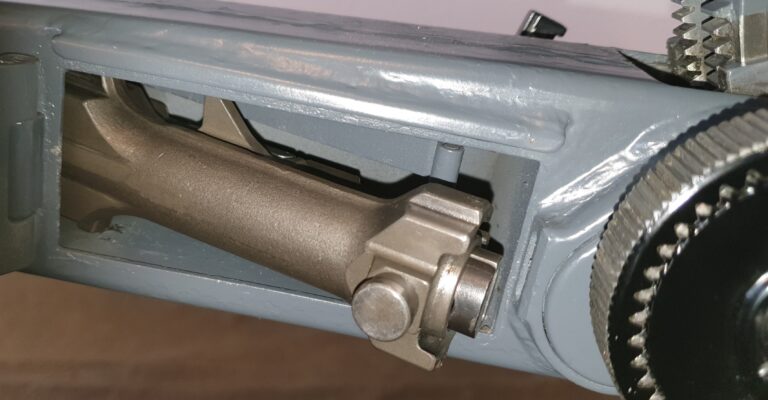
Another heart of the Mg 51 is the slide. He is also said to have been the "trigger" for Switzerland developing its own Mg, although there are at least 3 versions of this story. It is credible that in 1943 Mg 42 "Czech-made" were in Switzerland for test purposes, which were also fitted here with barrels in caliber 7.5×55 Swiss. The German wartime economy of the time was geared towards «saving», and the quality of the Mg's, but especially the locking system, was not well received here. History speaks of short shots due to the roller shutter. It is more likely that the highly carburized “spare steel” of the German breech caused the breech to occasionally recoil when it was closed. This opened the clasp slightly and a short shot was the result. The question arises as to what the result would have been if the material had been of the appropriate quality?
Storage compartment with the second lock(bolt) in the carriage
Regarding short shots, you have to know that then as now, in combat exercises, shots are fired over the troops, busy streets or inhabited buildings. If you look at civilian 300m shooting ranges (with shutters) in Switzerland, or take part in one of our long-range shooting events, this is also the case. Colloquially, the rule of thumb applies to our military training areas and a minimum height of 5m below a distance of 100m. This overshooting of the Mg is only permitted from the (field) carriage.
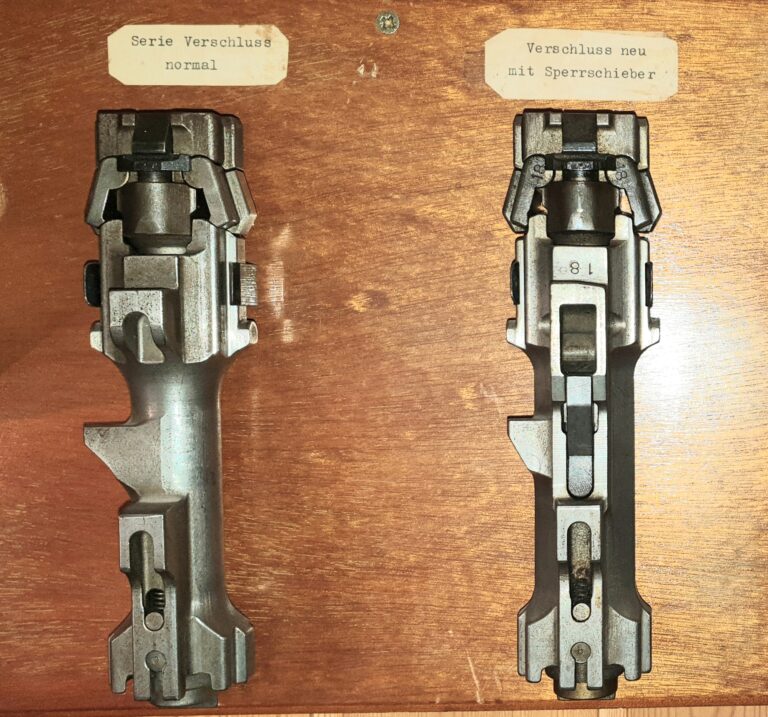
First version without locking slide on the left, current version on the right
But what is often not told is the fact that the Swiss developers also had trouble developing a closure that had better properties. There were trials of mass, roller and support flap closures and the first 2,570 or so delivered Mg51s did not yet have a locking slide like the current closure and had to be retrofitted for precisely the reasons above.
Nevertheless, today's breech runs like clockwork, in the already mentioned long-term test with 177,004 shots, the supporting flaps, breech case and head held up the entire test, the extractor and the ram behind it have to be replaced around every 12,000 shots , but this can be done in the field and is a matter of a few minutes. These parts are also packed in a small repair kit, and one way or another there is always a second bolt stowed away in the carriage. The same repair kit, which was a leather roll at the time, also contains the ejector (around 44,000 rounds) and the firing pin (177,004 rounds) as well as a cleaning cord, chamber cleaner and tools.
Cleaning and repair material with tools, small parts, spare firing pin and ejector
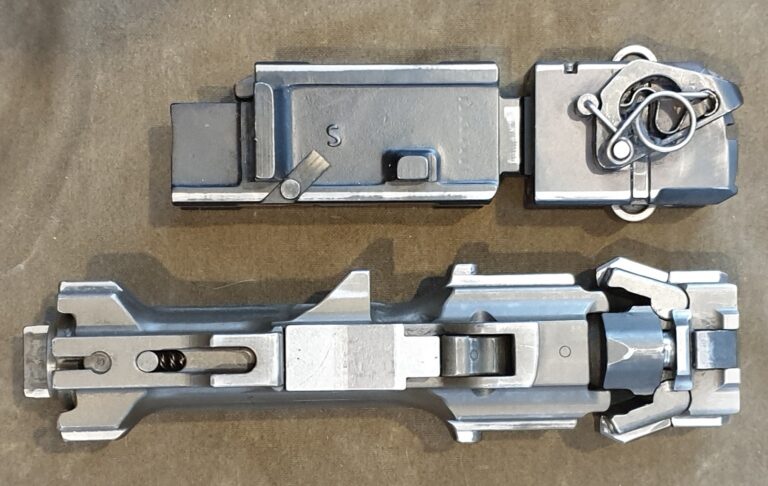
The Mg 51 does not actually have any faults, and it is/was quite the rule that several thousand rounds were fired with each Mg in the company in the three-week refresher courses. In 1957, a roller shutter was installed in the assault rifle 57 (Stgw57) , also a fully automatic weapon in the same caliber, which shows that a roller shutter can also work reliably.
Top bolt Stgw 57, bottom bolt Mg 51
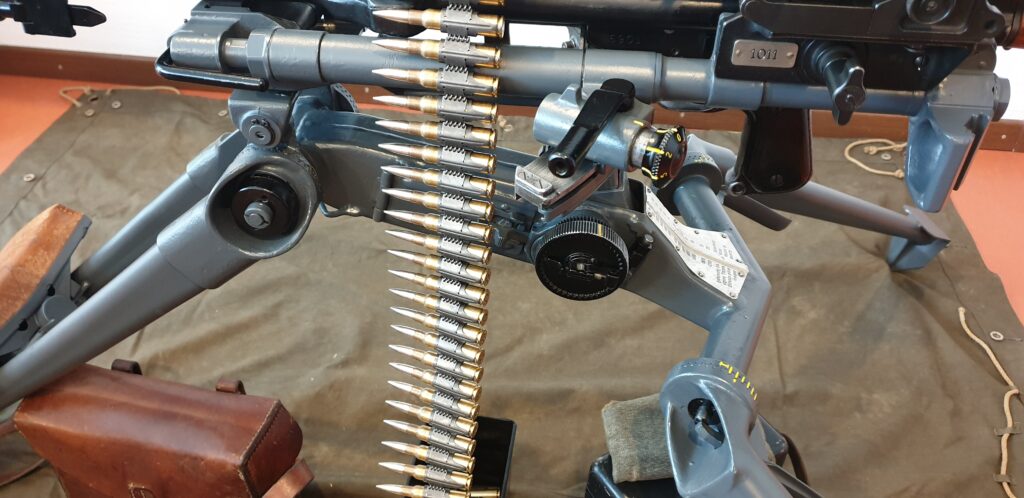
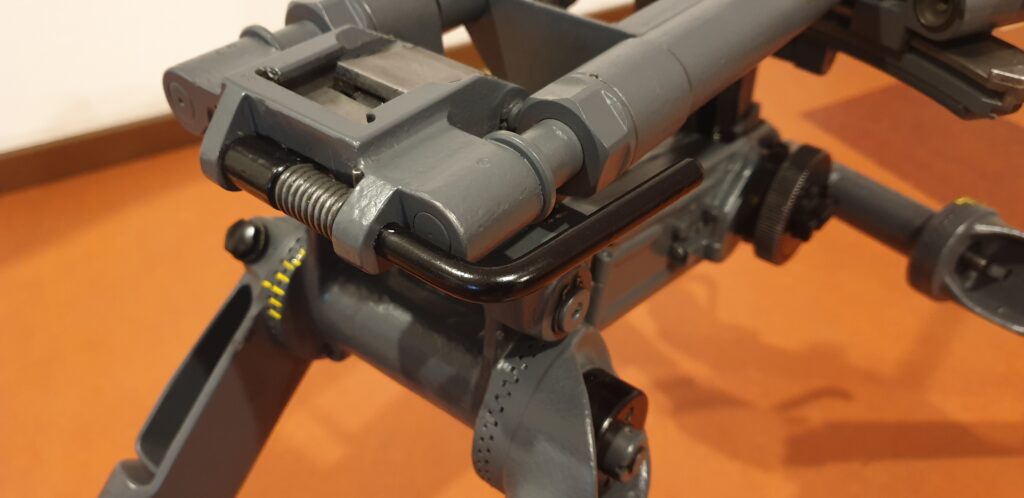
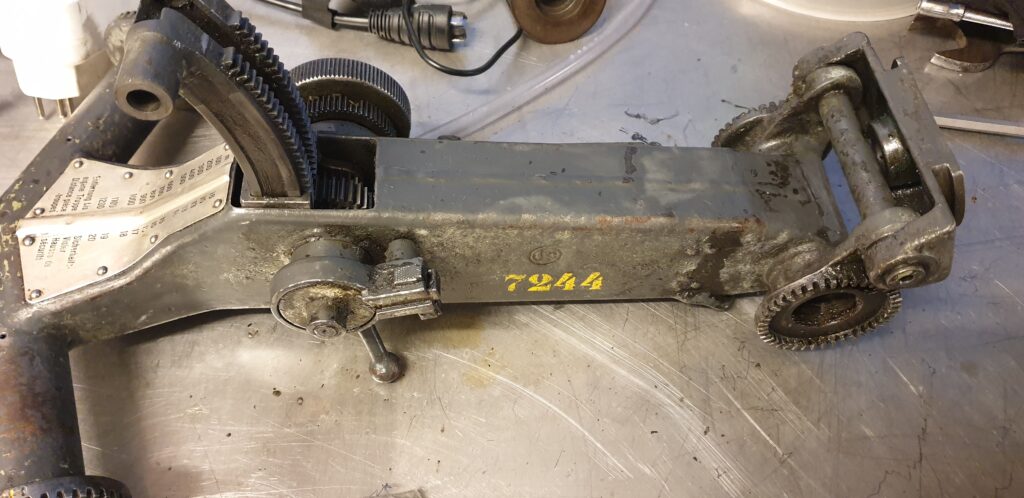
The carriage (simply called that) is actually the field carriage, because there is also a flab(Flak) support. Around 8,400 Mg51s were built in the initial production batch, and there must have been as many carriages in something. Later, other Mg51s were added in different versions (tanks/vehicles/fortress), but without carriages. The gun carriage of the Mg 51 is a precision instrument and firing from it is almost "surgical". It can be adjusted in height by 350 and in side by 450 artillery per thousand. For experienced ZF gunners it should be noted that one artillery per thousand corresponds to 0.982 mrad.
Directly to the right of the cartridge belt you can see the controls in black: from top to bottom - side clamp lever and scattered fire roller on the left, below this elevation wheel with locking slide and height limit lever
At 100m, this results in an adjustment range of a good 34m in height and a good 44m in the side. A lot of space can be covered with an Mg that has gone into position. In addition, the carriage has adjustable spread fire ranges in height and side. If the carriage is set up very flat, it is an extremely stable platform and does not move. Point fire at 600m with a grouping circle of 1.5m, even with long series, are absolutely no problem the periscope is indestructible and yet an absolute precision instrument. The Mg 51 can also be shot from the bipod, then from the belt boxes or the drum magazine,
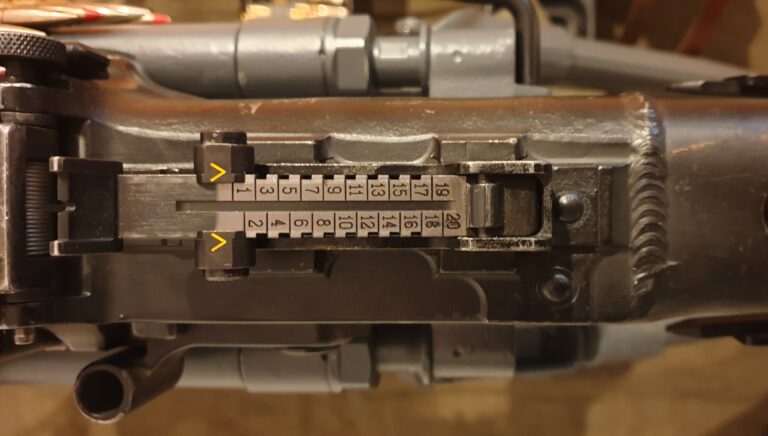
Visor with adjustment range up to 2'000m
The carriage as well as the entire system lives from the details, for example the mg lock in the rifle chamber is designed in such a way that if the mg springs in when shooting, the lock can no longer be opened. Unbelievable how much care was put into the development. There are detailed instructions for weapon mechanics for disassembly/assembly, which is particularly helpful with the lever spring shown below, as it shows exactly how to use it again.
Rifle stock with rifle holding latch and lever – this part also deflects when shooting
I am extremely enthusiastic about this carriage, because after 70 years you can disassemble it, clean it, process it and reassemble it without using force once. Unimaginable today. But that also had its price, the carriage is entered in the budget at around 3,000 Swiss francs, which corresponds to around 12,000 CHF/euro today. And at around 26kg including the interchangeable clasp, it is no lightweight. Nevertheless, tactical changes were quickly possible. If the positions were usable, the MG fired after a maximum of 30 seconds after leaving the last cover.
Mount before renovation
because they were retired when they were no longer operational. And dismantling the carriage requires at least three special tools.
Flab support with belt box holder
Finally, three more topics, even if there were many more. First a word about availability. The scope of the Mg 51 is one of the parts that are offered very often. The Mg 51 itself is “not” available, I know people who are very familiar with the scene who have told me that the number of functioning Mg 51s in private ownership is very small. Some museums and forts have an Mg on loan, but it's on the army books.
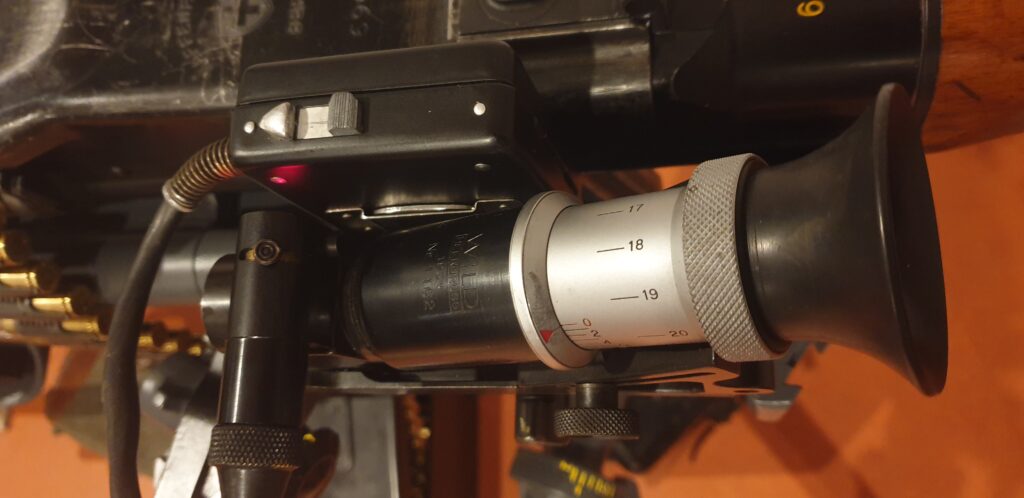
Scope with lighting device
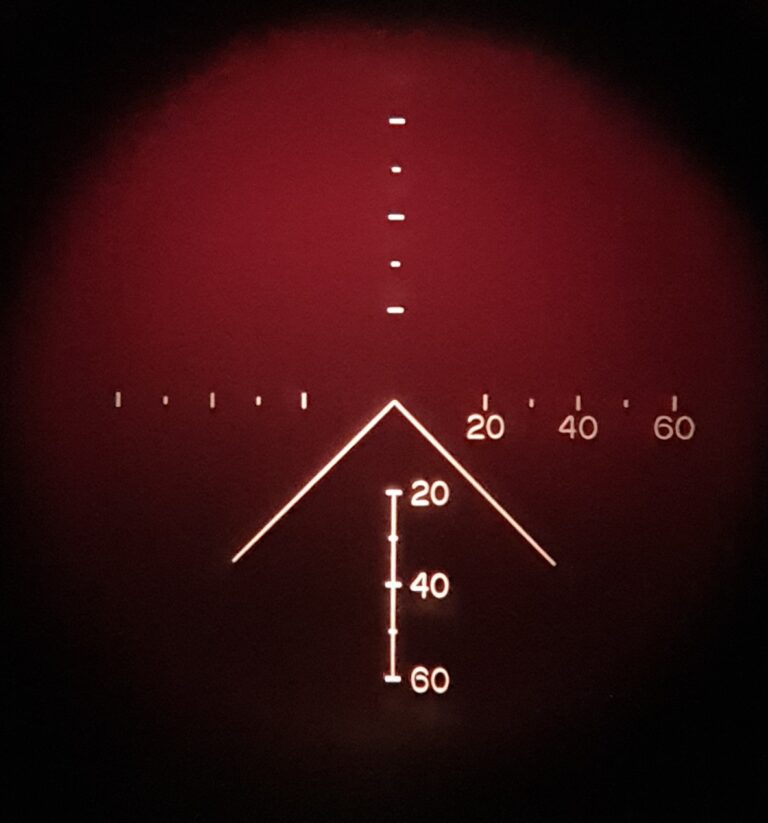
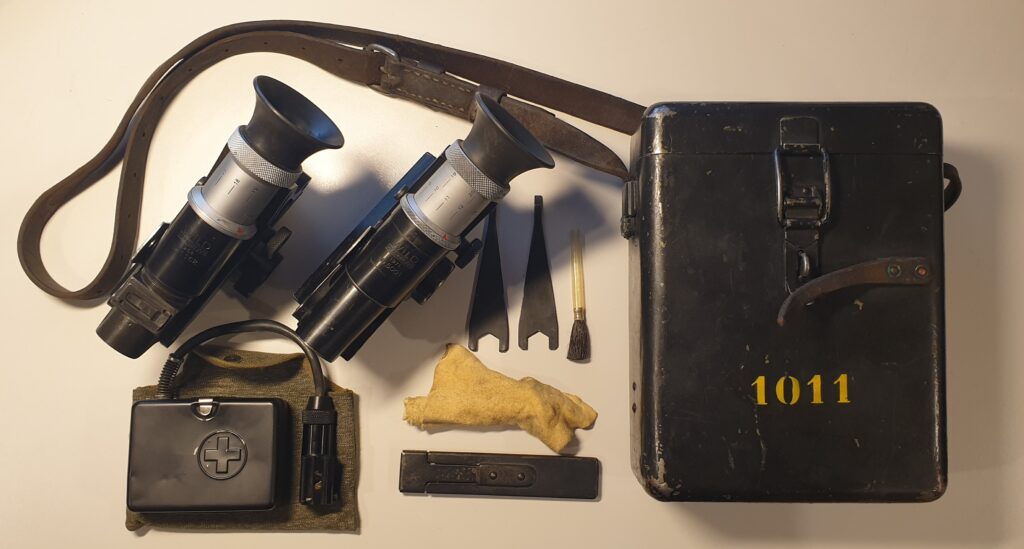
As already mentioned, there are a few more carriages, and accessories can often be found. The scope is quite a gem, and I know my way around scopes. It was manufactured by Wild Heerbrugg and has a magnification factor of 2.3 and a field of view of 200 per mil. It features a distance scale from 0m to 2000m and comes in two versions, an early one with the reticle illumination window on top and a more recent one with the illumination on the front. The continuously adjustable brightness of the reticle lighting and the red glow on the battery box can be seen clearly in the picture above, which shows that the lighting is also a small red light lamp that can be used to illuminate the settings.
illuminated reticle
Zeroing in the riflescope is described in detail, but without pictures, and it's not exactly self-explanatory. That's why it took a while to get it back on the gun and carriage. Contrary to a modern ZF, this precision instrument has no turrets, but a gate-guided focuser that controls the forward tilt. You have to think about it first.
both versions of the telescopic sight, the lighting device, the tool for the lateral correction, cleaning rags and the protective cover for the mounting rail (bottom middle)
Incidentally, an Mg51 rifle scope is only complete if you have a brush, cleaning cloth, two keys and the protective cover for the mounting rail of the rifle scope mount on the carriage. Finding it like this is winning the lottery, usually the protective cover is missing, for which there is an extra sheet metal tab in the rifle scope container. And the dimmable lighting unit is also a rare part. Regarding numbering, the Mg 51s start with the number 1001, so this is the telescopic sight of the eleventh Mg 51 (which I also like because the gun fires the GP 11).
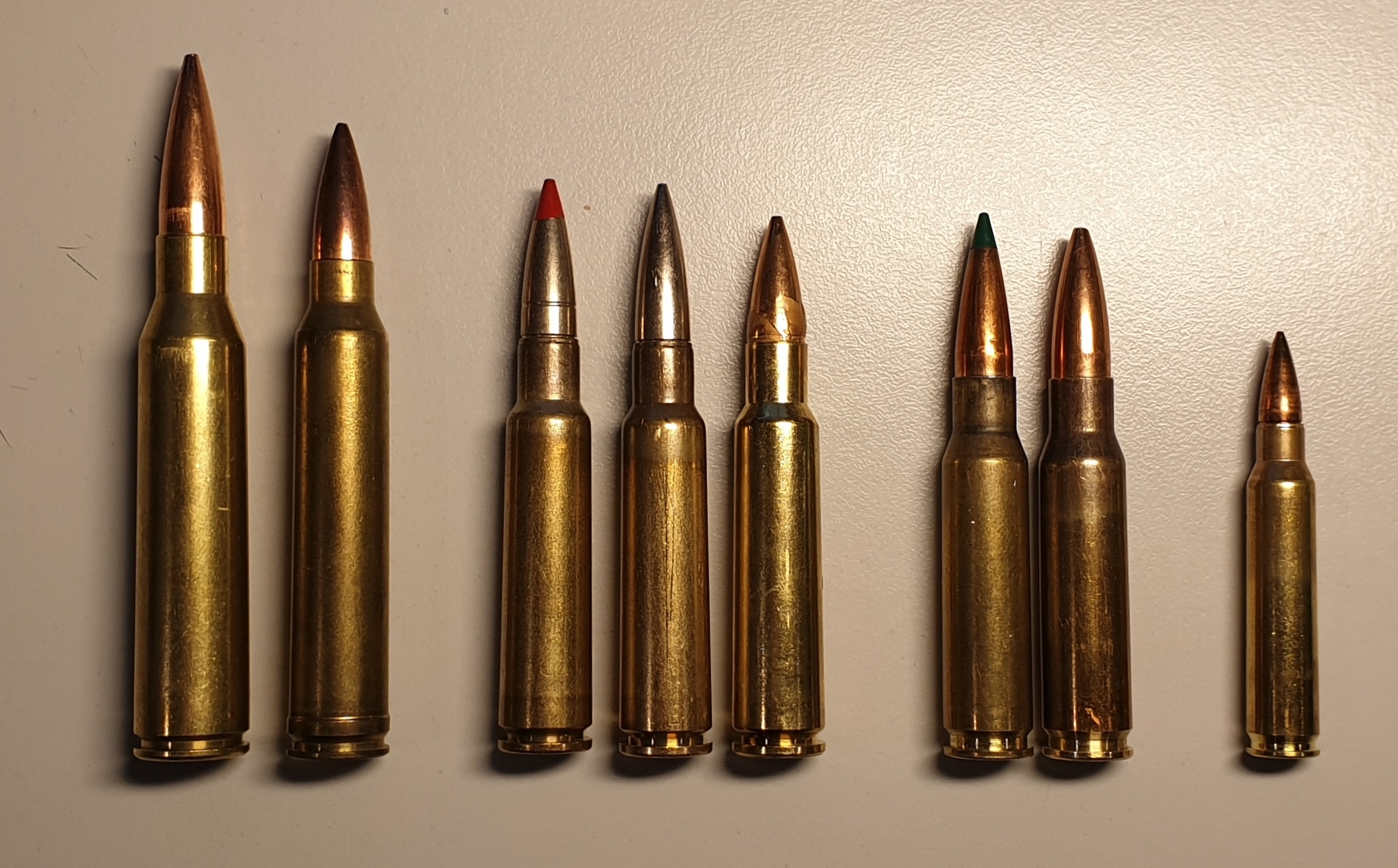
Left to right: .338LM, 300WM, GP 11-Lsp, GP 11, GP 11 Training Match with grease ring, .308 with TMK bullet, 308 OTM. GP90 (.556)
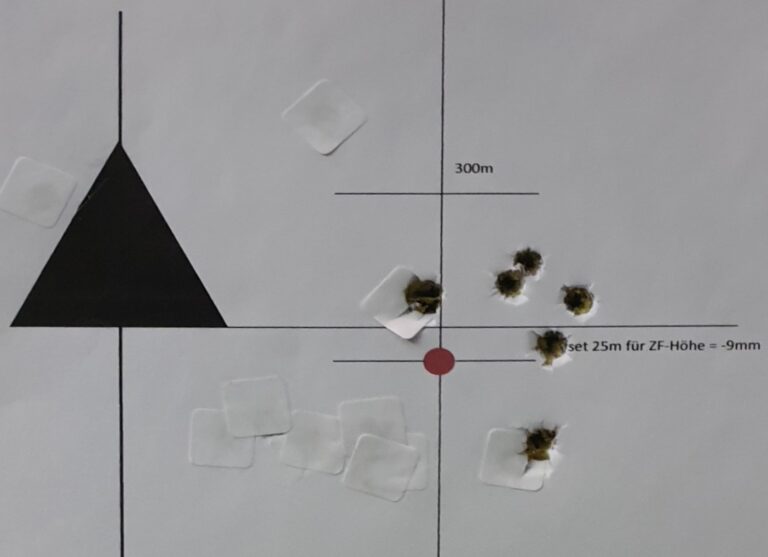
The GP 11 resp. 7.5×55 Swiss is a centerfire cartridge and was the standard ammunition of the Swiss Army from 1911 to 1994. It is still in use for the Mg 51 and has been in production again since 2016, but that is a very different and extensive story. The Mg 51 has a muzzle velocity of around 750m/s to 760m/s, particularly depending on temperature, the bullet is a 173grain boat tail bullet with a Haak ogive. This leads to the fact that it is very obedient resp. very forgiving in the transonic range. As a result, accurate Mg fire is easily possible at 1,500m or more, at 600m the Mg holds a 1.5m diameter range with the central sheaf being even narrower. For zeroing at 25m we have a special zeroing target,
our zeroing target Mg 51 at 25m
Finally, a few words about the Gurten filling device. It is loved and hated because it is a fiddly process to work with, but whoever has the knack loves it because it is a small clockwork, a contemporary witness of the industry 70 years ago. It should also load other comparable calibers in the 7.5mm range quite properly, I haven't tried this myself yet. Otherwise I'll let the little video do the talking.
[video]https://mittelkaliber.ch/wp-content/uploads/2022/02/20211231_120300.mp4[/video]
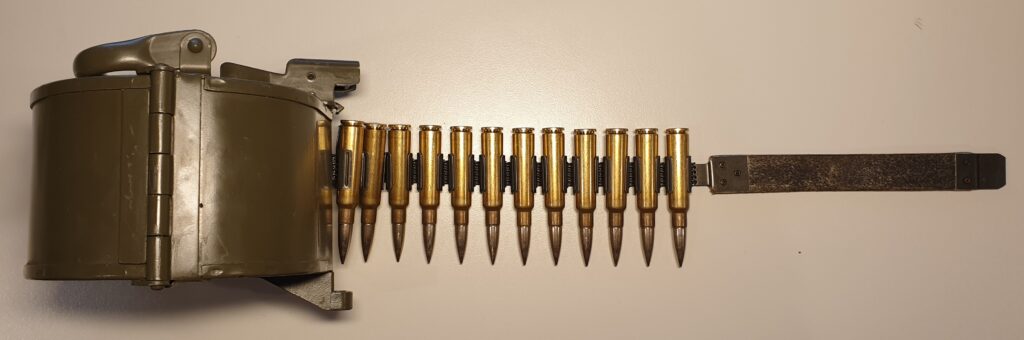
The belts of the Mg 51 are so-called permanent belts, i.e. they do not disintegrate into individual links when the ammunition is fired, only the insertion strip separates from the 50-gauge belt with the third shot. Normally, three ammunition boxes (model 11 or 61) with 202 shots each were carried with the Mg 51. In total, an Mg 51 including carriage, scope and ammunition weighed more than 70 kg, this load was shared among a team of three.
Drum magazine with belt and insertion strap (total 52 rounds)
There are other parts for the Mg 51, such as various barrels, tool bags and boxes, the periscope and the infrared night sight as well as instructional materials. The Mg 51 is also well documented in terms of documents, there are the regulations (manual), the manual for weapon mechanics and a detailed spare parts catalogue.
Unfortunately, the future of the Mg 51 in the Swiss Army is uncertain. More and more are being phased out, there is a lack of knowledge about this system, and investigations are underway to replace it with another system in caliber 7.62 (.308). From our point of view, this is very regrettable and not necessary, especially since one of the alternative systems, the Mg FN MAG, is already 70 years old. However, the Mg 51 will remain on the Leopard 2 until around 2035. As mentioned above, the new edition of the GP 11 was not without problems, although the new vintages are now more consistent.
For us Swiss shooters, the Mg 51 is an incredible masterpiece of its time, in service for over 70 years and still as good as it was on day one. Incidentally, this report is the first that I am also writing from the point of view of the UOV medium calibre . Many thanks at this point to Hansjörg Wieland for his support for this report, and especially to Erich, Peter and Kurt, who made all this possible!
Alfred, 02/06/2022, UOV medium caliber, SMKSG
Share our passion