...
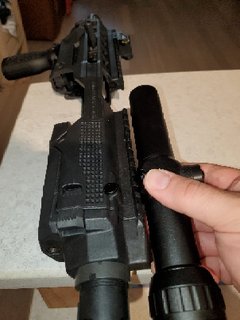
b) Offset rings would make one end of the scope elevated differently than the other end? So in my case the rear of the scope would be elevated slightly more (and somehow the rings made to accept this uneven angel.) Scope would then be angled sloping downward? I must have this wrong... seems like a terrible idea?
...
I do not know what you have been sold - "offset" rings should be exactly same height as regular rings - only they allow the scope to be mounted more forward or more rearward. For example, on a Ruger #1 rifle - the standard rear #4 ring ("Medium height") would hit the turret, before the scope was back far enough for me - so I purchased a #4 off set ring - that allowed the scope to be moved rearward almost another 1/2 inch. No change in scope height.
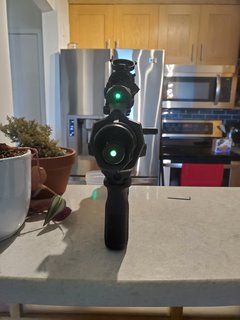
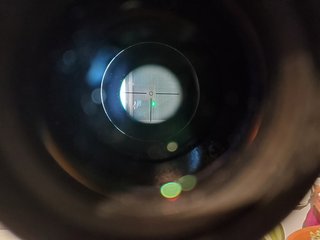
It might help to understand that a bullet will fly in an arc. Your line of sight through the scope will be a straight line - hence, can only have a straight line intersect an arc at maximum two places - one near and one far - in between, the bullet will be above the line of sight - up close and very far away, the bullet will be lower than your line of sight. Hence that laser thing that you are using is misleading you perhaps - that is NOT the bullet path, except for perhaps 2 or 3 meters from your muzzle. The higher that you mount the centre of your scope above the bore line, the greater is that maximum two points thing - is "normal" for many ballistic tables to assume that centre of scope is about 1.5" above the barrel bore line - for a typical hunting rifle - sounds like you are about double that? Will still work - you likely need to fire it - see bullet holes - instead of relying on your laser thing.
Assume that your closest "sighting in" point is 20 meters - from muzzle to that distance, your bullet should strike below that line of sight. Bullet strike will be exactly "on" at your sighting in range of 20 meters - after that it will strike higher than your crosshair. Until bullet drops back down to intersect the second time - so is a second point - out there - perhaps 150 meters - that you will also be "on" - after that, your bullet will strike low.
Perhaps a learning exercise for you - how I "sight in" my centre fire hunting scopes - so sandbags, shooting table, etc. - target at perhaps 20 meter - big target - say 60 cm x 60 cm - aiming point is a dot or cross - dead centre in that big target - aim at it and fire twice - want to see two holes pretty much touching, somewhere on that big target. Then measure or whatever - adjust the turrets - fire twice again - repeat - want to eventually get a pair to be perfect left / right, and perhaps "on" or a cm or two low of the aiming point. Then move target to 100 meters or where-ever you want your long distance sighting - you will be "on paper", if you did the first part - but might have to do "fine tuning" to get holes where you want them to land. I do not use a bore-sighter thing - is how I do it, and it works. My "big target" is just plain cardboard salvaged from a shipping box - aiming point is made with a jiffy marker.
If holes are not close to touching at 20 meters, is something very wrong with your rifle, your scope mounting or with your shooting ability - if the first holes are several inches apart, not much point in continuing, until you figure out and correct what is wrong.
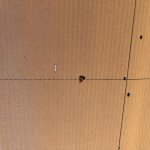
Do not discount "shooter's ability" - below is picture of "big target" - range was about 20 meters - middle of May this year - the three holes fired by my grand-daughter aimed at the "+" - I then fired the three holes aimed at the dot, higher up. Same rifle, same box of ammo, same scope setting - was a left hand Savage 93 in 22 Magnum - I shoot right handed; she wants to shoot left handed. Rifle forearm was supported on sand bags. These are the first 6 rounds that were fired that day - her shots were the first three. I had no clue until then, whether the new-to-me scope was aligned with the new-to-me rifle. (Note - loading this picture to this website, it went sideways - in real life, what you see as "left" should be "up" - I do not know how to fix that ...)