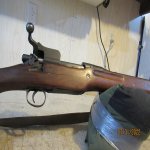
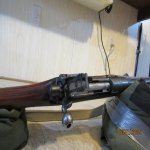
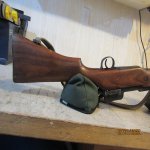
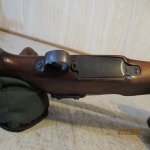
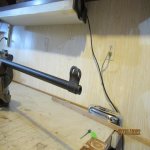
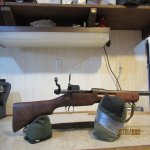
Pretty much as per posts above - I would go it is a P14 - at least the spring seat for the ejector box says P14. If so, and since was made for British - should be a serial number on that bolt handle - handle should be marked with an "E", at minimum. The "E" P14 here - SN 159### - has the serial number on bottom of bolt handle. I do not know if all were stamped there. Should also be the same serial number on the top forward edge of that rear sight - if it is original to that rifle. To be sure, that is NOT in original condition - fore-stock has been cut down to look like a sporter and the hand guards and bands removed - as was likely done for 10's of thousands of P14 and M1917 after WWII when they sold off as inexpensive rifles from various countries. My Dad "did up" his M1917 in 1948. They were very solid and dependable rifles - likely took trainloads of deer and moose, all across this country.
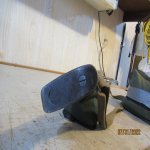
Your first picture looks like the narrower P14 extractor nose - versus the M1917 - but as mentioned in post above, is the bolt face that will tell the tale. A LOT of parts could be swapped and made to work - P14 to M1917 and vice-versa - so about any combination might be possible today. I just looked at several P14 receivers - might also be a "tell" on the left side receiver wall - a British "Broad Arrow", besides other markings. But is not definitive - I think some M1917 made it into British hands, so they would have got the Broad Arrow mark as well, when they got there. If you find an American "flaming bomb" or "eagle head" - anywhere - that component is from an M1917, not from a P14.
The right side of the stock might be showing a crack? Not sure - could be discolouration in that grain? For a similar, I removed the action and was able to install a threaded pin - straight down - the action covers the top of the pin - the crack did not spread or get worse after than.