Found at the Ranch

skwerl

CGN Ultra frequent flyer
Uber Super GunNutz
Rating - 100%
92   0   0
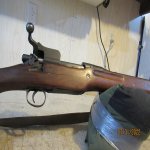
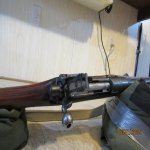
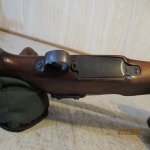
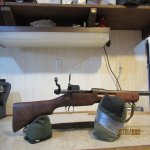
Some help identifying this rifle in .30 cl .
Only role stamps sr. # ERA 345316 matched to the barrel.
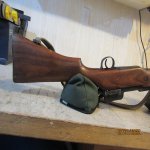
Steel butt plate .

We think it was Uncles....
 

Attachments

  • 303 receiver.jpg
    303 receiver.jpg
    64.3 KB · Views: 838
  • 303 blt.jpg
    303 blt.jpg
    63.2 KB · Views: 839
  • 303 trggr.jpg
    303 trggr.jpg
    66.8 KB · Views: 838
  • 303 btm.jpg
    303 btm.jpg
    55.8 KB · Views: 839
  • 303 butt.jpg
    303 butt.jpg
    65.3 KB · Views: 839
  • 303 frt site.jpg
    303 frt site.jpg
    62.4 KB · Views: 842
  • 303.jpg
    303.jpg
    66.7 KB · Views: 838
Last edited:
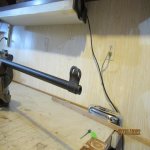
Pretty much as per posts above - I would go it is a P14 - at least the spring seat for the ejector box says P14. If so, and since was made for British - should be a serial number on that bolt handle - handle should be marked with an "E", at minimum. The "E" P14 here - SN 159### - has the serial number on bottom of bolt handle. I do not know if all were stamped there. Should also be the same serial number on the top forward edge of that rear sight - if it is original to that rifle. To be sure, that is NOT in original condition - fore-stock has been cut down to look like a sporter and the hand guards and bands removed - as was likely done for 10's of thousands of P14 and M1917 after WWII when they sold off as inexpensive rifles from various countries. My Dad "did up" his M1917 in 1948. They were very solid and dependable rifles - likely took trainloads of deer and moose, all across this country.

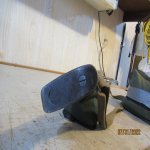
Your first picture looks like the narrower P14 extractor nose - versus the M1917 - but as mentioned in post above, is the bolt face that will tell the tale. A LOT of parts could be swapped and made to work - P14 to M1917 and vice-versa - so about any combination might be possible today. I just looked at several P14 receivers - might also be a "tell" on the left side receiver wall - a British "Broad Arrow", besides other markings. But is not definitive - I think some M1917 made it into British hands, so they would have got the Broad Arrow mark as well, when they got there. If you find an American "flaming bomb" or "eagle head" - anywhere - that component is from an M1917, not from a P14.

The right side of the stock might be showing a crack? Not sure - could be discolouration in that grain? For a similar, I removed the action and was able to install a threaded pin - straight down - the action covers the top of the pin - the crack did not spread or get worse after than.

 
Last edited:
It's a P14 in .303 unless someone put the base of a long range backsight from a P14 in there. If the bore's good it's a good rifle that can do anything $1500 rifles in the same calibre could do, but which you could drop in the river and not shed any tears over.
 
Looking through the Edgecombe book, I don't think Canada ever had more than a couple dozen "P14" - "on the books" - but I do believe was thousands of M1917 that were bought during WWII and used at RCAF bases, etc. within Canada.

Goes to mis-matching and "making something work" - so can find today a P14 with an RCAF stamped stock - that stock more than likely came from a M1917 - it will "fit" to a P14 barrelled action, with minimal fuss - I had received one here like that. As posted above, is other aspects of the stocks that were different to each other.
 
Either way its a strong action with a huge mag well if you wanted to build a magnum rifle with the action. I built a 500 jeffery with a ERA P14. It will fit 91mm length rounds without cutting the buttom lug area to length the mag area


 
Last edited:
Xlnt info. guys

The gun was Grandfathers , he was British army in the 1st. WW.
When he immigrated to Canada in the '20's he needed a hunting
rifle an got this , I guess that he used the same in England.

We will tie it to the bench rest to shoot .

Thnz again... skwerl
 
I have received a number of them in various condition - one was so bad I do not think light came down the bore - was chock full of rust. So at minimum - before you fire it - pull the bolt and peer down that bore towards light - make up you own mind whether fit to fire or not. I would suggest - as with that one here - if you can not see down the barrel and out the other end, maybe not a good idea to try to send a bullet through that either ... I would suspect that from his British Army training, that your Grandfather likely knew how to clean and maintain a barrel - especially if it was similar to one that he had been issued - but have to consider however many years have passed since.
 
I have received a number of them in various condition - one was so bad I do not think light came down the bore - was chock full of rust. So at minimum - before you fire it - pull the bolt and peer down that bore towards light - make up you own mind whether fit to fire or not. I would suggest - as with that one here - if you can not see down the barrel and out the other end, maybe not a good idea to try to send a bullet through that either ... I would suspect that from his British Army training, that your Grandfather likely knew how to clean and maintain a barrel - especially if it was similar to one that he had been issued - but have to consider however many years have passed since.

The bore is immaculate just quite worn , over all in pretty good nik.
Grandpa was the old English man who wore a shirt , tie & vest every daY.
 
Someone above mentioned they were converted to African calibers. I currently have them in 416 Rigby and 264 win mag. Have had several others in 7mag, 338wm, and 308nm.

Cheapest large magnum action for big magnum builds.

They (P14's) seem heavy enough for any thing , Quite
a blast with those larger calibres I bet .
 
Back
Top Bottom