What I have is a #4Mk 1*LB converted to .223 (5.56 mm). The barrel is a very heavy stainless Steel that is about 7/8" at the muzzle.The rate of twist is approx 1:9. The barrel has a taper (Small) until it reaches the front of the chamber where it increases to the size of the receiver ring. the bolt has the same serial number as the receiver except that the bolt head is modified by changing the extractor which is smaller than the .303 one. The fore stock is cut back and wood removed to free float the barrel. The magazine well has been modified in that it was filled and an insert was put in to make it single shot. I haven't shot this yet so I don't know how well it groups or functions. Has anyone seen these #4 conversions and know how well they work?













































You are using an out of date browser. It may not display this or other websites correctly.
You should upgrade or use an alternative browser.
You should upgrade or use an alternative browser.
Interesting Milsurp Conversion
- Thread starter LocknLoad
- Start date

What I have is a #4Mk 1*LB converted to .223 (5.56 mm). The barrel is a very heavy stainless Steel that is about 7/8" at the muzzle.The rate of twist is approx 1:9. The barrel has a taper (Small) until it reaches the front of the chamber where it increases to the size of the receiver ring. the bolt has the same serial number as the receiver except that the bolt head is modified by changing the extractor which is smaller than the .303 one. The fore stock is cut back and wood removed to free float the barrel. The magazine well has been modified in that it was filled and an insert was put in to make it single shot. I haven't shot this yet so I don't know how well it groups or functions. Has anyone seen these #4 conversions and know how well they work?
I've heard they are common in Australia, not sure though. Sounds like a very interesting rifle, nice to have one that will shoot cheaper ammo than hard to find .303.
Could you post some pics of it? If you don't know how you could email them to me and I'll post em for you.

- Location
- WMU248 near Edmonton
The Australian ones that I've seen picutes of had a ring and plunger type ejector added to the bolt face.
I amd very interested in seeing pictures as well.
perhaps my 277/303 project might get changed to a 6.8x43mm (6.8SPC)
I amd very interested in seeing pictures as well.
perhaps my 277/303 project might get changed to a 6.8x43mm (6.8SPC)
Last edited:

From Wikipedia (emphasis added by me):
So depending upon your chamber dimensions and if you have commercial spec .223 or 5.56NATO ammo, your chamber pressures are expected to fall in the 58,000 to 78,000psi range.
.303 Maximum SAAMI pressure is 49,000psi, while the MkVII and MkVIII service rounds generate 39,000psi and 40,000–42,000psi respectivelty. Granted, the No.4 action is stronger than the Long Lee and SMLE actions that the round has to work in, but the biggest round generally regarded as a safe caliber conversion i nthe No.4 action is the 7.62NATO.
7.62 NATO maximum pressure is 50,000psi.
This means that a .223 conversion of an original No.4 rifle will generate between 8,000psi and 28,000psi MORE chamber pressure than the most powerful generally accepted chambering for that action.
AIA gets around this by building a new action for their target rifles in .223 using different steels and heat treatment than the original No.4 receiver used.
I'm not going to climb onto a soap box about it, but please take these facts into consideration before firing your new rifle.
While the 5.56 mm and .223 cartridges are very similar, they are not identical. Military cases are made from thicker brass than commercial cases, which reduces the powder capacity (an important consideration for handloaders), and the NATO specification allows a higher chamber pressure. Test barrels made for 5.56 mm NATO measure chamber pressure at a the case mouth, as opposed to the SAAMI location. This difference accounts for upwards of 20,000 psi (140 MPa) difference in pressure measurements. That means that advertised pressure of 58,000 psi (400 MPa) for 5.56 mm NATO, is around 78,000 psi (540 MPa) tested in .223 Rem test barrels. The 5.56 mm chambering, known as a NATO or mil-spec chambers, have a longer leade, which is the distance between the mouth of the cartridge and the point at which the rifling engages the bullet. The .223 chambering, known as SAAMI chamber, is allowed to have a shorter leade, and is only required to be proof tested to the lower SAAMI chamber pressure. To address these issues, various proprietary chambers exist, such as the Wylde chamber (Rock River Arms)[1] or the Armalite chamber, which are designed to handle both 5.56 mm and .223 equally well.
So depending upon your chamber dimensions and if you have commercial spec .223 or 5.56NATO ammo, your chamber pressures are expected to fall in the 58,000 to 78,000psi range.
.303 Maximum SAAMI pressure is 49,000psi, while the MkVII and MkVIII service rounds generate 39,000psi and 40,000–42,000psi respectivelty. Granted, the No.4 action is stronger than the Long Lee and SMLE actions that the round has to work in, but the biggest round generally regarded as a safe caliber conversion i nthe No.4 action is the 7.62NATO.
7.62 NATO maximum pressure is 50,000psi.
This means that a .223 conversion of an original No.4 rifle will generate between 8,000psi and 28,000psi MORE chamber pressure than the most powerful generally accepted chambering for that action.
AIA gets around this by building a new action for their target rifles in .223 using different steels and heat treatment than the original No.4 receiver used.
I'm not going to climb onto a soap box about it, but please take these facts into consideration before firing your new rifle.
From Wikipedia (emphasis added by me):
So depending upon your chamber dimensions and if you have commercial spec .223 or 5.56NATO ammo, your chamber pressures are expected to fall in the 58,000 to 78,000psi range.
.303 Maximum SAAMI pressure is 49,000psi, while the MkVII and MkVIII service rounds generate 39,000psi and 40,000–42,000psi respectivelty. Granted, the No.4 action is stronger than the Long Lee and SMLE actions that the round has to work in, but the biggest round generally regarded as a safe caliber conversion i nthe No.4 action is the 7.62NATO.
7.62 NATO maximum pressure is 50,000psi.
This means that a .223 conversion of an original No.4 rifle will generate between 8,000psi and 28,000psi MORE chamber pressure than the most powerful generally accepted chambering for that action.
AIA gets around this by building a new action for their target rifles in .223 using different steels and heat treatment than the original No.4 receiver used.
I'm not going to climb onto a soap box about it, but please take these facts into consideration before firing your new rifle.
That's interesting.
BTW, is AIA selling a No 4 Mk 4 in .223 in Australia?
I'd love to have one in that calibre!
What I have is a #4Mk 1*LB converted to .223 (5.56 mm). The barrel is a very heavy stainless Steel that is about 7/8" at the muzzle.The rate of twist is approx 1:9. The barrel has a taper (Small) until it reaches the front of the chamber where it increases to the size of the receiver ring. the bolt has the same serial number as the receiver except that the bolt head is modified by changing the extractor which is smaller than the .303 one. The fore stock is cut back and wood removed to free float the barrel. The magazine well has been modified in that it was filled and an insert was put in to make it single shot. I haven't shot this yet so I don't know how well it groups or functions. Has anyone seen these #4 conversions and know how well they work?


That's interesting.
BTW, is AIA selling a No 4 Mk 4 in .223 in Australia?
I'd love to have one in that calibre!
Yes, they do. Not sure why there is no equivalent offering in Canada - you'd have to ask their importer (Marstar).
Yes, they do. Not sure why there is no equivalent offering in Canada - you'd have to ask their importer (Marstar).
I don't see that calibre in Lawrance Ordnance's ad, but I did see this...Minigun Barrels!
http://www.lawranceordnance.com/lawrance-ordnance/rifles-aia-m10-b3.html
There is something not adding up concerning the pressures 70,000 psi in a nato 5.56 x 45mm round? Anyway I use FC commercial brass, data from a Hodgdon manual for 26.5 grs BLC2 and a 52 gr BTHP. Why do I use the Hodgdon manual- because it is their powder and like most manuals, they have a tendancy to give "conservative" loadings. I will properly test the load anyway to see how it performs and chack the action for any signs of failure.

There is something not adding up concerning the pressures 70,000 psi in a nato 5.56 x 45mm round? Anyway I use FC commercial brass, data from a Hodgdon manual for 26.5 grs BLC2 and a 52 gr BTHP. Why do I use the Hodgdon manual- because it is their powder and like most manuals, they have a tendancy to give "conservative" loadings. I will properly test the load anyway to see how it performs and chack the action for any signs of failure.
Notice that pressure was obtained in a ".223 TEST BARREL".....very tight throat and bore. Not your typical commercial barrel.
Just before issue ammunition was no longer available for DCRA type shooting, there was a flurry of interest in 5.56 conversions, here and in Australia. IVI 5.56 ball had a reputation for generally fine accuracy. 5.56 target rifle conversions tended to be very accurate, often giving better performance than 7.62 conversions.
When a cartridge fires, hoop stressed are applied to the barrel. Obviously this poses no problems. Firing also creates backthrust against the boltface, which is in turn translated into thrust against the locking surfaces. Backthrust is determined by the surface available for the gas pressure to be applied. The controlling factor is the area of the inside of the base of the cartridge case. This is the only surface against which the gas can apply rearward pressure. The 5.56 has a much smaller surface area than the .303 or 7.62 do. This is why there are no observed problems even though the cartridge is operating at higher pressure. It would appear that one of the reasons that 5.56 conversions shot so well is that the reduced backthrust results in less action flex in the rear lug asymmetrical No. 4 action.
A single shot conversion does not need the flat boltface to be altered. If the rifle is to be a repeater, as the Australians are doing, a collared or counterbored boltface and an ejector are needed.
When a cartridge fires, hoop stressed are applied to the barrel. Obviously this poses no problems. Firing also creates backthrust against the boltface, which is in turn translated into thrust against the locking surfaces. Backthrust is determined by the surface available for the gas pressure to be applied. The controlling factor is the area of the inside of the base of the cartridge case. This is the only surface against which the gas can apply rearward pressure. The 5.56 has a much smaller surface area than the .303 or 7.62 do. This is why there are no observed problems even though the cartridge is operating at higher pressure. It would appear that one of the reasons that 5.56 conversions shot so well is that the reduced backthrust results in less action flex in the rear lug asymmetrical No. 4 action.
A single shot conversion does not need the flat boltface to be altered. If the rifle is to be a repeater, as the Australians are doing, a collared or counterbored boltface and an ejector are needed.
- Location
- WMU248 near Edmonton
.....
The 5.56 has a much smaller surface area than the .303 or 7.62 do. This is why there are no observed problems even though the cartridge is operating at higher pressure.
.....
A single shot conversion does not need the flat boltface to be altered. If the rifle is to be a repeater, as the Australians are doing, a collared or counterbored boltface and an ejector are needed.
ah thats what I thought,
checked the specs on the 6.8SPC and its not going to work with the 270 barrel I have.
ah thats what I thought,
checked the specs on the 6.8SPC and its not going to work with the 270 barrel I have.
Is that that new calibre that some want to produce M4's in?
ah thats what I thought,
checked the specs on the 6.8SPC and its not going to work with the 270 barrel I have.
Rework it into a ".270 Grendel"......

6.5 Grendel specs below. Swap in a .270 projectile and you are good to go.
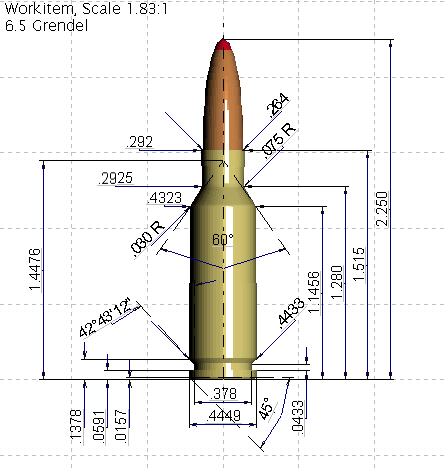

Tiriaq has got it right. No pressure problems.
The SAAMI and NATO pressure measuring systems are different. Think English vs. Metric. Different readings of the same thing.
5.56 and 223Rem are the same pressure. Same for 308 and 7.62. I used to manufacture ammo and had to have it tested at the fed gov't test facitlity at Bells Corners (Ottawa). They are remarkably well equiupped and even had tight target rifle barrels for testing so we could test match rifle ammo in barrels more like what people really used.
I have seen IVI 7.62 ammo test at 63,000 psi in a SAAMI barrel. This si about the same as the max pressure for 308, although in practice, manufactures like to keep pressure down to around 57,000 psi.
The rilfe is typical of many made for Canadian target rifle shooting. It probably has a Maclennan or Smith or Galliard barrel and the chamber will be throated to take the Sierra 80 seated well out.
The 80 Sierra is as good or slightly better, ballistcally as the Sierra 155 in 308. I once won a 1000 yard match with a 223. The only real drawback is getting the target marker to find that small hole on the big long range target.
Try the Sierra 80 on top of 25 gr of Re15, withthe bullet about 15 thou off the rifling.
I have 3 of them and they all group under a half inch at 100 yards. The bad news is that each works best with a different powder.
Jim Dugan of Saskatoon (or Regina?) made a number of #4 conversions with extractor changes like yours. Look for his intials stamped on the rifle.
The SAAMI and NATO pressure measuring systems are different. Think English vs. Metric. Different readings of the same thing.
5.56 and 223Rem are the same pressure. Same for 308 and 7.62. I used to manufacture ammo and had to have it tested at the fed gov't test facitlity at Bells Corners (Ottawa). They are remarkably well equiupped and even had tight target rifle barrels for testing so we could test match rifle ammo in barrels more like what people really used.
I have seen IVI 7.62 ammo test at 63,000 psi in a SAAMI barrel. This si about the same as the max pressure for 308, although in practice, manufactures like to keep pressure down to around 57,000 psi.
The rilfe is typical of many made for Canadian target rifle shooting. It probably has a Maclennan or Smith or Galliard barrel and the chamber will be throated to take the Sierra 80 seated well out.
The 80 Sierra is as good or slightly better, ballistcally as the Sierra 155 in 308. I once won a 1000 yard match with a 223. The only real drawback is getting the target marker to find that small hole on the big long range target.
Try the Sierra 80 on top of 25 gr of Re15, withthe bullet about 15 thou off the rifling.
I have 3 of them and they all group under a half inch at 100 yards. The bad news is that each works best with a different powder.
Jim Dugan of Saskatoon (or Regina?) made a number of #4 conversions with extractor changes like yours. Look for his intials stamped on the rifle.

Just a suggestion if anyone is considering doing one of these conversions (lots of cheap bubba'd No. 4s for donor actions). In a .303, there is a gap between the boltface and the breechface which is occupied by the rim if the rifle is a .303. If the rifle is being converted to a rimless cartridge, there is no reason to leave over 1/16" of cartridge handing out in the open air. When the Australians do the repeater conversions, a ring is added to the boltface, and this closes the gap. When No. 7 rifles were made, the barrel was extended back to reach the boltface. The same can be done if a .223 barrel is being installed. I think that one reason that few conversions like this are being done now is that a quality barrel, properly installed, costs $500 - $600. Most would rather use an action that is going to have greater appeal for resale.
http://www.surplusrifle.com/shooting/no4223/index.asp
I'd love to convert one of my bubbaed enfields to .223 for cheaper plinking.
Yeah, but not at $500-$600...
You could buy a new Savage for a lot less..
Just passing along info to narrow down the search.
I'm now wondering if there are bolt heads for sale in Auzzie land that have already been modified for .223?
Then one would just need a barrel no?
Mind you the 7.62x39 version would be even easier.
I'm now wondering if there are bolt heads for sale in Auzzie land that have already been modified for .223?
Then one would just need a barrel no?
Mind you the 7.62x39 version would be even easier.
Last edited:






















