Packing Dog

Check out the Bernese Mountain Dog. Large dog, can carry a pack easily, great with kids and originating from Switzerland, they're kinda' bred for mountain work. They've got some original Roman Mastiff blood in them, so they can handle guard duties in terms of bears, cats, wolves, etc... If I didn't have a housefull of Labradors, I'd have a pair of these.
 
Hey,

Look at a Leonberger. These are big dogs were originally bred for carrying heavy loads and protecting livestock. They are also great with children!
 
I am not a big fan of non-hunting breeds, but a well bred Akita or the like, or even a lab, would be better suited to the brush then a Bernese with their long hair. Nothing against the Bernese, just depends what you will be doing I guess.
 
I have a berner, my family has had 2 now, absolutely love them. They were bred for pulling carts in the alps. Great dogs and they love the winter.
As for the kids thing, These dogs put up with soooooo much abuse (pulling on ears, pulling on tails, etc) and they dont care at all. Can't say ive met any other breed that is so laid back.

pc250162uv8.jpg

This picture is at 6 months old and around 75-85 pounds.

pc211969pa0.jpg


This is a few months ago. probably 85-90 pounds.
 
I am not a big fan of non-hunting breeds, but a well bred Akita or the like, or even a lab, would be better suited to the brush then a Bernese with their long hair. Nothing against the Bernese, just depends what you will be doing I guess.

He was looking for a good dog to handle the mountains & elevated terrain which is generally more open country & free of heavy underbrush for the most part.

Akitas make for good guard dogs, but they aren't that great around kids and there are better choices for what he's looking for. Labs are great waterdogs, upland game & fantastic companion/family animals, but not the ideal choice for what he's talking about & I love my Labs! I've got four laying at my feet right now!:)

My vote still goes for the Bernese Mt. Dog!:)
 
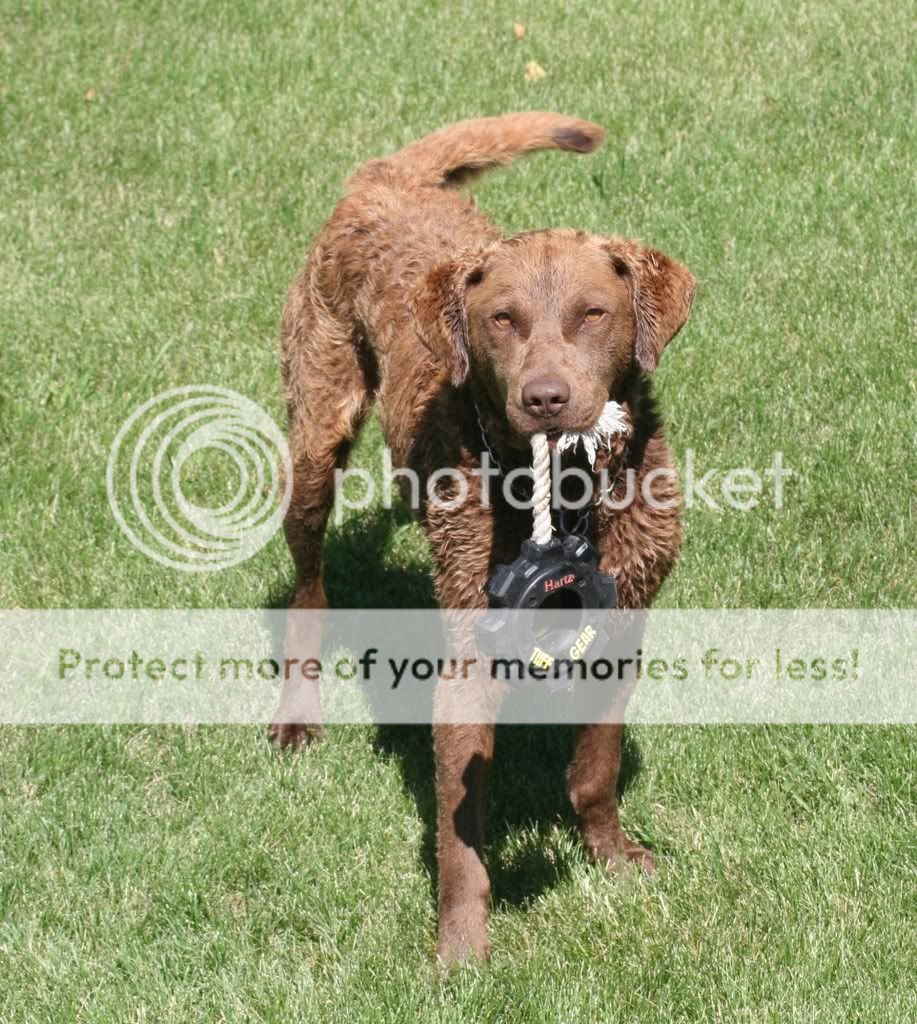
you might try a chesapeek. had them for years. very tough dog, and mine have all been very good with the kids. he pulls a sled with kids on it in the winder with a harness, and on the wagon in the summer.

IMG_1681.jpg


IMG_1674.jpg
 
He was looking for a good dog to handle the mountains & elevated terrain which is generally more open country & free of heavy underbrush for the most part.

Akitas make for good guard dogs, but they aren't that great around kids and there are better choices for what he's looking for. Labs are great waterdogs, upland game & fantastic companion/family animals, but not the ideal choice for what he's talking about & I love my Labs! I've got four laying at my feet right now!:)

My vote still goes for the Bernese Mt. Dog!:)

Akitas make great pack dogs, we have owned many. If you don't think so, ask my father who used them for over 15 years in the Territories and Yukon as pack dogs in sheep country. They are true work horses, tried, tested and true.

Any dog is only as good as its owner/trainer. Bring them up and train them right they are fine around children. Some say certain breeds are better than others around children, with the majority of dogs I don't believe that. I truly believe it is the way they are brought up that makes the difference.

I would love to hear your vast experience using dogs for packing heavy loads in the mountains, always great hearing other experiences.
 
My vote goes to the Bernese as well. I've met up with a few of them walking my dog ( a golden retriever). Their temperment is very similar to a golden (very gentle and even mannered with others, including other dogs.) There advantage is their much larger size and strength. Also, they are great protectors of their pack members (i.e. you and your family).

You will have to put up with the long haired shedding coat, but this won't be the dog who will complain or freeze because it's cold out. Also, big dogs mean walks every day and exercise for you and the dog.

Be careful as to where you buy this dog. Some of them turn out to be litter runts and are much smaller in size.

http://en.wikipedia.org/wiki/Bernese_Mountain_Dog

One last thing. Have you ever owned a dog? All I can say is it's a commitment for the life of the dog. Family dogs are kids that never grow up.
 
I had an Alaskan Malemute for 10 years, big strong dog excellent with family and kids, very strong pack instincts and not scared of anything. I never packed with him but I bet he could have carried me around.

Not so good with cats though. I think his lifetime kill numbers was over 100. He onced cleaned 25 muskrats out of a dugout in a week. 3-4 a night!
 
At one time there was a breeder of Akbash dogs in BC, perhaps on the island. These guys would fill all the requirements you are looking for, if you can afford to feed him (34" at the shoulder 180 lbs). The look is that of a super sized lab. The coat is white and comes in two lengths. The breed is listed under the working dog classification, and was used in Turkey for protecting sheep. They are said to be wonderful and protective family dogs.
 
One last thing. Have you ever owned a dog? All I can say is it's a commitment for the life of the dog. Family dogs are kids that never grow up.

A lot of people I've met (I ran a business taking care of dogs) got an idea in their heads about what kind of dog they wanted, then got it, and realised it wasn't the animal they had pictured in their minds.

In my mind - Fester was on the ball with his comment:


If you go to the SPCA you'll probably find exactly what you're looking for. All of our dogs have been strays, and they've been loving, smart, long lived, and devoted pets as we could hope for. I've knoticed many large Husky-lab crosses at the spca over the years, which combines the strength and coat of a husky with the temperment and work ethic and drive to please of a lab. Plus, crossbreeds are often free of all those defects caused by overbreading in purebreeds. Once again - in all my time looking after dogs, it's almost always the purebreeds that get the problems, and when it's your pet, you'll really appreciate the extra years you get to spend together before you part ways or have to put them down.

To reiterate, before you go out and spend $500-$3000 on a puppy, go to the SPCA, or several of their branches, and ask to take some dogs for a trial walk. You'll be amazed at the number of amazing dogs that are perfect, loving, (already house trained and teethed) and exactly what you're looking for. You've got nothing to lose in trying it.:)
 
A lot of people I've met (I ran a business taking care of dogs) got an idea in their heads about what kind of dog they wanted, then got it, and realised it wasn't the animal they had pictured in their minds.

In my mind - Fester was on the ball with his comment:


If you go to the SPCA you'll probably find exactly what you're looking for. All of our dogs have been strays, and they've been loving, smart, long lived, and devoted pets as we could hope for. I've knoticed many large Husky-lab crosses at the spca over the years, which combines the strength and coat of a husky with the temperment and work ethic and drive to please of a lab. Plus, crossbreeds are often free of all those defects caused by overbreading in purebreeds. Once again - in all my time looking after dogs, it's almost always the purebreeds that get the problems, and when it's your pet, you'll really appreciate the extra years you get to spend together before you part ways or have to put them down.

To reiterate, before you go out and spend $500-$3000 on a puppy, go to the SPCA, or several of their branches, and ask to take some dogs for a trial walk. You'll be amazed at the number of amazing dogs that are perfect, loving, (already house trained and teethed) and exactly what you're looking for. You've got nothing to lose in trying it.:)

Thanks I could not say more
 
Lengthy, but may end your search, I know i am biased

Newfoundland Dog. Tie a red scarf on him so he doesn't get mistaken for a bear.


Some info:


International Kennel clubs generally describe the breed as having a sweet temperament. They have deep barks, are easy to train and are known as guardians, watchdogs and good with children

Some Famous Newfoundlands

Sgt. Gander the Mascot of the Royal Rifles of Canada who was killed in action at the Battle of Hong Kong when he carried a grenade away from wounded soldiers. For this he was awarded the PDSA Dickin Medal retroactively in 2000

Brutus- first dog to complete the Appalachian Mountain Club's "Winter 48"; climbing all 48 peaks in one calendar winter


Although he is a superior water dog, the Newfoundland has been used and is still used in Newfoundland and Labrador as a true working dog, dragging carts, or more often carrying burdens as a packhorse.

The Newfoundland Club of America encourages its members to foster and maintain the working dog abilities that are such an important part of the history of the breed. Local clubs across the country are encouraged to host Draft Tests and training seminars to promote the working heritage of the Newfoundland dog.

The history of the Newfoundland not only reflects the courage and stamina exhibited in rescuing people from the water, but also shows the draft work abilities of the dogs. They were indispensable to local residents of Newfoundland, particularly fishermen, as the dogs helped them haul in the heavy fishing nets. The dogs were then hitched to carts or wagons to take the day’s catch to market and make other deliveries. They were also used to haul loads of firewood from the forests to their owner’s homes.

Draft work showcases a remarkable bond between dog and handler. The dogs learn many commands, such as back, slow left, right, and stop. They have been trained to ignore any intriguing distractions while harnessed and working. Their handlers learn how to verbally direct their dogs around and through numerous obstacles. The results are truly a team effort.

The NCA Draft Test is a series of exercises designed to promote the working heritage of the Newfoundland dog. There are four parts to the Draft Test, all of which are done off-leash:
Basic Control; Harnessing, Hitching & Equipment Check; Maneuvering Course & Basic Commands; Freight Haul

Upon successful completion of all components of the test, dogs are awarded the title of Draft Dog. Teams are also encouraged to enter, and follow the same requirements as a single dog. Qualifying teams are awarded the title of Team Draft Dog.
The Newfoundland is exceptionally well built for water work. He has a water resistant double coat, a strong muscled tail which is used as a rudder, webbed feet, ears that cling close to the head, and a strong swimming style resembling a breast stroke.

Newfoundlands are used to help patrol the beaches in Britain, France, and Italy. During their annual water training demonstration at the Molveno Dog Show, the Italian School of Dog Training showcases circumstances in which Newfs and their handlers jump out of helicopters hovering 15 feet above the water's surface. The French Coast Guard has determined that a well-conditioned Newf can tow an inflatable life raft with 20 people aboard two miles to shore with out being unduly stressed.

The water rescue instincts of the Newf are particularly evident when children or other family members are in the water. The Newf takes his life guarding responsibilities very seriously, quite often circling around and herding his "family" to shore. They have an uncanny ability to sense when someone in the water needs help, whether a family member or stranger, and will immediately swim out to assist. Some dogs circle around the "victim" until they feel the person grab onto them, then head to shore; others will take the person's arm in their mouth and proceed to tow them to safety that way.

The Newfoundland is primarily a dog of the sea. Long ago they were the constant companions of fishermen, and boats would often not leave the shore without a Newfoundland on board. History is full of old tales recording heroic rescues made by these courageous animals. Today, the breed standard stresses that the dog should be "at home in the water and on land." The Newf is exceptionally well built for water work. He has a water resistant double coat, a muscled tail which is used as a rudder, webbed feet, ears that cling close to the head, and a strong swimming style resembling a breast stroke.

There are many conflicting stories as to the origin of the Newfoundland. It is agreed only that he is one of the older breeds of dogs in existence today. He may not have originated in Newfoundland, though skeletons of giant dogs have been discovered in Indian gravesites in Newfoundland dating from the 5th century, AD. One of the more appealing speculations rests on the legend that when Leif Erikson discovered North America about 1000 AD, he had aboard his boat a large black dog resembling a Newfoundland, called
"Oolum." The Vikings "Bear Dogs" remained in Newfoundland and by the 1600's were the Newfoundland dog of today.

This famous breed has a world reputation for hardiness. In its native country it was used for centuries for the roughest work a dog can do- hunting the bear, dragging sledges, carrying packs, while living for long periods on fish. Being strong swimmers, they have a wonderful record for life-saving in the water.
 
Last edited:
Also, You can make a cart for your Berner! (this is what they have done for YEARS in the alps, They would pull carts of milk from the farms to the villages ever day Without any people with them)

XVeylaCart1.JPG
 
the akbash dog is great but so is the kuvas it is used in the mountains to protect shhp great with kids makes a great pac dog but oh my god how will you feed him the are huge i think the akbash and kuvas is related.
 
Back
Top Bottom