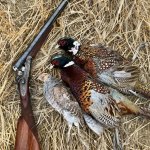
Skeet choked guns for bird hunting

struff55

CGN Ultra frequent flyer
Rating - 99.6%
243   1   0
Location
saskatchewan
Skeet choked guns are designed to throw their patterns at 20-22 yards
Most upland birds flush at 25 to 60 yds not sure how they would perform in those situations
Exception maybe ruffies in heavy cover
Pheasants. Sharptails and huns don’t like to sit very tight even ruffies that have been shot at are wary
There is always a few birds that hold but they are the exception to the rule
 
Woodcock comes to mind even cyl bore with a load of #8 or #9 . Roosters and woodlot Ruffies with pointing dogs and a skeet choke work well down this way as does steel loads for waterfowl .The west has a lot of big open country I think a lot depends on what part of O Canada you live in. I see where Struff is coming from in regards to skeet chokes I find with the sub gauges and light shot weights I am going to tighter chokes mod ,imp mod and full chokes to get a good pattern and some range with 3/4 oz loads . Also western bird country mod and full are not bad choices.
 
Last edited:
Just want to add that unless you actually take the time to pattern your ammunition in your gun with your chosen choke, and at different distances, you really are just guessing what the pattern is going to do.
 
I shoot cylinder for most of my grouse (Ruffed) hunting. Shot size #8 or #9 max yardage about 30. Never any issues. 30 yards is a long shot in the boreal forest cover I hunt. I also hunt with a dog so cripples are a lesser issue. Must admit I have not had many cripples but Ruffies are pretty fragile.
Darryl
 
Skeet will work well for pheasants when using pointers but I still choke tighter than that since there will almost always be a longer shot eventually. I’d never choke skeet for hunting behind flushing dogs since so many can get out in front of the shooters too far.
 
I hunted last fall with a rather unusual old double barrel 16 ga. that was cylinder bore in the right barrel and full in the left. Using an ounce of #6 shot, I took huns, sharptails, and wild pheasants with the cylinder bore barrel. I never kept track of the distances exactly, but they were farther away that I would have assumed that cylinder bore would work well. I don't think an open choke shotgun is as much of a handicap as some believe. But your must be quick to get on the birds. I'm quite quick, so that may be the difference.
 

Attachments

  • IMG_6715.jpg
    IMG_6715.jpg
    168.4 KB · Views: 282
I use a skeet gun for bird hunting here in Ontario, both in the wild and at preserves. I never felt limited in this regard, bear in mind that ammunition has improved over the years, and generally patterns tighter. Of course, a fella can always buy ammo with flight control wads (Federal?) if more distance was needed.
 
First, people over think this because it's fun to over think it.

Second, ruffed grouse and woodcock are fine with VERY open chokes, including cylinder and skeet. Same with most preserve birds.

Third, Huns and sharptails deserve slightly tighter chokes and pheasant tighter still. All three can be shot with more open chokes earlier in the season but benefit from tighter chokes as the season wears on.

And finally, the most important part of the equation is to learn to shoot well. Nothing like having the target in the center of the pattern, no matter what the pattern is like, open or tight.
 
I have a Lc smith sxs choked skeet 1 and skeet 2 I like it for grouse. I do pack a couple of heavier loads if the birds are wild and flush early. Usually 1 oz loads but 1 1/8 if needed to fill the pattern.
 
Yep, ruffs in the bush OC or Skeet is fine. Sharptails I've found IC / Mod good with a 20 gauge, and will use a Mod choke for a semi. They sometimes will flush at 25 yards or more, not giving you much time.
 
I expect everyone who goes after turkeys (which I'm considering taking up) knows that you need a full choke bore for them because head shots are a must. But I'll throw that in anyway.
 
I expect everyone who goes after turkeys (which I'm considering taking up) knows that you need a full choke bore for them because head shots are a must. But I'll throw that in anyway.

I prefer to shoot my turkey the way Bard the Bowman killed the dragon Smaug. Catch them in the soft, unprotected skin right under the wing. So I set up under the roost tree and get 'em on the way down. Choke is meaningless. Laugh2
 
First, people over think this because it's fun to over think it.

Second, ruffed grouse and woodcock are fine with VERY open chokes, including cylinder and skeet. Same with most preserve birds.

Third, Huns and sharptails deserve slightly tighter chokes and pheasant tighter still. All three can be shot with more open chokes earlier in the season but benefit from tighter chokes as the season wears on.

And finally, the most important part of the equation is to learn to shoot well. Nothing like having the target in the center of the pattern, no matter what the pattern is like, open or tight.

This, especially for woodcock i can't have them open enough...I often find myself forcing to wait on the shot to give the bird time to get a little further - pretty easy to completely mangle a woodcock at close range, even with a 28 gauge.

... I also agree that chokes are mostly over thought, with a few exceptions.
 
I hunted last fall with a rather unusual old double barrel 16 ga. that was cylinder bore in the right barrel and full in the left. Using an ounce of #6 shot, I took huns, sharptails, and wild pheasants with the cylinder bore barrel. I never kept track of the distances exactly, but they were farther away that I would have assumed that cylinder bore would work well. I don't think an open choke shotgun is as much of a handicap as some believe. But your must be quick to get on the birds. I'm quite quick, so that may be the difference.

That is a particularly British combination, open choke on the right, tight on the left. Mostly for driven grouse hunting. But works here as well.
 
Back
Top Bottom