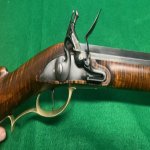
American Longrifle caliber advice

Oh you really stepped in it now ... ;)

When you are finished the gunsmith book, pick up "Recreating the American Longrifle" - pretty much the same with a few differing points - It's cheap and a fun read and good to get a couple different perspectives.

Barrels, Rice is pretty much considered top of the pile for production barrels, I like Colerain and Green Mountain as well, but if you are looking at a swamped barrel I believe Rice & Colerain are the only options. (Chambers kits use Rice barrels BTW)

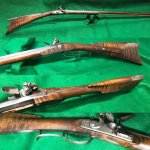
So - if you are looking at a Lancaster (Pennsylvanian-style) rifle, your barrel will probably be swamped and anywhere from 32" - 44" .54 is a good choice, You would not want to carry a .50 44" barrel for very long. .58 would be even better.

If you were to go with a half stock, Hawken style, go with a tapered barrel, .54 at least .58 would be better. (lighter that is)

Locks and hardware, most hardware is pretty much the same supplier to supplier, but they all have different people doing the castings, so quality can vary - Chambers has very nice castings.
Chambers locks. nothing else. (I actually have about 10 of these on hand)

Your plank, Sugar Maple, (good luck!) or a particularly hard piece of Red Maple - other Maple species are too soft. It will be challenging to find a board over 2" thick. Ideally 2 1/2" is what you are looking for.
If you are going for Walnut, shop carefully, again hard to find a board thick enough and newly cut Walnut just does not seem to have the density of a 200 year old piece .... (oh well)
Other options are Cherry, Birch and Ash - Curly Black Ash can look pretty remarkable.

As far as building, yea, barrel channel and ram rod channels are the no-guts-AND-no-glory jobs, but you can get 90% of them done with a router in a little over an hour. (unless you don't know what a climb cut is .... then you are in for it!)

The challenging moment is drilling the ram rod hole. (you need a 4' drill!)

So yea - the payoff really is looking at your hands thinking "I made that with these" ... let us know if you need any pointers and HAVE FUN!
Is sugar maple that hard to find elsewhere seem to the everywhere down here. i don’t know about the Oshawa area(think their is a supplier up that way) but down in Essex county everyone and their grandma is milling lumber.

Lots of woods can be used stock thickness would have to very because some are better then others but some of the other woods are things like cherry,mulberry ect want to stay away from oak as it has acids in the wood.
 
Is sugar maple that hard to find elsewhere seem to the everywhere down here. i don’t know about the Oshawa area(think their is a supplier up that way) but down in Essex county everyone and their grandma is milling lumber.

YES! it is incredibly hard to find - people would much rather milk them for sap for 200-300 years ... seems to be more lucrative than cutting them down.
I have about 3-4 places I can get dried planks within an hour of me and another 3-4 2-3 hours away, only once have I ever gotten a piece of curly Sugar Maple 3" thick - that was from Exotic Woods in Brampton.

Also, Maples are getting harder to find in the States - climate change and all, they do better up here. but that is changing too.

Lots of woods can be used stock thickness would have to very because some are better then others but some of the other woods are things like cherry,mulberry ect want to stay away from oak as it has acids in the wood.

My hands turn bright purple after working Walnut for more than an hour ... very acidic.
 
YES! it is incredibly hard to find - people would much rather milk them for sap for 200-300 years ... seems to be more lucrative than cutting them down.
I have about 3-4 places I can get dried planks within an hour of me and another 3-4 2-3 hours away, only once have I ever gotten a piece of curly Sugar Maple 3" thick - that was from Exotic Woods in Brampton.

Also, Maples are getting harder to find in the States - climate change and all, they do better up here. but that is changing too.


My hands turn bright purple after working Walnut for more than an hour ... very acidic.

Essex county has plenty of maples both red and sugar along with anywhere else in the Carolinian forest area. Wish people would stop building in wood lots we barely have anything here anymore.
 
Oh you really stepped in it now ... ;)

When you are finished the gunsmith book, pick up "Recreating the American Longrifle" - pretty much the same with a few differing points - It's cheap and a fun read and good to get a couple different perspectives.

Barrels, Rice is pretty much considered top of the pile for production barrels, I like Colerain and Green Mountain as well, but if you are looking at a swamped barrel I believe Rice & Colerain are the only options. (Chambers kits use Rice barrels BTW)

So - if you are looking at a Lancaster (Pennsylvanian-style) rifle, your barrel will probably be swamped and anywhere from 32" - 44" .54 is a good choice, You would not want to carry a .50 44" barrel for very long. .58 would be even better.

If you were to go with a half stock, Hawken style, go with a tapered barrel, .54 at least .58 would be better. (lighter that is)

Locks and hardware, most hardware is pretty much the same supplier to supplier, but they all have different people doing the castings, so quality can vary - Chambers has very nice castings.
Chambers locks. nothing else. (I actually have about 10 of these on hand)

Your plank, Sugar Maple, (good luck!) or a particularly hard piece of Red Maple - other Maple species are too soft. It will be challenging to find a board over 2" thick. Ideally 2 1/2" is what you are looking for.
If you are going for Walnut, shop carefully, again hard to find a board thick enough and newly cut Walnut just does not seem to have the density of a 200 year old piece .... (oh well)
Other options are Cherry, Birch and Ash - Curly Black Ash can look pretty remarkable.

As far as building, yea, barrel channel and ram rod channels are the no-guts-AND-no-glory jobs, but you can get 90% of them done with a router in a little over an hour. (unless you don't know what a climb cut is .... then you are in for it!)

The challenging moment is drilling the ram rod hole. (you need a 4' drill!)

So yea - the payoff really is looking at your hands thinking "I made that with these" ... let us know if you need any pointers and HAVE FUN!
Is that the book by William Buschelle you are referring to??. If so, it is OK IMO but I found Alexanders book to be better. As someone that likes flash, I ALWAYS bought the best Curley maple I could find. HOWEVER, wood with curl is difficult to work whether it be inletting or carving so I would recommend a blank more on the "plain" side of the figure scale as a first time project. The harder the wood, the easier it is to work with, the more figure, the more of a PITA it is to work with.
 
YES! it is incredibly hard to find - people would much rather milk them for sap for 200-300 years ... seems to be more lucrative than cutting them down.
I have about 3-4 places I can get dried planks within an hour of me and another 3-4 2-3 hours away, only once have I ever gotten a piece of curly Sugar Maple 3" thick - that was from Exotic Woods in Brampton.

Also, Maples are getting harder to find in the States - climate change and all, they do better up here. but that is changing too.


My hands turn bright purple after working Walnut for more than an hour ... very acidic.
Only time one would require a 3" blank is for a sxs flint. 2 1/2" is plenty for a rifle or single barrel smoothbore (and maybe even a small bore sxs with recessed breeches).
 
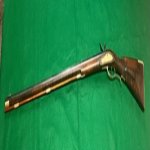
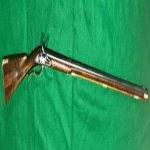
Going back to the original question of caliber, I think 58 cal is as big as we need for anything in North America. One of my favourite rifle is a 58 cal Kibler Colonial I built last year. In our black powder club most guys hunt with 50 cal but several have 54 and none of them complain about nock down power. I have built from scratch as well as from Kibler and Jim Chambers kits and have enjoyed all of them. I think the Kiblers are the best quality and easiest of all of them to build however. This is a pic of my 45 cal Kibler SMR and it is great fun to shoot and probably the smallest caliber for deer.
A56B2113-C64F-45C7-B4B5-BF06C2B71415.jpg
35BB9FDB-8355-4E78-AF17-C1FC18DFE3A5.jpg
This is the 58 ColonialD23DB3D9-2B07-474D-9A79-834026044048.jpegB0125404-6051-46CC-91F2-879D67D726C1.jpeg56B7397F-65F3-4B1D-BC68-FC3E19D27BB0.jpeg
 

Attachments

  • A56B2113-C64F-45C7-B4B5-BF06C2B71415.jpg
    A56B2113-C64F-45C7-B4B5-BF06C2B71415.jpg
    71.4 KB · Views: 53
  • 35BB9FDB-8355-4E78-AF17-C1FC18DFE3A5.jpg
    35BB9FDB-8355-4E78-AF17-C1FC18DFE3A5.jpg
    99.3 KB · Views: 54
  • D23DB3D9-2B07-474D-9A79-834026044048.jpeg
    D23DB3D9-2B07-474D-9A79-834026044048.jpeg
    34.5 KB · Views: 53
  • B0125404-6051-46CC-91F2-879D67D726C1.jpeg
    B0125404-6051-46CC-91F2-879D67D726C1.jpeg
    45.8 KB · Views: 52
  • 56B7397F-65F3-4B1D-BC68-FC3E19D27BB0.jpeg
    56B7397F-65F3-4B1D-BC68-FC3E19D27BB0.jpeg
    97.6 KB · Views: 51
I know that this information may be "secret squirrel", but I was wondering if I could maybe get the names of some mills in Ontario to check out to supply curly or plain maple for our purposes?

I'll be sure to check out that other book too, and I'll keep the .58 in mind for a potential future project.

Rwnblack, those rifles look amazing. Very nice rifles
 
Folks purchasing their maple planks from a mill should keep in mind the time to air dry is generally considered to be one year per inch. I consider that to be the absolute minimum.
 
Only time one would require a 3" blank is for a sxs flint. 2 1/2" is plenty for a rifle or single barrel smoothbore (and maybe even a small bore sxs with recessed breeches).

well.... not so much, 1 7/8" butt plate plus cheek piece is cutting 2.5" rough plank real close, problem is no one really cuts to odd sizes (unless you buy the tree) a dressed board will be 2" never seen anything that was not advertised as "live edge" over 2" dressed (which we don't need) 2" rough cut will be around 2.25"
My guess is that anything you see over 2" is the mill trying to hog off material to get to the good stuff. 2.5+ is out there, it's just real hard to find cuz the demand is not there.


I know that this information may be "secret squirrel", but I was wondering if I could maybe get the names of some mills in Ontario to check out to supply curly or plain maple for our purposes?

I'll be sure to check out that other book too, and I'll keep the .58 in mind for a potential future project.

Rwnblack, those rifles look amazing. Very nice rifles

no secrets, there are 3 or 4 in/around Burlington, Exotic Woods is the only one I can think of ATM - google the rest. Woodchuckers (.com) Steeles and Morningside, Century Mill in Stoufille. Peacock in Oshawa - sells rough stuff, you won't find anything with figure, but looks like they have been bringing in some live edge stuff. Northdog is also in Oshawa, but they specialize in huge chunks of live edge.

My goto is Woodchuckers - they have a second unit/storage and lots of stuff not on the floor - talk to the guys if you don't see what you are looking for.
They also get a lot of silver, spalted and ambrosia maple - nice looking stuff, too soft for a gun. stay away from that stuff.

The other book is like a coles notes for the gunsmith book, more to the point, less fluff.
 
Just came across this post and couldn't help adding my opinion. Some I agree with and some I don't. If you build from a plank forget the saw mill wood unless you are willing to wait several years for it to properly dry. Buy from someone who knows gunstock wood. A Chambers kit will take about 40 hrs. to assemble. Kibler's SMR will require several days, the Colonial about one day and the Woodsrunner 2 or 3 hrs. [ plus time required for the finish. ]

Alexander's book has some interesting historical theories and some helpful hints. Most builders do not follow his methods. Totally agree with B_noser, Buchele's is the best.


[ stain
 
Alexander's book has some interesting historical theories and some helpful hints. Most builders do not follow his methods. Totally agree with B_noser, Buchele's is the best.
I have always marched to the beat of a different trumpet player myself. For example, most of the high end makers that I know stab in the outline of their relief carving, I chase it with a V parting tool. Many of the high end makers I know cut the outline of their inlays with an exacto knife, I stab it in. I bought Buchele's book in the 80's when I started cobbling flintlocks together and use some of what I gleaned from it. I then came across Alexanders book inn the early 2000's and found it to be more user friendly. I don't recall which things specifically but there was a couple methods in PA's book that I liked, some I don't. I know that Buchele's book is more popular amongst the makers that have been around awhile but, I also know that Peter is not a popular guy among the experienced makers and I think this dislike spills over into his book. When I built my sxs flint I bought Brockways book. I took Brockways method of breeching a set of suppository barrels and changed it up to suit me. I then did a tutorial on breeching barrels for a double flint and posted it on ALR (it has since been lost in the transition to the next forum format) and Bill Brockway commented that he preferred the method I had used to his own in his book. The point is, IMO, NO book is the "bible" when it comes to gunstocking. They are all just references and, again, IMO should be learned from but do NOT have to be followed verbatim. In fact, when I bought my copy of PA's book I took it and showed it to Taylor Sapergia. At that time, Taylor was an accomplished gunmaker with many many guns under his belt and he was fascinated by the book and bought one right away. For those unaware, Taylor is a VERY fine maker, one of, if not THE best in Canada and one of the very few that I know of in Canada that has build a gun "from scratch" (A lovely wheel-lock pistol). At any rate, for the price of these books and what you get, my suggestion is to buy all that are available, even if you have been doing this for awhile. All you need is to glean one tidbit that helps to be worth the price of admission.
 
I have always marched to the beat of a different trumpet player myself. For example, most of the high end makers that I know stab in the outline of their relief carving, I chase it with a V parting tool. Many of the high end makers I know cut the outline of their inlays with an exacto knife, I stab it in.

When I was building model airplanes and such I started using scalpel blades. sharper - longer - better geometry and way cheaper. just a pointer ;)
I use a bit of all 3, but mostly outlines for both carving and inlays (as well as inlets) start with a chip carving knife. not a lot of stabbing and never really got the hang of using a V tool for carving outlines.

I bought Buchele's book in the 80's when I started cobbling flintlocks together and use some of what I gleaned from it. I then came across Alexanders book inn the early 2000's and found it to be more user friendly. I don't recall which things specifically but there was a couple methods in PA's book that I liked, some I don't. I know that Buchele's book is more popular amongst the makers that have been around awhile but, I also know that Peter is not a popular guy among the experienced makers and I think this dislike spills over into his book.

Whenever anyone asks I usually recommend buying both and doing what suits you best ... yes I know what you mean about Alexander's book. He does have some very strong opinions about how things should be done. ;) I've spoken with Alexander (on the phone) once, maybe twice. Nice guy, very straight to the point without mucking about!
 
When I was building model airplanes and such I started using scalpel blades. sharper - longer - better geometry and way cheaper. just a pointer ;)
I use a bit of all 3, but mostly outlines for both carving and inlays (as well as inlets) start with a chip carving knife. not a lot of stabbing and never really got the hang of using a V tool for carving outlines.


Whenever anyone asks I usually recommend buying both and doing what suits you best ... yes I know what you mean about Alexander's book. He does have some very strong opinions about how things should be done. ;) I've spoken with Alexander (on the phone) once, maybe twice. Nice guy, very straight to the point without mucking about!
I think this is why he is not liked so much among upper class builders. He had a table at Dixons gunmakers fair and I talked with him briefly. Seemed like a nice Chap but is VERY confident in his abilities/methiods which can come across as arrogant and rub some the wrong way. IMO, the most important aspect of stocking a flintlock is getting the architecture correct. How one goes about achieving that is a personal thing and there IS no wrong way IMO. When William Buchele released his book, there was really nowhere for us that live outside the eastern USA to really observe and learn from the originals. Therefore, any chance of getting the architecture correct without a book like his was pretty much nil. Today, there are several books and videos out there to teach proper architecture and, more importantly, quality kits made by the likes of Chambers and Kibler that one can buy that has the architecture baked right in. I never really knew how much we (Canadians) were missing until I went to Dixons and got to view/handle dozens of originals of many schools. Taylor and I were like kids in a candy shop. We went to one collectors house that had a collection of 20 or 30 spectacular originals from many schools and when he would bring one out for us to inspect, out faces would light up like Christmas morning. We got to handle them and discuss between us various features and observations. the owner of the collection (who USUALLY does not show this guns) was delighted to see the excitement on our faces with each gun he produced. It was QUITE the experience. Anyways, I digress. point is that there IS proper style/architecture to these guns (if one is inclined to be historically correct) but there is no absolute "correct" way to achieve it. In fact, I was perusing ALR looking for something the other day and came across this thread that I had started and thought Tom Curran's comment in post #5 pretty much summed up my position. https://americanlongrifles.org/forum/index.php?topic=47.0
 
Back
Top Bottom