Refinishing Winchester model 12

Prairieoyster

New member
Rating - 100%
2   0   0
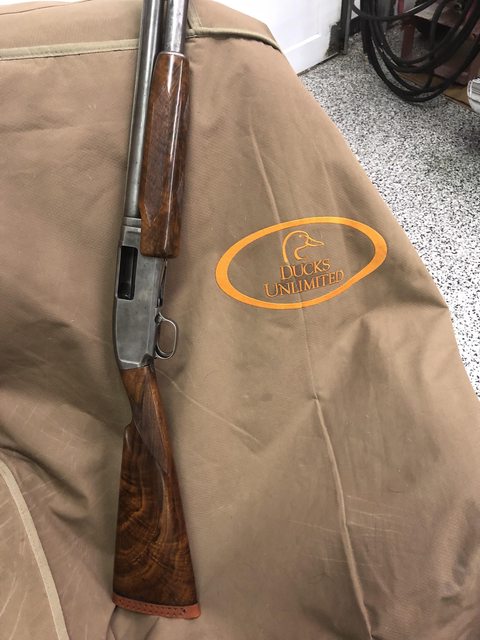
I inherited some fine guns when my father passed a few years ago, one of which is a 1913 model 12. After stripping it down, cleaning and lubing properly, it's been running like new. Bluing is generally all faded for the most part, stock is in good condition, a few minor dings and scratches. I've toyed with the idea of refinishing it completely. Half of me likes it in all it's historical glory, and the discussion it inevitably brings up at the trap range. The other half wouldn't mind seeing it all prettied up. Is there any good reason not to refinish it?
 
I agree with FF .Just picked up a model 12 trap 1940 ( thanks Don )with the idea of restoring it but the patina is nice and with the English stock it is perfect the way it is. Might update the stock to a newer version of the English as the original has been pinned but that would be it.
 
Ya, I think I would regret refinishing this one in particular. My dad took good care of it, it's used but not abused. And a ton of history with it in it's current state. As suggested, I might look to pick up another one to pretty up and keep this one as is. It's always amazing to me the way these things were built and how well they age mechanically.
 
Ya, I think I would regret refinishing this one in particular. My dad took good care of it, it's used but not abused. And a ton of history with it in it's current state. As suggested, I might look to pick up another one to pretty up and keep this one as is. It's always amazing to me the way these things were built and how well they age mechanically.

I agree completely. A model 12 in any kind of reasonable condition is among the smoothest cycling pumps ever made. And, even though they are a take-down design, they remain tight and rock-solid for centuries.

On the subject of whether or not to refinish heritage firearms, I confess to being conflicted. The British tradition has been for the master of the house to return his guns to the original maker or a qualified local gun maker to be cleaned, refurbished and refinished as necessary. For this reason, vintage examples of fine English guns can be found in good to excellent condition.

The American experience was a very different one. The average American gun owner was not the lord of any manor. Rather, he was a farmer, a rancher, or subsistence hunter. There were no local makers or even gun smiths, in most cases. The guns themselves, while they could be rugged and serviceable, did not receive a great deal of effort in embellishments and aesthetic finishes. These guns were expected to function for decades with minimal servicing or repairs. They were rarely, if ever, returned to the manufacturer.

These differences resulted in the current state where British guns are refinished routinely and buyers of used pieces expect them to be in excellent condition. Collectors of vintage American guns have been conditioned to look for examples that are in good condition, despite never having been refinished.

Add to this the pressure to honour one's ancestors by preserving their legacy - which translates for some people into "not erasing their mark on life". I don't see any of these traditions as absolute. I have in my collection a Savage model 1904 .22cal rifle that belonged to my Great Grandfather. At one point, I considered refinishing it. But I decided it wouldn't benefit much from such a refinish and that I probably will never fire the gun anyway. I also have a 16 ga 1897 that belonged to my Grandfather. This gun (like your model 12) is in great mechanical condition, but displays the nicks, scrapes, and stains of over 100 years of use. I see this gun as a different scenario. I inherited it when I was still quite young and used it regularly for decades. The 1897 could easily continue to serve in regular use for centuries to come.

So, while I chose to honour Great Granddad by keeping his .22, unmolested, as a memorial, I chose to honour my Granddad by keeping his 16 ga in the field, hopefully for generations to come. This is a shot of the 16 ga. after the refinish:

IMG_0062.jpg

I also refinished a friend's 16 ga Model 12 last winter (this gun never belonged to any of his relatives).

IMG_0135.jpg
 

Attachments

  • IMG_0062.jpg
    IMG_0062.jpg
    112.3 KB · Views: 331
  • IMG_0135.jpg
    IMG_0135.jpg
    103.1 KB · Views: 334
I agree completely. A model 12 in any kind of reasonable condition is among the smoothest cycling pumps ever made. And, even though they are a take-down design, they remain tight and rock-solid for centuries.

On the subject of whether or not to refinish heritage firearms, I confess to being conflicted. The British tradition has been for the master of the house to return his guns to the original maker or a qualified local gun maker to be cleaned, refurbished and refinished as necessary. For this reason, vintage examples of fine English guns can be found in good to excellent condition.

The American experience was a very different one. The average American gun owner was not the lord of any manor. Rather, he was a farmer, a rancher, or subsistence hunter. There were no local makers or even gun smiths, in most cases. The guns themselves, while they could be rugged and serviceable, did not receive a great deal of effort in embellishments and aesthetic finishes. These guns were expected to function for decades with minimal servicing or repairs. They were rarely, if ever, returned to the manufacturer.

These differences resulted in the current state where British guns are refinished routinely and buyers of used pieces expect them to be in excellent condition. Collectors of vintage American guns have been conditioned to look for examples that are in good condition, despite never having been refinished.

Add to this the pressure to honour one's ancestors by preserving their legacy - which translates for some people into "not erasing their mark on life". I don't see any of these traditions as absolute. I have in my collection a Savage model 1904 .22cal rifle that belonged to my Great Grandfather. At one point, I considered refinishing it. But I decided it wouldn't benefit much from such a refinish and that I probably will never fire the gun anyway. I also have a 16 ga 1897 that belonged to my Grandfather. This gun (like your model 12) is in great mechanical condition, but displays the nicks, scrapes, and stains of over 100 years of use. I see this gun as a different scenario. I inherited it when I was still quite young and used it regularly for decades. The 1897 could easily continue to serve in regular use for centuries to come.

So, while I chose to honour Great Granddad by keeping his .22, unmolested, as a memorial, I chose to honour my Granddad by keeping his 16 ga in the field, hopefully for generations to come. This is a shot of the 16 ga. after the refinish:

View attachment 702434

I also refinished a friend's 16 ga Model 12 last winter (this gun never belonged to any of his relatives).

View attachment 702440

Thank you for the response, really appreciate your thoughts on the subject. This gun definitely falls into the latter category. I remember sitting down to duck or grouse dinner many times thanks to my dad and this gun!
 
Model 12 shotguns never look right after a re blue. Your gun will be Nickle steel and it is even harder to get the right look. My vote is for leaving it as is. I wish was able to get my dad's model 12 but he sold it when he and mom needed money and he never mentioned it to me. They are both gone now. I have the serial# and remember the gun well. Maybe someday I can find it.
Darryl
 
Model 12 shotguns never look right after a re blue. Your gun will be Nickle steel and it is even harder to get the right look. My vote is for leaving it as is. I wish was able to get my dad's model 12 but he sold it when he and mom needed money and he never mentioned it to me. They are both gone now. I have the serial# and remember the gun well. Maybe someday I can find it.
Darryl

Pretty much made up my mind to leave as is. I've read and looked at a lot of pictures lately and I tend to agree, I don't think new bluing would look right on this gun.

I still can't get over how well it operates mechanically. Testament to old school quality.
 
I appreciate old, worn blueing on guns akin to toning on old silver coins. Can’t replicate that without decades of handling.
 
kClWANPl.jpg
XIGqgKvl.jpg
tFVtZi8l.jpg
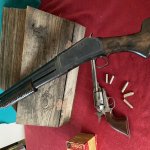
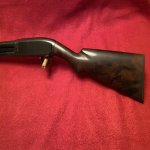
found a NOS stock for my old model 12 TRAP .Gentlemen took it off and stored it as he did not like the english style which is what mine also had, he had a custom one made then sold the gun looks pretty good :)
 
Last edited:
I'm of the two opinions as well. A little bluing loss or fading looks fine on a firearm to show that it has been experienced and loved, especially an heirloom. But when the bluing is almost completely gone, regardless of its heritage, it doesn't look good to my eyes. I would consider the restoration if all else is sound, and you could find someone who could get the specific Model 12 bluing right. You've now breathed new life into that shotgun for another 100 hundred years and returned it to a thing of beauty.

 
kClWANPl.jpg
XIGqgKvl.jpg
tFVtZi8l.jpg
found a NOS stock for my old model 12 TRAP .Gentlemen took it off and stored it as he did not like the english style which is what mine also had, he had a custom one made then sold the gun looks pretty good :)
Nice looking model 12 it is one of the smoothest I have ever owned and I have have had some gems over the past 50 years
 
As mentioned previously refinished incorrectly makes a model 12 look awful .
Over buffed pulled littering wrong texture
Also nickel steel guns will come out purple if done incorrectly when bluing nickel steel needs the bluing salts heated to a higher temature
The best method would be rusted blued
Basically as mentioned a nice patina is a much better way to go
 
Back
Top Bottom