Pistol and Revolver Accuracy

Its all pretty relative, gun, calibre, shooters skill. I have a 1911 22 pistol I can do 2 hand grip 1/2" groups at 25 yds, a 1911 45 acp pistol can do 1" groups and a .44 mag revolver I can get them in at 2". But it has taken me years to get that good and guns are sighted in properly and in excellent cond. Always learn to shoot a hand gun with "both eyes open technique" as well.
 
I am a guy who spent thousands of hours training on shooting a da/sa pistol for competition. My comp gun has a 9.5lbs da pull and a 2lbs single action. In a match I don't even notice the difference between pulls.


What do you want out of shooting pistols? To hit paper on the weekend or to be an ipsc winner?
 
Every trigger has its own personality, so you have to get to know each of your guns to have an idea of how much or little to take up and then how they break and reset. There's a lot of overlap between the nicest DA triggers and the crappiest SA ones. So it doesn't work to simply think of SA in one bucket and DA in the other.

Then the different match disciplines vary in whether you're carefully aiming each shot for precision or hammering targets fast and hoping to stay within a generous zone. Which gun to bring varies accordingly! And then what you like to do when you're plinking on your own time can be another thing entirely.
 
I eventually would like to try competing .
Leavenworth
I am a guy who spent thousands of hours training on shooting a da/sa pistol for competition. My comp gun has a 9.5lbs da pull and a 2lbs single action. In a match I don't even notice the difference between pulls.


What do you want out of shooting pistols? To hit paper on the weekend or to be an ipsc winner?
 
As far as targets go, most of them are too big. Take any target - I like paper plates because I'm cheap, and get a package of small Post-It notes, the ones that are too small to write a note on. Put one Post-It in the middle of the target, shoot the Post-It. The old expression "Aim small, Miss small" is very accurate.
 
As far as targets go, most of them are too big. Take any target - I like paper plates because I'm cheap, and get a package of small Post-It notes, the ones that are too small to write a note on. Put one Post-It in the middle of the target, shoot the Post-It. The old expression "Aim small, Miss small" is very accurate.

Pretty much what I’ve switched to as well for pistol shooting, except I use a square piece of red duct tape with the point down as a bullseye. I go so far as to use small white square labels to cover holes and reuse them till they get too shot up lol.
 
Start close 5m at the most.
Dry fire practice
Consider a red dot if the FA is capable and you have the budget.
Use open sights if you plan to use it for IPSC style shooting.
If you’re using open sights, a good mod is night sights. I find it really helps my old eyes in low light days.
I find shooting can be like golf. There are some days when maybe you shouldn’t have left the driveway.
Have fun!!!
 
" the individuals talk about the pistol or revolvers accuracy and how it’s bang on with out any modifications."

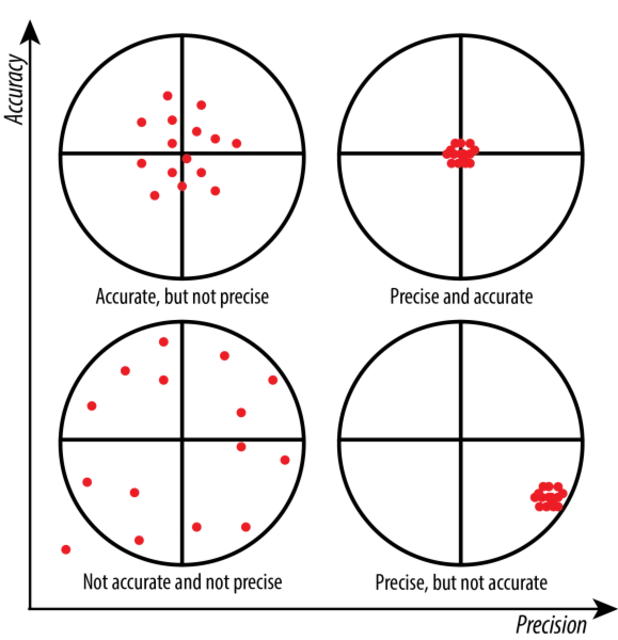
The word "accuracy" has two common meanings.

1) Does it group tightly?

2) Does it hit where you aim?

Most of us are concerned about tight groups - which is a function of the gun and our ability (mostly the latter). We usually don't fret about where it is hitting, because the sights can be adjusted to put the group where we want.
When a writer comments about a handgun hitting where it is aimed, he is probably referring to a gun without adjustable sights. Many handguns have no adjustment or azimuth only.

My Derringer, for example, has one barrel that hits where I aim and the other hits 18" high at 7 yards. No adjustments available.

On non-adjustable handguns, it is important that the factory build them right - hence the comment.

https://wp.stolaf.edu/it/gis-precision-accuracy/
 

I like it, lol. I posted it directly to the board for you so others wouldn't have to click the link.

"dPracticing GIS demands a nuanced understanding of the important differences between precision and accuracy. Precision is how close measure values are to each other, basically how many decimal places are at the end of a given measurement. Precision does matter. Accuracy is how close a measure value is to the true value. Accuracy matters too, but it’s best when measurements are both precise and accurate.

Failure to understand the tension between precision and accuracy can have profound negative effects on how one processes data, and the final outcome of geospatial analysis."


precsionvsaccuracy-crashcourse.webp
 
I like it, lol. I posted it directly to the board for you so others wouldn't have to click the link.

"dPracticing GIS demands a nuanced understanding of the important differences between precision and accuracy. Precision is how close measure values are to each other, basically how many decimal places are at the end of a given measurement. Precision does matter. Accuracy is how close a measure value is to the true value. Accuracy matters too, but it’s best when measurements are both precise and accurate.

Failure to understand the tension between precision and accuracy can have profound negative effects on how one processes data, and the final outcome of geospatial analysis."


precsionvsaccuracy-crashcourse.webp

I brought a buddy of mine to our project in Russia to give a course on gold assay QAQC.

Barry was the pre eminent geochemist on QAQC in the world at that time.

So he's up there running through the presentation and through our translators is explaining the difference between accuracy and precision and he us getting a lot of blank stares from our Russian staff.

So he tries a couple of different ways to explain it and still, nothing.

We talk to the translators and found out that the Russian translation fir accuracy and precision was the same word......

So he added a diagram like above to his presentation.
 
Dan , I’m not sure yet . I need to look at the different shooting disciplines and what would appeal to me . Maybe I can get an idea from the Forum .
Leavenworth

Do you want speed shooting, do you want super slow bullets where you want most precsion, or mix of both?

PPC will teach you bit more than IPSC when it comes to accuracy. Its static shooting, but will shoot standing, kneeling, sitting, prone. From 3-50 meters. It's much more slower firing, at 50 meters, you might have 90 seconds to fire 12 rds. But might do some 3m snap shooting where you fire 2 rds in 3 seconds. You dont need much gear, 2 mags, and basic holster as it's more just to carry the gun. It's good for all skill as you shoot from the 45. You dont need a course to partake.
 
Steel Challenge is the other way round. You have about three to five seconds to fire five rounds at different steel plates. There is one stage called "Smoke and Hope" which I refer to as " Shoot like a crazy person".
 
Depends on the handgun, ammunition, etc. If you're shooting bullseye, you'll be looking a pistol capable of repeat sub moa within 25 yds. IPSC a fist sized group at the distance you shoot is fine, same with cowboy. Silhouette you'll want moa out to 200. In general, the weak link is going to be the shooter. Hunting will be similar to silhouette. So, it depends. - dan

WTF, people expect MOA at 200 (Like, 2" groups) from PISTOLS??

For real?
 
set up a 5" pie plate at 15y and put 10 rounds into it, then move back 5 yards, repeat.

Silhouette is usually a single shot pistol in a rifle caliber eg. .221 fireball or .308 ; I will open the can of worms by saying .32 .38 and all rimmed pistol calibers are more accurate then rimless like 9mm .45 and .40. What do they use in the Olympics? what does PPC or bullseye gallery Course 600 or 1200?


 
Back
Top Bottom