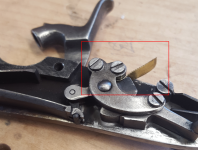
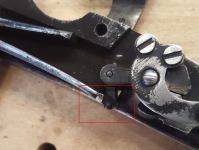
Adjusting mainspring and stirrup on percussion lock....

sean69

CGN frequent flyer
Rating - 100%
95   0   0
Location
Oshawa
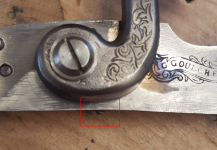
Seen this with nearly every R.E. Davis Goulcher lock I've installed - never thought much about it. The mainspring and stirrup hang down below the lock plate when the lock is not caulked (HA!) preventing the lock from being removed and of course smashing into the side of the lock mortise when fired.

Has anyone used any clever methods to resolve this?

- I can solder a shim to one of the screw lugs on the bridle.
- I've seen TC locks (I think TC) with an adjustment screw in the tumbler
- I've seen either the shoulder on the hammer or the top of the lock plate shimmed as well.

This hammer does not have a shoulder, so shimming that or the lock plate is a non-starter, nor am I willing to put a screw in the tumbler - that actually makes no sense.

I did also send an email (to this effect) to R.E. Davis .... just thought I'd see what other solutions are out there.
 

Attachments

  • Screenshot_1.png
    Screenshot_1.png
    863.3 KB · Views: 6
  • Screenshot_2.png
    Screenshot_2.png
    742.2 KB · Views: 5
  • Screenshot_3.png
    Screenshot_3.png
    782.3 KB · Views: 5
When the hammer is on the nipple are the spring and stirrup contacting the inlet? If not, no problem.
When the lock is on half #### do the spring and stirrup descend below the edge of the lockplate? If not, remove the lock at half ####.
 
I commented on it on Facebook, but I will here too. If you line it up right it shouldn’t hang below the edge of the lock plate when the locks in the gun and the hammers down on the nipple. It will mean that you’ll have to half #### the lock to take it out of the stock. I have owned antiques with this same thing.
 
It is not unusual to see antique guns which show gnawing of the inlet where the lock has been installed or removed with the hammer all the way down.
 
I commented on it on Facebook, but I will here too. If you line it up right it shouldn’t hang below the edge of the lock plate when the locks in the gun and the hammers down on the nipple. It will mean that you’ll have to half #### the lock to take it out of the stock. I have owned antiques with this same thing.
You have to set the hammer to half #### anyway because you can't remove the lock if the hammer is resting on the nipple!
The stirrup and mainspring would only hang down past the lock plate when fully at rest - i.e. when not installed other wise it would have to be a miracle installation where the hammer contacts the nipple at the exact limit of it's travel! (then it would be an actual problem)

When the hammer is on the nipple are the spring and stirrup contacting the inlet? If not, no problem.
When the lock is on half #### do the spring and stirrup descend below the edge of the lockplate? If not, remove the lock at half ####.
Like I said - done that, didn't care, my gun etc..... what I neglected to mention this is a commission and the problems arise when they see that tiny little gap or tear a chunk out of the lock molding trying to remove the lock....

I just want to see if anyone has any clever ideas better than mine before I solder a shim to the bridle.
 
A mechanical fix to the lock would involve altering the stop area of the bridle, of the tumbler, or both. The tumbler alteration could involve building up the area with weld, reshaping, re-heat treating. A piece could be silver brazed to the bridle. Or, the bridle or tumbler could be replaced. Could a shorter stirrup be made? This might be the easiest.
 
I think you are on the right track, but don't understand how the owner is tearing out chunks of wood if removing the lock while on half c ock. I would temporarily place a shim of the required thickness and, with the lock in the gun, make sure the hammer is making good contact with the nipple. Given good contact - permanently attach the shim. I have worked on numerous antiques that had excavations cut into the lower edge of the mortise to provide clearance for an overhanging tumbler/stirrup/spring. As would be expected, some of those also had chipped inlets due to failure to properly remove the lock.
 
A mechanical fix to the lock would involve altering the stop area of the bridle, of the tumbler, or both. The tumbler alteration could involve building up the area with weld, reshaping, re-heat treating. A piece could be silver brazed to the bridle. Or, the bridle or tumbler could be replaced. Could a shorter stirrup be made? This might be the easiest.

Making a new stirrup is crazy talk ... I think you might be slipping ;) It could be done, but is far more work that 15-20 minutes to fit and solder a shim to the bridle where the tumbler bears on it. (the stirrup does need work anyway as it scrapes against the lock plate)



Not seeing any new ideas here or on the facebook groups ... (mostly "it's not broke - don't fix it")

Other than shimming the tumbler and/or bridle, replacing the stirrup I guess other options are:

Modify the lock plate, filling and relocating the bridle screw holes to rotate it slightly - way too much work. Better to make a whole new lock plate.
Alter the arm on the tumbler that holds the stirrup - also too much work

Replace the tumbler altogether - actually a very good idea as it gives the opportunity to tune the full & half #### notches so that the sear bar's position does not change in full & half #### positions
 
I think you are on the right track, but don't understand how the owner is tearing out chunks of wood if removing the lock while on half c ock. I would temporarily place a shim of the required thickness and, with the lock in the gun, make sure the hammer is making good contact with the nipple. Given good contact - permanently attach the shim. I have worked on numerous antiques that had excavations cut into the lower edge of the mortise to provide clearance for an overhanging tumbler/stirrup/spring. As would be expected, some of those also had chipped inlets due to failure to properly remove the lock.
There is a strong possibility that these excavations you have seen are there specifically because the stirrup has stretched, bridle shifted, some kind of wear - I would be curious to see if any originals using a bearing hook on the tumbler show the same 'wallowing' (actually the more I think about it, it should be impossible for bearing hook to do this. )

Not worried about the hammer position, this is a snail breech and the hammer will need significant bending anyway.
 
I agree regarding the stretched stirrup, but a beaten out/worn stop on the tumbler/bridle could be the more likely cause, as could worn shafts and corresponding holes. Also, at least some of the excavations might date to the build and provide clearance for a lock that had the issue when originally assembled.

I am certain I have also seen the excavations in inlets for locks with bearing hooks. As above, the locks might have had the issue when originally assembled. Alternately, a worn hammer attachment at the tumbler, a beaten out hammer stop (shelf) or worn shafts/holes could cause the problem.
 
Back
Top Bottom