












































You are using an out of date browser. It may not display this or other websites correctly.
You should upgrade or use an alternative browser.
You should upgrade or use an alternative browser.
Annealing
- Thread starter Hmatt
- Start date


If you cared to elaborate that would be appreciated… I am learningHow they look indicates nothing

You can’t tell how soft or hard they are by looks. I have a tray I put cases in and fill with water half way up the case. I do my annealing in a dark room. As soon as I see a colour change it’s done. I leave them standing if I don’t want soft cases. Tipping them over into the water directly after using the torch makes them softer.
Some people anneal with the case held in their fingers and when they feel heat they stop heating. And then drop in water.
The true test of your method is firing them and see how long they last. Has it improved accuracy?
Some people anneal with the case held in their fingers and when they feel heat they stop heating. And then drop in water.
The true test of your method is firing them and see how long they last. Has it improved accuracy?

- Location
- Blaster land, Okanagan BC
Eric Cortina has a couple good videos on the subject, especially with regards to over annealing.
As I mentioned before annealing brass is not rocket science, I find that annealing for a couple seconds more it's better than under annealing.
As it was shown by Eric Cortina the difference is minimal even by going to the extremes like he did, and if it's good for the champ it certainly is Good for me!
As it was shown by Eric Cortina the difference is minimal even by going to the extremes like he did, and if it's good for the champ it certainly is Good for me!
Eric uses an AMP anneal machine if you follow his subsequent video's.As I mentioned before annealing brass is not rocket science, I find that annealing for a couple seconds more it's better than under annealing.
As it was shown by Eric Cortina the difference is minimal even by going to the extremes like he did, and if it's good for the champ it certainly is Good for me!

BattleRife
CGN Ultra frequent flyer
- Location
- of No Fixed Address
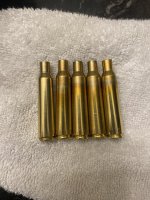
Case on left is in treated, the other 4 are 12 seconds...
Why did you vary the times? Obviously they are not annealed consistently with that much difference in heating time.
There is not much we can learn about the annealing from appearance, but one thing we often can judge is how consistent your technique is. But when you've intentionally done them inconsistently, even that is out the window.
You can’t tell how soft or hard they are by looks.
True, but how hard or soft they are doesn't matter, so that's no loss.
I leave them standing if I don’t want soft cases. Tipping them over into the water directly after using the torch makes them softer.
Tipping them into water just cools them down. If they got softer, it's the heating by torch that made them softer.
Has it improved accuracy?
Please share if it does, as the world is still looking for any real evidence that annealing has any effect on accuracy.

How they look indicates nothing
That’s Very interesting SCIENCE of AnnealingYou can’t tell how soft or hard they are by looks. I have a tray I put cases in and fill with water half way up the case. I do my annealing in a dark room. As soon as I see a colour change it’s done. I leave them standing if I don’t want soft cases. Tipping them over into the water directly after using the torch makes them softer.
Some people anneal with the case held in their fingers and when they feel heat they stop heating. And then drop in water.
The true test of your method is firing them and see how long they last. Has it improved accuracy?
 .
.  . RJ
. RJI did not vary times. There is an UN treated case beside 4 that I did 12 seconds of heat on.Why did you vary the times? Obviously they are not annealed consistently with that much difference in heating time.
There is not much we can learn about the annealing from appearance, but one thing we often can judge is how consistent your technique is. But when you've intentionally done them inconsistently, even that is out the window.
True, but how hard or soft they are doesn't matter, so that's no loss.
Tipping them into water just cools them down. If they got softer, it's the heating by torch that made them softer.
Please share if it does, as the world is still looking for any real evidence that annealing has any effect on accuracy.
I have brass that hardly shows any annealing and others that LOOK Cooked to death . It varies with brass manufacturers.
Looks -Color of brass is no indication of proper annealing .
In the End the idea of annealing is to give longer case life and to help consistent neck tension !
Neck tension is very important for shot - shot accuracy ! RJ
I use a AMP NACHINE but used to use propane !
Looks -Color of brass is no indication of proper annealing .
In the End the idea of annealing is to give longer case life and to help consistent neck tension !
Neck tension is very important for shot - shot accuracy ! RJ
I use a AMP NACHINE but used to use propane !
Attachments
Why did you vary the times? Obviously they are not annealed consistently with that much difference in heating time.
There is not much we can learn about the annealing from appearance, but one thing we often can judge is how consistent your technique is. But when you've intentionally done them inconsistently, even that is out the window.
There is the rub, consitency matters the most for repeatability.
Heat treat, verify amount softened even if you use a rudimentry jig, then use a system that gives you repeatable results.
I must have squished dozens of cases.
Also note that every manufacturer and ever batch could use different settings.
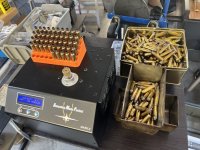
THIS. I use an Annealeez machine, which is super easy to adjust for time so I run the machine in a dark room and watch for the neck to glow before it drops.I do my annealing in a dark room. As soon as I see a colour change it’s done.
OP, annealing manually, one case at a time is super slow and will not be very consistent. A machine of some kind greatly increases consistency and makes the process quicker and easier. Once you've done a few bigger batches of cases yer gonna get tired of doing it manually.
I had a rotary table type of annealer but that was annoying to use because it had to be constantly fed. The Annealeez machine is way nicer to use because it has a shelf that acts as a hopper so it can accept 15 or 20 cases and feed itself.

davide montini
CGN frequent flyer
- Location
- sudbury, ontario
If you do it your way turn lights down or off and look for the colour change when applying the heat ….count your seconds …keep turning the cases …use a socket and twist back and forth or use a drill turn with that …and drop in water
Use a test case try say 7 seconds …try 8try 9 ..10 …you will see the colour change on the mouth and shoulder
Use a test case try say 7 seconds …try 8try 9 ..10 …you will see the colour change on the mouth and shoulder
More Science and WHAT color is just right ? RJIf you do it your way turn lights down or off and look for the colour change when applying the heat ….count your seconds …keep turning the cases …use a socket and twist back and forth or use a drill turn with that …and drop in water
Use a test case try say 7 seconds …try 8try 9 ..10 …you will see the colour change on the mouth and shoulder
This is exactly how I did it. I rolled them on a wet cloth not dropped in waterIf you do it your way turn lights down or off and look for the colour change when applying the heat ….count your seconds …keep turning the cases …use a socket and twist back and forth or use a drill turn with that …and drop in water
Use a test case try say 7 seconds …try 8try 9 ..10 …you will see the colour change on the mouth and shoulder
Or you could build your own annealerIf you do it your way turn lights down or off and look for the colour change when applying the heat ….count your seconds …keep turning the cases …use a socket and twist back and forth or use a drill turn with that …and drop in water
Use a test case try say 7 seconds …try 8try 9 ..10 …you will see the colour change on the mouth and shoulder


I do mine manually. Made a wood jig to hold the torch heads, and a slot to slide the drill . Cordless drill with an impact deep socket, on low speed.
Use a 20lb propane tank with two burners.
Dwell time is controlled using a metronome app on my phone with the volume up.
For the calibers I shoot, it’s either 4 or 5 seconds, also depends on brass thickness. Long dwell times will let the heat travel down the case too far. Never as precise as an amp, but good enough for most shooters easily.
Use a 20lb propane tank with two burners.
Dwell time is controlled using a metronome app on my phone with the volume up.
For the calibers I shoot, it’s either 4 or 5 seconds, also depends on brass thickness. Long dwell times will let the heat travel down the case too far. Never as precise as an amp, but good enough for most shooters easily.

I tried socket on drill with torch. Ruined some brass going till it turned orange on neck, so soft had zero neck tension. Started going until the brass gets a smoked look, its the first change I see, before it turns orange. At the same time I am counting seconds and keeping time consistent per piece of brass within a batch of brass. Not sure if its enough but its not too much. Now I am doing salt bath annealing, a probe/controller holds the molten salt at set temp. The system is a tenth the cost of an AMP annealer, labour intensive, has some fumes, and usually leaves some residue that needs cleaned off, but for the budget takes the brass necks to a very controled temp.






















