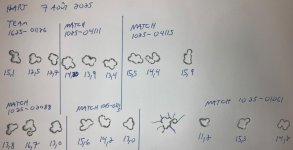
To be fair, sorting *does* help. It just doesn't help enough to really bother with. I mean, Olympic shooting teams had dedicated tools built to speed up rim sorting, according to the local Canadian Olympic shooter I know. Whether it is still worthwhile today compared to decades ago might be another matter. It is possible that manufacturing tolerances we see today have been tightened up enough to make the practice less worthwhile than it may have been in the past. Maybe that's why the amount of difference it can make is as small as it is nowadays.
I've tested weight sorting, rim sorting, rim to driving band sorting, and squishing rounds with the Waltz die, all quite extensively. (Sometimes sorting/squishing entire 5000-round cases.) Every single method returned some positive results. None of it would turn CCI Standard Velocity into Eley Tenex. You're not going to save a bunch of money and get waaaay better ammo out of it. If you don't mind spending a ton of time doing it then you will get slightly better results than if you don't do it. Even if you're sorting Eley Tenex or Lapua X-Act. Just don't expect it to turn Eley Sport into Eley Tenex, because it isn't going to do that. It's generally not going to be enough of an improvement to even turn Eley Sport into Eley Club. But it will turn Eley Sport into a slightly better Eley Sport.
Frankly, the reduction in variance can't not help. The math won't let it not help. And it does indeed help. The magnitude of the improvement just isn't as large as we'd like it to be. If you're seriously bored and have nothing else to keep you occupied, it doesn't hurt. If you really want to get better results the best way to do it is to spend more money. And the time spent doing this is jacking up the price in the end anyway, unless you don't value your time at all. Buying a case of Eley Sport and adding the time to sort is going to be more expensive than simply buying a case of Eley Club. And the Club is still going to shoot better. You can use the culled rounds for warmup, or seasoning the bore after cleaning, to defray some of the cost.
Someone mentioned "you don't know what you're weighing" as someone always does. This is true, you don't know what you're weighing since you're weighing a complete round with five different sources of variance, but ultimately that doesn't really matter much. Why? Two rounds that both weigh 50.7 grains are more likely to be similar than two rounds where one weighs 50.2 grains and the other weighs 50.9 grains. The two 50.7-grain rounds aren't guaranteed to be similar, but the chances are much greater than two rounds that have different weights. I've taken apart enough rounds and weighed the components to know the majority of any weight difference is in the bullet. The cases and powder do have some small variance, too, but the vast majority is in the bullets. And the bullet is the vast majority of the weight, period, so this shouldn't be a surprise. Even with 1000 rounds that all have the same rim thickness and all weigh the same amount you're still going to see variance on target. The amount of primer compound and mixture varies. The amount of powder and mixture varies. The bullets aren't perfectly shaped. They're not all perfectly crimped with the same amount of seal. They don't all have the same amount of lube, and that's yet another mixture that can vary.
Sorting by rims won't make all the ones in the good pile identical, but they will be more alike. Sorting by weight won't make all the ones in the good pile identical, but they will be more alike. Sorting by rim to driving band won't make all the ones in the good pile identical, but they will be more alike. Even squishing up a bunch with the Waltz die won't make all the ones in the pile identical, but they will be more alike. And being more alike will yield better performance. Just don't expect earth-shattering differences, because you won't get them. Testing with very large sample sizes will indeed verify that there is a very real improvement from sorting via any method. It's just that it also happens to be a relatively small improvement. But if you're culling 15% of the rounds because of the rims, and 15% because of the weight, and 15% because of the rim to driveband length, you don't end up having all that much in the good pile. You'd be better off just buying better ammo. I know it makes a difference after seeing the evidence from all of my own personal tests. But I rarely bother doing it anymore, unless I get really, really bored.
I've tested weight sorting, rim sorting, rim to driving band sorting, and squishing rounds with the Waltz die, all quite extensively. (Sometimes sorting/squishing entire 5000-round cases.) Every single method returned some positive results. None of it would turn CCI Standard Velocity into Eley Tenex. You're not going to save a bunch of money and get waaaay better ammo out of it. If you don't mind spending a ton of time doing it then you will get slightly better results than if you don't do it. Even if you're sorting Eley Tenex or Lapua X-Act. Just don't expect it to turn Eley Sport into Eley Tenex, because it isn't going to do that. It's generally not going to be enough of an improvement to even turn Eley Sport into Eley Club. But it will turn Eley Sport into a slightly better Eley Sport.
Frankly, the reduction in variance can't not help. The math won't let it not help. And it does indeed help. The magnitude of the improvement just isn't as large as we'd like it to be. If you're seriously bored and have nothing else to keep you occupied, it doesn't hurt. If you really want to get better results the best way to do it is to spend more money. And the time spent doing this is jacking up the price in the end anyway, unless you don't value your time at all. Buying a case of Eley Sport and adding the time to sort is going to be more expensive than simply buying a case of Eley Club. And the Club is still going to shoot better. You can use the culled rounds for warmup, or seasoning the bore after cleaning, to defray some of the cost.
Someone mentioned "you don't know what you're weighing" as someone always does. This is true, you don't know what you're weighing since you're weighing a complete round with five different sources of variance, but ultimately that doesn't really matter much. Why? Two rounds that both weigh 50.7 grains are more likely to be similar than two rounds where one weighs 50.2 grains and the other weighs 50.9 grains. The two 50.7-grain rounds aren't guaranteed to be similar, but the chances are much greater than two rounds that have different weights. I've taken apart enough rounds and weighed the components to know the majority of any weight difference is in the bullet. The cases and powder do have some small variance, too, but the vast majority is in the bullets. And the bullet is the vast majority of the weight, period, so this shouldn't be a surprise. Even with 1000 rounds that all have the same rim thickness and all weigh the same amount you're still going to see variance on target. The amount of primer compound and mixture varies. The amount of powder and mixture varies. The bullets aren't perfectly shaped. They're not all perfectly crimped with the same amount of seal. They don't all have the same amount of lube, and that's yet another mixture that can vary.
Sorting by rims won't make all the ones in the good pile identical, but they will be more alike. Sorting by weight won't make all the ones in the good pile identical, but they will be more alike. Sorting by rim to driving band won't make all the ones in the good pile identical, but they will be more alike. Even squishing up a bunch with the Waltz die won't make all the ones in the pile identical, but they will be more alike. And being more alike will yield better performance. Just don't expect earth-shattering differences, because you won't get them. Testing with very large sample sizes will indeed verify that there is a very real improvement from sorting via any method. It's just that it also happens to be a relatively small improvement. But if you're culling 15% of the rounds because of the rims, and 15% because of the weight, and 15% because of the rim to driveband length, you don't end up having all that much in the good pile. You'd be better off just buying better ammo. I know it makes a difference after seeing the evidence from all of my own personal tests. But I rarely bother doing it anymore, unless I get really, really bored.