












































You are using an out of date browser. It may not display this or other websites correctly.
You should upgrade or use an alternative browser.
You should upgrade or use an alternative browser.
5.56mm in .223REM rifles: What's the real story?
- Thread starter Smis Five Creedmoor
- Start date


It doesn't need to be a catastrophic failure in order for this still to be a problem (I mean 5.56NATO in .223). The typical pattern is this - it shoots, but the higher pressure results in primer popping out. Casing gets extracted, but the primer gets stuck in the locking lugs. The next round is fed, and while the bolt fails to close on it to be in battery, the bolt gets stuck. This might be not a big deal in bolt action, but it may be pretty problematic in semi-auto. If you are lucky to have your charging handle attached to BCG, you hammer it to pull the bolt out. It still grabs the cartridge by the rim and spills some powder, and the bullet gets stuck in the chamber. Then, if you have a long cleaning rod at hand, you can push it out. While this may be entertaining once (if you are not busy with anything more important), it would be rather annoying if you needed it to perform reliably.If shooting .223 in a 5.56 chamber or shooting 5.56 in a .223 chamber was a problem there would be thousands of pictures on the internet of blown up rifles and disfigured shooter.
Up until the early 90's the DND issued ammo for DCRA and PRA shooting competitions. Lots of shooters built .223 rifles it take advantage of the better quality 5.56 ammo (until the DND fixed this and made 5.56 ammo shoot just a $hitty and the 7.62 ammo)It doesn't need to be a catastrophic failure in order for this still to be a problem (I mean 5.56NATO in .223). The typical pattern is this - it shoots, but the higher pressure results in primer popping out. Casing gets extracted, but the primer gets stuck in the locking lugs. The next round is fed, and while the bolt fails to close on it to be in battery, the bolt gets stuck. This might be not a big deal in bolt action, but it may be pretty problematic in semi-auto. If you are lucky to have your charging handle attached to BCG, you hammer it to pull the bolt out. It still grabs the cartridge by the rim and spills some powder, and the bullet gets stuck in the chamber. Then, if you have a long cleaning rod at hand, you can push it out. While this may be entertaining once (if you are not busy with anything more important), it would be rather annoying if you needed it to perform reliably.
Do you think the DND would issue ammo that was dangerous knowing that 5.56 ammo was being fired in .223 rifles? The cadet program also shot 5.56 ammo in there .223 target rifles. Do you thing the DND would allow this if there was a safety concern?
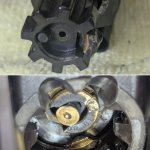
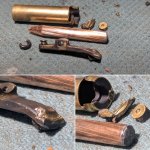
fred0000, looking at those pictures I would say that it was more than likely a round loaded with the wrong powder than a .300 BLK loaded into a .223 chamber. Hard to believe that a round that is approximately .080" larger diameter would fit into .223 chamber and allow the bolt to go into battery. And what is that long copper thing in the picture? Can't be a bullet, it is longer than the case.
That is what happens when a .300B is fired in a 5.56 rifle. I have personally seen one such specimen. Didn't see it happen, of course, just saw the results. The forward assist might be needed to get the breech closed.Up until the early 90's the DND issued ammo for DCRA and PRA shooting competitions. Lots of shooters built .223 rifles it take advantage of the better quality 5.56 ammo (until the DND fixed this and made 5.56 ammo shoot just a $hitty and the 7.62 ammo)
Do you think the DND would issue ammo that was dangerous knowing that 5.56 ammo was being fired in .223 rifles? The cadet program also shot 5.56 ammo in there .223 target rifles. Do you thing the DND would allow this if there was a safety concern?
fred0000, looking at those pictures I would say that it was more than likely a round loaded with the wrong powder than a .300 BLK loaded into a .223 chamber. Hard to believe that a round that is approximately .080" larger diameter would fit into .223 chamber and allow the bolt to go into battery. And what is that long copper thing in the picture? Can't be a bullet, it is longer than the case.
Have you actually seen or experienced this happen?It doesn't need to be a catastrophic failure in order for this still to be a problem (I mean 5.56NATO in .223). The typical pattern is this - it shoots, but the higher pressure results in primer popping out. Casing gets extracted, but the primer gets stuck in the locking lugs. The next round is fed, and while the bolt fails to close on it to be in battery, the bolt gets stuck. This might be not a big deal in bolt action, but it may be pretty problematic in semi-auto. If you are lucky to have your charging handle attached to BCG, you hammer it to pull the bolt out. It still grabs the cartridge by the rim and spills some powder, and the bullet gets stuck in the chamber. Then, if you have a long cleaning rod at hand, you can push it out. While this may be entertaining once (if you are not busy with anything more important), it would be rather annoying if you needed it to perform reliably.
If you want to compare maximum specified pressure levels (which are not the same as typical working pressures) have a look at the specs for SAAMI and CIP .223 ammunition.

lucky07
CGN frequent flyer
Why do people argue just for the sake of arguing?fred0000, looking at those pictures I would say that it was more than likely a round loaded with the wrong powder than a .300 BLK loaded into a .223 chamber. Hard to believe that a round that is approximately .080" larger diameter would fit into .223 chamber and allow the bolt to go into battery. And what is that long copper thing in the picture? Can't be a bullet, it is longer than the case.
You can literally see the headstamp of the case while it's still in the chamber. And a proper sized barrel wouldn't have extruded the bullet like that so pretty safe to assume it wasn't fired though such a barrel.
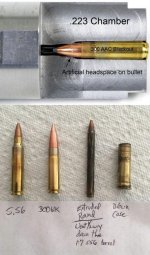
Yes, I experienced this myself at least twice with a rifle chambered in .223. I can also tell, that the bolt doesn't close on 5.56 "Go" gauge in that chamber.Have you actually seen or experienced this happen?
If you want to compare maximum specified pressure levels (which are not the same as typical working pressures) have a look at the specs for SAAMI and CIP .223 ammunition.
As an aside, the modern DND doesn't even want other nations 5.56 fired from a C7. I'm curious about their reasoning, perhaps liability?Up until the early 90's the DND issued ammo for DCRA and PRA shooting competitions. Lots of shooters built .223 rifles it take advantage of the better quality 5.56 ammo (until the DND fixed this and made 5.56 ammo shoot just a $hitty and the 7.62 ammo)
Do you think the DND would issue ammo that was dangerous knowing that 5.56 ammo was being fired in .223 rifles? The cadet program also shot 5.56 ammo in there .223 target rifles. Do you thing the DND would allow this if there was a safety concern?
fred0000, looking at those pictures I would say that it was more than likely a round loaded with the wrong powder than a .300 BLK loaded into a .223 chamber. Hard to believe that a round that is approximately .080" larger diameter would fit into .223 chamber and allow the bolt to go into battery. And what is that long copper thing in the picture? Can't be a bullet, it is longer than the case.






















