Improving Factory Ammunition

TakDriver

Regular
Rating - 96.3%
103   4   1
Location
Ontario, Canada
I'm new at reloading but can honest;y say that I've definitely caught the bug and having blast learning this fascinating and challenging hobby. I began reloading one caliber and have now graduated to 4. There's nothing more rewarding than seeing tiny little ragged holes made by your hands and recipe as a result of hours and hours research patience trial and error.

But the other day I was thinking that if someone didn't want to spend the money, or simply couldn't afford at this time, to setup to reload, there is a very viable and reasonably inexpensive way to achieve similar goals without the buying the entire package. Basically avoiding sliding down that inevitable rabbit hole of "acquiring" a pile of items and loading supplies. I mean let's face it, many of us simply strive to load accurate ammunition for hunting. Not the BR or competition shooters, that to me is an entirely different movie, but with the same goal in mind.

So here's my thoughts: there's gotta be someone here that has slimmed down the needed components to accurize or improve factory ammunition. My guess is that all you would need is an inexpensive press like the Lee press that is often used a second to de prime only - under 100 bucks used, I see them often. A set of calipers and maybe comparator kit - however I've seen reloaders much smarter and certainly more clever than myself use sockets or straight walled cartridges as stand-ins for a comparator. And of course you'll need a set of caliber specific dies.

We have all seen factory ammo perform with very acceptable results - and occasional ragged holes depending on caliber and such. But I've come to learn that you can often tweak factory ammo by simply seating the bullet to a place where YOUR rifle likes it to be. Often you'll notice a box of factory ammo will have about 10 rounds (more or less) that stand out and are extremely accurate compared the rest in that box.

Example: if you buy a few boxes of ammo (with same bullet weight to help reduce variables) to determine which brand and bullet your rifles responds to, you then can buy several of those and measure each cartridge (coal, bto, datum) record the data, and then shoot them in small groups recording the results of each shot. And if for example you discover a certain bto that performs better than the rest half way through a box, you could then try seating the remainging catridges and record the results. You may just find an less expensive way of shooting accurately tuned factory ammunition.

What do you think? Has anyone here tried it?
 
One thing I’ve done with factory ammo just happens to be with my 300 WSM. A local gunstore was transisioning from primarily sporting arms to black gun and handgun specific. I happened to go through one dsy and there was a table set up in the middle with ammo at ridiculous prices. Some was higher end specialty things but there was a pile of 300 and 7 WSM. Hard to believe 300 WSM at 13 bucks a box but needless to say when I left most of the table left with me. I needed brass anyway.
When I shot it it was ‘t that hot, anything under 2” was a good group for it. I shot enough to have loading brass and sort of back burnered the rest. N the meantime I found new brass so it sat some more.
I was thinking about selling it, but on a bit of a whim pulled down one cartridge. I used that bullet to measure length to lands and found that they were a mile off the lands. Kimbers have a longer mag on the short mags than most, so I waz able to get about .020” off and still have reliable function. Bumped a box out partway with a kinetic puller and reseated to the new COL On testing it would hold 1 MOA with just that one change. I filed that under “Good to know” and I still have it.

Mexican match ammo used to be a thing; pull down surplus military ammo and reseat the bullet of your choice.

An older and long deceased friend told that when they were shooting DCRA with supplied ammunition hat a lot of them rolled the cartridges on a mirror and saved the straightest ones for the longer ranges.
 
You find interesting things when you pull factory ammunition apart. Powder charges with 2 grains variation, extreme neck tension differences, etc. If I have some that doesn’t shoot I see no harm in tweaking them. Had a similar case with some Barnes factory 270WSM ammo. Bumped the bullets out and reseated to the standard starting point of .050 off the lands and shot way better with more consistent velocity.
 
I was shooting Barnaul 203gr 7.62x54r with decent results on paper and decided, out of curiosity, to tear down 40rnds. I measured each powder charge and weighed the bullets. There ended up being a roughly 3gr variation in powder charge and the bullets were within half a grain. I averaged the powder charge, reseated and crimped the bullets, and found my groups shrank correspondingly.
 
The current recent thinking supported by tests by Hornady and others in the industry (and Todbartell) is that seating depth doesn’t have as much influence as previously thought.
 
Depends a lot on how the chamber, specifically the free bore section.

Ever notice that when bullet makers make the jump to ammunition makers they all seem to decide that length to lands doesn’t matter much? Pretty darn convenient discovery, when the hunting market is huge compared to the target market, and you’d like to sell high BC bullets in factory ammo to guys with SAMI length mags.
 
The current recent thinking supported by tests by Hornady and others in the industry (and Todbartell) is that seating depth doesn’t have as much influence as previously thought.

That's interesting. All I can add here is that from my limited experience I noted a marked difference in bullets that were seated 0.020 or more off the lands when shooting small groups.

However I would agree that when shooting larger groups 10-30rds this could/would change dramatically. The Hornady episodes, I believe #50 and #52 on their YT channel, opened my eyes wide open. They recorded tons of data regarding groups sizes and accuracy and discovered (and dispelled) some of the online bro science floating around. Do with it as you please. For my intents and purposes I'm simply looking for the best small two shot group I can duplicate often, and then hopefully follow up with 5 shots under under MOA once powder charge and BTO has been determined. I rarely shoot twice on an animal. But that's just me. YMMV
 
Yeah it's easy to get side tracked and slide down that slippery accuracy slope when discussing bullet seating, jam..ect.

The original intent of this thread was to see if anyone here actively purchases factory ammo and tinkers with it as opposed to buying an entire reloading kit and powders primers..ect.
 
Have a look at todbartell test. He tested OCW and picked the best and worst powder charge for 3 shot groups. With his best powder charge he tested seating depth. Again, he picked the best and worst. He tested the optimal powder charge with the best seating depth against the worst powder charge and worst seating depth for a 30 shot group. The worst/worst combo shot better then the best/best combo! It just shows that what we sometime see as a definitive improvement in a group is just a happy coincidence in a too small sample.

https://www.canadiangunnutz.com/forum/threads/load-development-method-optimal-charge-weight.2515066/
 
Just went through that thread, fantastic intel presented by Todd. And the results basically mirror what the Hornady guys were saying in those two popular podcasts regarding various sized groups of 3, 5, 10 20 30 and 50. Having seen that do you feel a person could further accurize (is that even a word?) today's factory ammunition, or is our current commercially available ammo about as good as it gets?
 
Well I turned 4” groups with Winchester Supreme 6.5 CM with 142gr ABLR into 1” groups with just resizing the necks. Using an inertia puller some bullets came out with a mild tap and some required pounding on a 2x4 as hard as I could about 20 times.
 
Well I turned 4” groups with Winchester Supreme 6.5 CM with 142gr ABLR into 1” groups with just resizing the necks. Using an inertia puller some bullets came out with a mild tap and some required pounding on a 2x4 as hard as I could about 20 times.
How many shots in those groups?
 
  • Like
Reactions: DGY
Just resized in a standard Hornady FL die without the decapping pin. 3 shot groups, only 20 in a box and I had two boxes. A 30 shot group after the initial testing would have only proven that I was out of ammunition. I reload almost all my ammunition. These were in the store and I wanted to try them. I certainly wouldn’t buy any more of those. For the listed $80 + per box they were complete garbage. I’m just saying that they were ‘improved’ simply by pulling them apart to see why and fixing what I thought was the issue.
 
Just resized in a standard Hornady FL die without the decapping pin. 3 shot groups, only 20 in a box and I had two boxes. A 30 shot group after the initial testing would have only proven that I was out of ammunition. I reload almost all my ammunition. These were in the store and I wanted to try them. I certainly wouldn’t buy any more of those. For the listed $80 + per box they were complete garbage. I’m just saying that they were ‘improved’ simply by pulling them apart to see why and fixing what I thought was the issue.
If you superimpose all those three shot groups it will give you a good representation of your result. Individual 3 shot groups, not so much.

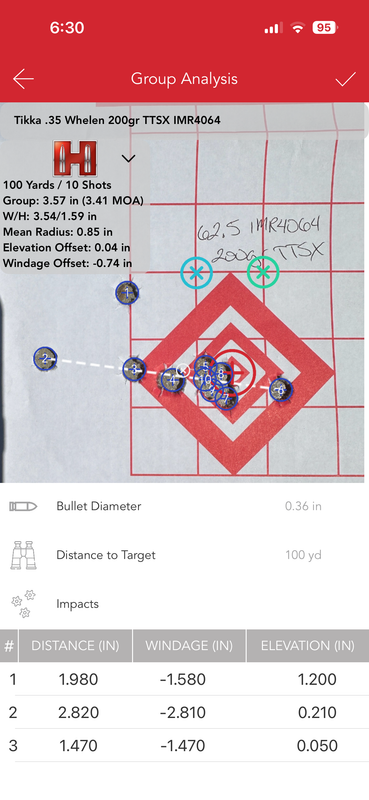
Take this group I shot testing loads with my Whelen for example. If I would have shot a three shot group and my first three shot were shots numbered 5, 8 and 10 one could stop and say they found the magic load and their rifle is a quarter inch rifle! On the contrary, if the first three shots were shot 1, 2 and 6 then it’s a 3”+ group! Larger sample gives you a more accurate representation of your load.

If I shot the 3”+ group first and decided the blow a kiss to the rest of the box then shot the 0.25” group after, I’d be posting some pretty wild claim on the internet!! 😆
IMG-8073.png
 
Only thing I've done on factory stuff is using the same or very similar bullet, match the OAL on the handloads with the factory stuff. Did it once with Rem 7-08 and once with Fed Prem 338WM and once on Fed Prem 6.5CM, all three shot about the same with first handload as the factory load, subbed a Scenar for the Berger on the 6.5, the 338 was partitions for partition, Rem was partition for corelokt . Often thought about farting about with reseating them, but, never bothered as I didn't have enough to work with. One I was really tempted on was Hornady match, shot the worst of 5 different bullets and 4 brands, and yet had the best sd's. Only had 10 rds ea left though, 140 & 147gr 6.5CM. Herters shot far better.
 
Remembered another instance. I used to buy 28 Nosler with 168 custom competition bullets in Nosler factory ammo because it was cheaper than empty brass. Trouble was that on a warm; not even hot day the bullets would start popping in the air. Not all of them, but about half. I guess a 30” 1-8 twist was more than they had in mind.

The work around was to pull the factory bullets and substitute 168 ABLRs which I already knew shot well in that rifle. I don’t think they load the first bullet anymore, the cheap option is now the 160 grain Ballistic Tip, I found a sale on those, bought a bunch and not surprisingly they shot well. I kinda figured because the 160 Accubonds shot well. They are all back burnered now too, because while digging through my stuff I found enough brass to shoot out a few barrels. Oh well, maybe the day will come when some ammo is better than no ammo😄
 
Back
Top Bottom