By 1851 Samuel Colt had been to England several times, his first believed to have been as a young sailor in 1830/31. Colt was very fond of London in particular, returning in 1835 and again in 1849 to register patents for his revolver. In 1851 Colt had an exhibit in the US pavilion at the Great Exposition, and his revolving firearms made a stir. Even Prince Albert, the Queen’s Consort, paid a personal visit to Colt at his display and was impressed by what he saw. Europeans, and the English in particular, regarded America with both distain and admiration. These provincial upstarts defied the well-established norms and protocols of European propriety with their boisterous, aggressive “can-do” attitude and considerable financial and industrial might. Many a “baron of industry” from America could challenge the old British order with his wealth and influence, much to the chagrin of the Old World. Samuel Colt was typical of this newly emerging social class, coined the “nouveau riche”. By 1851 the flamboyant American was already extremely wealthy, perhaps the richest and most influential man in the US, a mere twenty or so years after he had been just a poor sailor. This sort of success was unknown in the Old World, and both envied as well as despised. It is not surprising then that the colonel’s foray into the traditional English gun trade was met with considerable resistance by the established makers in Birmingham and London. Through his dealings in London in the late 1840’ and early 50’s, Colt learned very quickly that the market for firearms in Europe was huge. Most European governments, including Britain, were still reeling from the Napoleonic Wars, and several revolutions on the Continent in the 1840’s. Reconstruction of infrastructure and military capability was slow. The standard infantry and cavalry issue small arms consisted of muskets and single-shot percussion pistols, with revolving firearms gaining ground only very slowly. The British government in particular was under pressure to modernize, with her huge, global expanse of colonies, protectorates and “spheres of influence”.
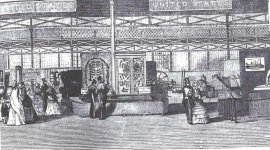
Colt’s Display at The Great Exhibition in London, 1851
In 1852 Colt acquired land on the banks of the Thames and began the construction of the London Armory. The process did not go as expected by the colonel who was used to getting things done quickly back home, and with minimal resistance from those around him. Britain was a different environment: Colt found the English difficult to deal with, government bureaucracy, labour issues, and a lack of skilled tradesmen slowed the start-up. Bringing over some of his best hands from the States and training local, unskilled labourers would become his method of operation. In 1854 Colt was called before a Select Committee on Small Arms of the House of Commons to testify about his factory in London. The committee members queried him about his productions, and he freely admitted that he preferred an unskilled man at 2 shillings a day and train him as he saw fit over one who claimed to be skilled and would seek 9 shillings a day. “You want good brains and little knowledge?” asked one Mr. Walpole, to which Colt replied “Yes, I take the raw material…”
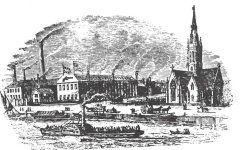
The London Armory, 1853. Note the steamer’s name: “Revolver”. The artist’s nod to Sam Colt?
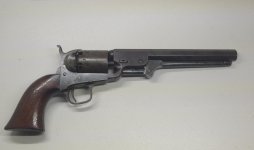
Colt’s armory turned out some 700 Dragoons, 11,000 1849 Pockets, and some 42,000 1851 Navy’s during its time in operation. Further to that, many Hartford-made Colts found their way across the pond, duly stamped with the London address but displaying Hartford characteristics. Colt’s biggest contract (much to the dismay of the Birmingham gun trade) came from the British government itself, which ordered 23,000 Navy’s for the Crimean War effort. The London endeavour proved less successful than expected in the long run, though. By 1856 the Crimean War had ended, and demand for Colt’s products had slowed. Pressure and competition from the English makers, plus the increasing likelihood of war in his native America, led Colt to decide on the closure of the London Armory in 1857, a mere four years after the operation had begun. The land and buildings were sold, the machinery, supplies and inventory in production, as well as the American staff still working at the factory were transferred back to Hartford. Samuel Colt saw the clouds of war gathering on his native horizon, and a new market was about to open for the colonel…
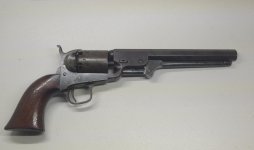
London Address Colt M1851 Navy, SN 42068. London or Hartford-made?
Colt’s Display at The Great Exhibition in London, 1851
In 1852 Colt acquired land on the banks of the Thames and began the construction of the London Armory. The process did not go as expected by the colonel who was used to getting things done quickly back home, and with minimal resistance from those around him. Britain was a different environment: Colt found the English difficult to deal with, government bureaucracy, labour issues, and a lack of skilled tradesmen slowed the start-up. Bringing over some of his best hands from the States and training local, unskilled labourers would become his method of operation. In 1854 Colt was called before a Select Committee on Small Arms of the House of Commons to testify about his factory in London. The committee members queried him about his productions, and he freely admitted that he preferred an unskilled man at 2 shillings a day and train him as he saw fit over one who claimed to be skilled and would seek 9 shillings a day. “You want good brains and little knowledge?” asked one Mr. Walpole, to which Colt replied “Yes, I take the raw material…”
The London Armory, 1853. Note the steamer’s name: “Revolver”. The artist’s nod to Sam Colt?
Colt’s armory turned out some 700 Dragoons, 11,000 1849 Pockets, and some 42,000 1851 Navy’s during its time in operation. Further to that, many Hartford-made Colts found their way across the pond, duly stamped with the London address but displaying Hartford characteristics. Colt’s biggest contract (much to the dismay of the Birmingham gun trade) came from the British government itself, which ordered 23,000 Navy’s for the Crimean War effort. The London endeavour proved less successful than expected in the long run, though. By 1856 the Crimean War had ended, and demand for Colt’s products had slowed. Pressure and competition from the English makers, plus the increasing likelihood of war in his native America, led Colt to decide on the closure of the London Armory in 1857, a mere four years after the operation had begun. The land and buildings were sold, the machinery, supplies and inventory in production, as well as the American staff still working at the factory were transferred back to Hartford. Samuel Colt saw the clouds of war gathering on his native horizon, and a new market was about to open for the colonel…
London Address Colt M1851 Navy, SN 42068. London or Hartford-made?