What temperature range for annealing?

bigHUN

CGN frequent flyer
Rating - 100%
3   0   0
Location
Aurora/ON
I finished my induction annealer, but didn't wanna do a new batch reloading in a cold over the winter - for a next warmer weather season.
I am looking now for a liquid Tempilaq but cannot decide which one for the Temp.
I know that many people using up to 700F (sub 400C) temperature indicator, unsure why.
The engineering books everywhere saying a best Temp to anneal brass is in 550-600C range (roughly between 1000-1100 F).
I don't want to waste my budget to buy several but to pick one bottle only, to play with timing and depth adjustments.
The efficiency of my diy annealer is pretty good, thanks to many people helping me with advise.
I believe it can reach a 750F (430C) safely well under 3 sec, but I have seen couple melted one as well how I set the height wrong. No it didn't tach the sides on copper tube.

Q: Anybody using or tried annealing between 700F and let say 900 F ??
 
Why are you annealing?

My own testing showed the frequency of neck cracks in stressed cases is dropping when annealing is done at 350C, but cracking isn't entirely eliminated until temperature reaches 500C. Significant microstructural changes don't begin until 600C, so if you stay in the range 500C to 600C you will eliminate cracking without getting grain growth.

Now, if you think you're annealing to improve accuracy, well I don't know anything about that.
 
I will be interested to hear what replies that you get. I was under the impression that annealing was about BOTH temp and time - so a lower temp could do annealing, but need to hold to longer time. However, I am just going from the write-up that came with salt bath annealing kit - there may be different ways to "get 'er dun".
 
Why are you annealing?
I completely forgot the ammo details that I learned to prepare:
Win 308 Lapua brass; Hodgson 45.8; Sierra 155 Match King; SD 0.028"; AV speed 2950 fps pretty consistent over a larger quantity.

Last season (over summer months only for me) friends from my club were annealing for me. Somehow happened that three boxes did three person. Don't ask why, it just happened that way.
I was reloading these brass in batches, same preparation process and same powder, and I have seen/feel differences on my press when pushing the bullet (I have a press force meter on my inline press).
Also I have seen differences in ten groups shapes and sizes @ 300 meters. I don't call it a group if less then ten shots to count.

This triggered me to make my own annealing machine, so nobody else to blame for anything. Now the entire process is in my hands, and I am very precise also very picky when doing my things.
I just need to pick a max Temp - and go from there with Timer.
Initially I was speculating around 450-500 C, but me better ask, because I have seen people were talking much lower temps about 700F.
I will buy that next step up Temp testing liquid for 550C and go from there.
 
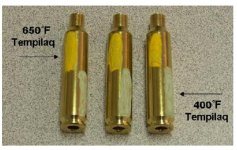
According to Bench Source Annealing procedure, both 650F and 400F Tempilaq is recommended.
For the top of the case (neck, shoulder upper part of the case body) use 650F and use 400F tempilaq for the middle to lower part of the case…as the photo attached.

You want the upper part to turn clear and the lower part to not turn clear. In other words temper until the top the case exceeds 650F but the lower part of the case stays below 400F.

On my machine (and with my brass) I have found a “trick” that seems to work well for me. I aim the heat tip at the middle of the shoulder. I heat the brass until the top of the case neck starts to glow orange for the briefest of moments (aim for 1/2 sec) before the case moves away from the heat source. I turn the lights off in the room to see the brief glow more clearly. I may adjust the “time in heat” a small amount as I work through the lot of brass, while using the brief glow as my indicator. Using the tempilaq as recommended led me to this time saving trick. This process, while it works well for me, may not work the same for you …depending if on your annealing machine and the brass your working on.

Of interest, the annealling marks on my finished cases look very similar to new Lapua brass.
 

Attachments

  • IMG_1756.jpeg
    IMG_1756.jpeg
    100.4 KB · Views: 26
Last edited:
I'm assuming you have seen how an AMP annealer works? It burns a case first to find the tolerance of the specific case type and brand. There is no one time does all from my understanding and that means different temperatures must be achieved for different cases. I know AMP makes some very informative vids but I don't know if they provide that info for free. I too am curious what answers come up here. Cheers
 
I will be interested to hear what replies that you get. I was under the impression that annealing was about BOTH temp and time - so a lower temp could do annealing, but need to hold to longer time.

Time is a variable, but on a much less sensitive scale than temperature. I did all my tests at 4 or 5 seconds immersion, which probably translated to 3-4 seconds at target temp (this was with salt bath, flame heating will transfer heat more slowly.) You would probably have to increase/decrease the time by a factor of 2 (IE double it to 8s or halve it to 2s (at temp)) to see any difference.
 
Last night I was searching for Tempilaq prices. The average 600-700 F lowest $45 at amazon, but the stupid 1000 F I am aiming for lowest asking $90 plus shipping and I have seen also $145 for a 2 oz=50ml bottle. And I would use it ones maybe one more time to doublecheck.
Oh man where we heading with this prices ???

Edit:
I have a decent quality IR thermometer but cannot measure between tightly wrapped coils from a shiny surface.
What else could be used to measure a Temp, that I can dual purpose later in time?
 
What else could be used to measure a Temp, that I can dual purpose later in time?

You could try Tempilstiks (https://markal.com/products/tempilstik-94/028058), go by colour of the neck mouth as observed in a dark room and then by how far down the case you see discolouration after the fact, or get a Webster (or Chinese equivalent) W-20B and experiment until you get the annealed hardness you want.

I don't think annealing needs to be precise in order to improve the useful life of a case.
 
  • Like
Reactions: DGY
I’ve been doing mine with induction working up by 0.1 second steps until you just start to see dim glow in a dark room. Usually a bit less than enough to make a blue colour at the transition. :)
 
Back before I moved to an AMP annealer, I had tried using the temp sticks, but found them very difficult to get results compared to the liquid.....
 
Back
Top Bottom