I have trouble believing that on a heavy barrelled 22 rimfire, that barrel oscillation is a significant source of inaccuracy. And that by moving the weight slightly alters that oscillation enough to improve accuracy. I can readily accept that on a high pressure centre fire cartridge, the barrel oscillates enough that finding a node might make a difference, but I am skeptical about a heavy barrelled 22 rimfire. I remain open minded, but a better barrel and better ammo would do more for me than a tuner (I speculate!).
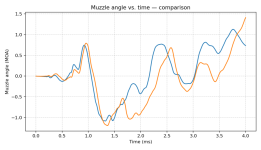
0.5 MOA at 26" (a common length of barrel for benchrest guns) is less than 0.004" of muzzle movement. Typical barrels might swing anywhere from 1.5-2.0 MOA during the firing cycle. Here's a Win52D factory barrel without a tuner in blue, and with a 252-gram Harrell tuner installed set at 0 clicks in orange. As you can see, adding that weight changes how the barrel moves quite a bit. The orange line is being stretched to the right so that things are happening a little bit later, and it also changes the overall shape due to how the different harmonics are now summing compared to how they sum without the tuner installed.
Here are some numbers associated with the blue curve, the bare barrel:
Muzzle launch-angle diagnostics (root-moment pulse):
Modes used: 16 Damping ζ: 0.010
Force source: CSV (force_curve-Win52D.csv)
Exit time used: 2.310518 ms (source: CSV map)
Peak muzzle angle: 1.129 MOA
Peak muzzle angular rate: 8.109 MOA/ms
At t = 2.3105183 ms: angle = 0.737 MOA, rate = 0.987 MOA/ms
Saved plot: muzzle_angle_vs_time.png
Saved JSON: Win52D-factory-barrel-bare-25C.json
Bare natural frequencies: 50.00 Hz, 260.79 Hz, 691.87 Hz, 1335.66 Hz, 2193.98 Hz, 3266.78 Hz, 4554.10 Hz, 6055.94 Hz, 7772.32 Hz, 9703.24 Hz, 11848.69 Hz, 14208.69 Hz, 16783.22 Hz, 19572.30 Hz, 22575.92 Hz, 25794.08 Hz
With lumped masses: N/A
I'm not quite happy with my ammo parameters yet, as the exit time likely should be somewhere in the region of 2.1-2.15 milliseconds, but that doesn't really matter for the sake of this discussion. With the parameters it is currently using, the shot exits at around 2.31 milliseconds and the barrel is swinging upwards at a rate of 0.987 MOA/millisecond. Then after we add the 252-gram Harrell tuner we get this:
Muzzle launch-angle diagnostics (root-moment pulse):
Modes used: 16 Damping ζ: 0.010
Force source: CSV (force_curve-Win52D.csv)
Exit time used: 2.310518 ms (source: CSV map)
Peak muzzle angle: 1.481 MOA
Peak muzzle angular rate: 8.820 MOA/ms
At t = 2.3105183 ms: angle = -0.110 MOA, rate = 5.341 MOA/ms
Saved plot: muzzle_angle_vs_time.png
Saved JSON: Win52D-factory-barrel-old-tuner-25C.json
Bare natural frequencies: 50.00 Hz, 260.79 Hz, 691.87 Hz, 1335.66 Hz, 2193.98 Hz, 3266.78 Hz, 4554.10 Hz, 6055.94 Hz, 7772.32 Hz, 9703.24 Hz, 11848.69 Hz, 14208.69 Hz, 16783.22 Hz, 19572.30 Hz, 22575.92 Hz, 25794.08 Hz
With lumped masses: 47.94 Hz, 202.77 Hz, 614.12 Hz, 1316.05 Hz, 1898.08 Hz, 3187.93 Hz, 4296.17 Hz, 5583.63 Hz, 7771.75 Hz, 8963.51 Hz, 11453.60 Hz, 14000.10 Hz, 15718.40 Hz, 19438.48 Hz, 21684.80 Hz, 24831.07 Hz
Now we've got the barrel swinging upwards at a rate of 5.341 MOA/millisecond when the shot exits. The ammo itself is going to change the upswing rate you ultimately need for a 50-yard tune by a little bit, but it would generally need to be somewhere in the 5-6 MOA/ms region to provide the optimal amount of positive compensation for that distance. The bare barrel's 0.987 MOA/ms value is nowhere near that. That means you're going to be largely at the mercy of the ammo's velocity variation because this slow upswing rate isn't going to provide very much positive compensation. That amount of positive compensation, 0.987 MOA/ms, will have a small effect, but where shots impact is largely going to be governed by muzzle velocity. But with the tuner installed, that 5.341 MOA/ms will be fairly close to the optimal amount of positive compensation needed for 50 yards. That means it is going to be doing a fairly decent job of altering the launch angle just enough for the muzzle velocity differences.
At least, if the ammo were very consistent in its ignition and burn behaviour it would do a fairly decent job of giving the appropriate amount of positive compensation. Burn rate differences from shot to shot in the primer compound and the powder, plus the amount of powder, and the bullet weight will all affect the variance in shot exit time, even when the muzzle velocity is the same. So you still see variance on target due to that. But the barrel itself will be doing a pretty decent job at its portion of the total job. This is why you still need good target ammo, and why a tuner isn't going to make Remington Golden Bullet shoot just as well as Lapua Midas+. You get better shot exit timing consistency with better ammo. And that's just as important as a barrel helping you as much as it can.
Every barrel is different. Their dimensions change what the base natural frequencies are, its harmonics, and those are what sum to give the overall shape of the movement trace. And you'll need a particular amount of added weight to change those frequencies by an amount that will be helpful for your intended target distance. As you can see in the second set of figures, the ones for when the tuner is installed, it lists both the bare natural frequencies and what they've been changed to by adding the lumped mass. The two sets of frequencies are fairly different. And that'll mean when you sum the individual waveforms at those frequencies you'll get an overall trace that is also quite different. And so, benchrest performance requires that you have a barrel contour and length that will show movement a bit faster than what you need for your target distance, and then you need to add a certain amount of weight to slow it down just enough to give good positive compensation. A given amount of weight changes how a given barrel moves in a particular way. Change the amount of weight and it'll change its behaviour again. In other words, you can't just throw a random tuner on a random barrel and expect it to give good results. You have to have a good starting point, and you have to alter things by just the right amount with just enough added weight. I have three different screw-on weights for my Harrel. Here's what happens if I throw on the lightest one, an 82-gram aluminum one, for a total weight of 334 grams instead of the 252 grams that was used in the previous example. The graph is the same as before, only now with a green line added for the tuner with the weight installed.
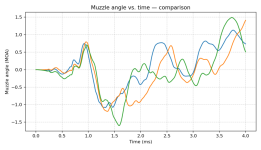
Now we have a huge problem. Not long after we pass the 2.0-millisecond mark, and we are now expecting the round to exit shortly, the barrel is in a downswing. A barrel in a downswing is providing negative compensation. That means the muzzle velocity variance is actually producing more elevation variance on target. It is making things worse. Here's the data for that setup.
Muzzle launch-angle diagnostics (root-moment pulse):
Modes used: 16 Damping ζ: 0.010
Force source: CSV (force_curve-Win52D.csv)
Exit time used: 2.310518 ms (source: CSV map)
Peak muzzle angle: 1.599 MOA
Peak muzzle angular rate: 10.122 MOA/ms
At t = 2.3105183 ms: angle = -0.223 MOA, rate = -1.479 MOA/ms
Saved plot: muzzle_angle_vs_time.png
Saved JSON: Win52D-factory-barrel-old-tuner-25C-82weight.json
Bare natural frequencies: 50.00 Hz, 260.79 Hz, 691.87 Hz, 1335.66 Hz, 2193.98 Hz, 3266.78 Hz, 4554.10 Hz, 6055.94 Hz, 7772.32 Hz, 9703.24 Hz, 11848.69 Hz, 14208.69 Hz, 16783.22 Hz, 19572.30 Hz, 22575.92 Hz, 25794.08 Hz
With lumped masses: 44.70 Hz, 203.53 Hz, 689.95 Hz, 1123.78 Hz, 2183.49 Hz, 2875.39 Hz, 4526.23 Hz, 5484.68 Hz, 7712.51 Hz, 8962.94 Hz, 11738.97 Hz, 13316.06 Hz, 16602.93 Hz, 18547.83 Hz, 22302.49 Hz, 24660.65 Hz
Now we see it is swinging at -1.479 MOA/ms at shot exit. So instead of giving slower shots a higher launch angle it is aiming slower shots downwards even more than it is aiming faster shots. It is amplifying the elevation on target giving you even worse performance. The amount of weight is now horrible for that particular barrel length and contour. It is hurting your score rather than helping it. You must have a suitable barrel and a tuner that is suitable for that barrel. Pairing random barrels and random tuners together does not work.
And in case you're curious about how much of a difference the tuner's range of click adjustment makes, that 5.341 MOA/ms at 0 clicks without the screw-on weight installed becomes 5.304 MOA/ms at 500 clicks, which is moving the outer portion outwards by 0.5 inches, when talking about that particular barrel. Not a large change. How much difference that makes will naturally vary depending on barrel spec, and whether or not you've added screw-on weights. The adjustment range of the tuner is more or less supposed to allow you to account for small ammo differences and temperature differences throughout the year. You've got to play with barrel specs and amount of total tuner weight to make large changes.