












































You are using an out of date browser. It may not display this or other websites correctly.
You should upgrade or use an alternative browser.
You should upgrade or use an alternative browser.
Neck sizing
- Thread starter tomL
- Start date

- Location
- Quesnel B.C.
Brass necks are not perfect in thickness, inside wall is critical for seating with consistant tension.
I have used neck dies and found I get less runout with full length dies.
Enjoy.
I have used neck dies and found I get less runout with full length dies.
Enjoy.
It can, but if you want to size the neck from the case mouth to the shoulder junction, you will still be resizing the body as well.Why can't a FL die size the neck to spec. in one step, just like the body. Instead of sizing it smaller and expand it to spec.?
Tom
When using a FL died to neck size, without partially sizing the body of the case, the die has to be set up in the press so that shoulder contact doesn't happen.
The best way to do this is to blacken a neck/shoulder/sidewall area with a felt pen and check for contact.
I find, in almost every case, there is a very slight "second shoulder" on the case neck, where the die doesn't touch.
Most commercial chambers in "off the shelf" rifles will be close to maximum SAAMI spec, to accommodate any commercial dimension munition the shooter might purchase. This can vary quite a bit, from minimum specifications to maximum specifications.
The idea behind neck sizing only is to tighten dimensional tolerances between the chamber and the cartridge.
When a small "second shoulder" is left on the neck, theoretically, the cartridge will be better centered to the axis of the bore.
Rifles with tight tolerances tend to be more accurate. Not always, but it helps.
Historical and practical reasons mostly - it's what most reloaders know, understand and use 'cause it works - de-prime, size and expand in one step. Neck wall thickness is not standard between brands and sizing from the inside won't cause seating issues like sizing from the outside can. Internal expansion ensures concentrically of the neck mouth, plus de-priming could become another step depending on your dies.Why can't a FL die size the neck to spec. in one step, just like the body. Instead of sizing it smaller and expand it to spec.?
Tom
You can always have custom dies made if you want to do it differently.

I agree with all of the above! I switched a couple years ago for my 6.5 x 55; the caliber I shoot the most (three rifles) The M38 and the M96 have slightly longer chambers than my Zastava M70, so I keep the ammo and brass seperate. Generally, I shoot heavier bullets in the two military rifles.Get yourself a lee collet die and only bump the shoulder back on the FL die once the bolt starts resisting on closure. I’ve had remarkable increases in accuracy using the collet die, and a nice bonus is brass lasts longer.
Case necks stay more concentric with the cartridge body, and wall thickness on the neck remains more uniform. Cartridges rarely require trimming. It is not uncommon to get more than 10 reloads out of most of the brass, some to 16; and I don't load "light".
BTW, the Lee Collet Dies are not expensive either.

I`ve been reloading for 50+ years. Started with fill length dies, then used to neck size only with full length dies, then used neck sizing dies and now use lee collet neck sizing dies. I`m into the accuracy - varmint shooting thing and have found that Lee collet dies are the answer, at least for my purposes. They produce very straight, if not the straightest ammo, brass lasts forever, very little if any trimming, clean - no messy lube on or off, last but not least just as accurate, as in tightest groups, if not the tightest as anything else. I only use full length dies to size brass before fire forming.
Oh yes they are very reasonably priced also if that matters.
Oh yes they are very reasonably priced also if that matters.

If you using a full length bushing die like a Whidden you can do exactly that.Why can't a FL die size the neck to spec. in one step, just like the body. Instead of sizing it smaller and expand it to spec.?
Tom
Cat

You can if you get yourself a Wilson FL bushing die or a Redding FL bushing die or a Forster FL bushing die, or...................
If you using a full length bushing die like a Whidden you can do exactly that.
Cat
Except that with bushing dies, you are still "drawing" the material with friction through a hole that is smaller than it is. With a collet die, you are squeezing (swaging) the neck; that means less work hardning. I do not anneal, I see no need to do so.You can if you get yourself a Wilson FL bushing die or a Redding FL bushing die or a Forster FL bushing die, or...................
The brass is still being worked however , and with a bushing die you can precisely select just how much neck tension you want as opposed to Lee collet die which takes more fuddling around .Except that with bushing dies, you are still "drawing" the material with friction through a hole that is smaller than it is. With a collet die, you are squeezing (swaging) the neck; that means less work hardning. I do not anneal, I see no need to do so.
I use both but for my match rifles I use the Whidden FL bushing die so no need to use a body die to set the shoulder back.
Cat
Last edited:
BR Hall of Fame member Speedy Gonzales also did a very good interview with Eric Cortina on the history of neck sizing and the neck bushing / body die set that Redding offers.There's a fellow by the name of Eric Cortina, who won quite a number of long range championships.
His advice is STOP NECK sizing!
Can't say any of my groups have gotten any bigger since I did!
Cat
QUOTE>>>>>Except that with bushing dies, you are still "drawing" the material with friction through a hole that is smaller than it is. With a collet die, you are squeezing (swaging) the neck; that means less work hardening. I do not anneal, I see no need to do so.<<<<<ENDQUOTE
No, you're not "drawing" the neck over. It's an outside bushing that squeezes the neck to the precise diameter you require. The Lee collett die is a crude version, in which you squeeze the neck down, but you cannot precisely control the sized diameter, whereas with a bushing die you can.
No, you're not "drawing" the neck over. It's an outside bushing that squeezes the neck to the precise diameter you require. The Lee collett die is a crude version, in which you squeeze the neck down, but you cannot precisely control the sized diameter, whereas with a bushing die you can.
Exactly, my Whidden bushing die sets my shoulders back perfectly at .001 and the proper neck bushing gives me the exact neck tension I need - EVERY time.I have a Lee collet die for my .223 but stopped using it because my estimated 25lbs of force each pull cannot compete with the predictability of an expander mandrel or a properly sized full length die
Cat
What ever works for him...There's a fellow by the name of Eric Cortina, who won quite a number of long range championships.
His advice is STOP NECK sizing!
Can't say any of my groups have gotten any bigger since I did!
Sorry, drawing was the wrong terminology; in drawing the material being formed is being pulled; it is being "extruded" through the the die bushing; like the diagram below:QUOTE>>>>>Except that with bushing dies, you are still "drawing" the material with friction through a hole that is smaller than it is. With a collet die, you are squeezing (swaging) the neck; that means less work hardening. I do not anneal, I see no need to do so.<<<<<ENDQUOTE
No, you're not "drawing" the neck over. It's an outside bushing that squeezes the neck to the precise diameter you require. The Lee collett die is a crude version, in which you squeeze the neck down, but you cannot precisely control the sized diameter, whereas with a bushing die you can.
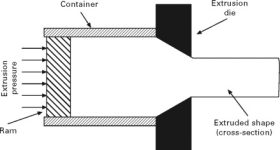
Extrusion pushes (in this case, the cartridge neck through the extrusion die bushing), it still involves friction, which causes work hardening in varous metals, such as brass and other copper aloys. I proved this to myself by seeing a lot less cracked necks, and more stable cartridge lengths.
Collet dies swage, which is more like cold forging, which theoretically tends to have positive effects on the crystaline structure of metals, improving the strength of materials; think about wrenches, receivers, barrels, handgun slides, etc...
Also, since full length resizing dies use a neck bushing and a mandrel for internal sizing, you are actually extruding the neck, then drawing over the mandrel; working the brass twice.
Only FL dies that use an expander ball work the brass twice.Sorry, drawing was the wrong terminology; in drawing the material being formed is being pulled; it is being "extruded" through the the die bushing; like the diagram below:
View attachment 1077879
Extrusion pushes (in this case, the cartridge neck through the extrusion die bushing), it still involves friction, which causes work hardening in varous metals, such as brass and other copper aloys. I proved this to myself by seeing a lot less cracked necks, and more stable cartridge lengths.
Collet dies swage, which is more like cold forging, which theoretically tends to have positive effects on the crystaline structure of metals, improving the strength of materials; think about wrenches, receivers, barrels, handgun slides, etc...
Also, since full length resizing dies use a neck bushing and a mandrel for internal sizing, you are actually extruding the neck, then drawing over the mandrel; working the brass twice.
It is also a fact that when using a neck sizing die - collet, bushing or expander style, the shoulder will have to be pushed back eventfully with either a body die or a FL die.
One cannot simply use a collet die and expect the same results every time because the brass will eventually jam in the chamber.
Cat
Last edited:






















