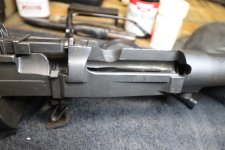
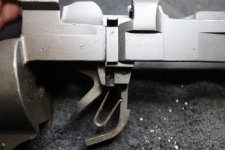
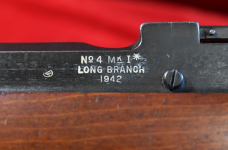
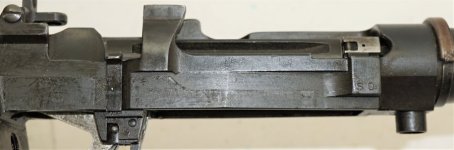
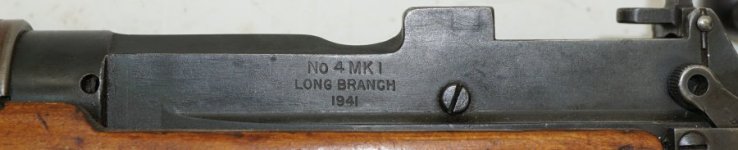
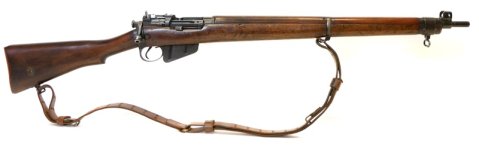
1942 Long Branch No.4 MkI* built on a MkI Receiver ?

chiefrench

New member
Super GunNutz
Rating - 100%
49   0   0
Location
Ottawa Valley
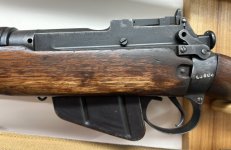
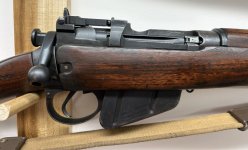
Correct me if I am wrong but I alway's believed that the bolt release location/method designated the difference between a No.4 Mk I and Mk I* receiver. The Mk I bolt release is located at the rear of the boltway and is a spring catch/latch. The Mk I* located at the front of the boltway and is a machined slot. Having said this I have a 1942 dated Long Branch No.4 MkI* serial #16L###X but it has the first style bolt release associated with the early 1941 Mk I receiver.
I am hoping for some thoughts and insight.
Thanks, Mark
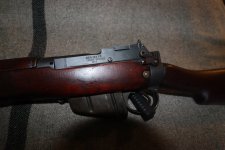
 

Attachments

  • IMG_1190.jpeg
    IMG_1190.jpeg
    77.9 KB · Views: 82
  • IMG_1186.jpeg
    IMG_1186.jpeg
    114.2 KB · Views: 84
  • IMG_0983.jpeg
    IMG_0983.jpeg
    81.2 KB · Views: 81
  • IMG_0980.jpeg
    IMG_0980.jpeg
    73.8 KB · Views: 84
interesting rifle, the stock looks like an earlier stock with the low sidewall as well.

perhaps it was an incomplete rifle that got put aside and forgotten about for a few months and then found its way back onto the production line.
 
Correct me if I am wrong but I alway's believed that the bolt release location/method designated the difference between a No.4 Mk I and Mk I* receiver. The Mk I bolt release is located at the rear of the boltway and is a spring catch/latch. The Mk I* located at the front of the boltway and is a machined slot. Having said this I have a 1942 dated Long Branch No.4 MkI* serial #16L###X but it has the first style bolt release associated with the early 1941 Mk I receiver.
I am hoping for some thoughts and insight.
Thanks, Mark
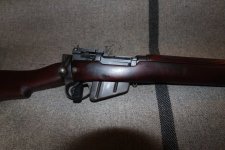
The 16L serial number is nicely in the middle of Stratton's serial number range for 1942. He approximates Mk I production in 1941 and Mk I* production in 1942. He gives a few other distinguishing features that would have to be measured on the receiver to fit it into one of his categories. This is not to say Stratton is the oracle, but the best efforts of a writer who tried pre-internet to write on a complex subject.
 
interesting rifle, the stock looks like an earlier stock with the low sidewall as well.

perhaps it was an incomplete rifle that got put aside and forgotten about for a few months and then found its way back onto the production line.
Yes it is an earlier stock as the later stock would not accommodate the spring catch bolt release. The earlier stock has a cut-out/inlet to let it work. Thanks
 
Interesting rifle! My oddball 6L 1941-dated body with both Mark I and Mark I* bolt release mechanisms also has the "SD" in on the cutoff block. Possibly the initials of the gentleman who reworked defective bodies into serviceable ones that were then inserted into standard production?


DSC07094.JPGDSC07045.JPG
 
It has been some years since I played with Lee Enfield #4 rifles. What "trick" exists to confirm that a mod was done at the rifle factory and not by some home guy in his workshop - maybe 20 years after WWII?? That would still be like 60 some years ago?
 
Interesting that 6L is probably the highest numbered 1941 MkI receiver out there and to have both bolt release mechanism. Interesting theory about the "SD" marking on both receivers in the same place.
 
Yes it is an earlier stock as the later stock would not accommodate the spring catch bolt release. The earlier stock has a cut-out/inlet to let it work. Thanks
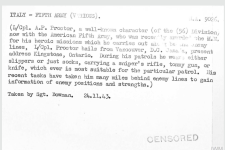
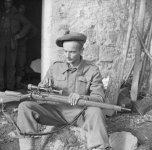
I believe the low sidewall of the early design forestock was there, originally, to accommodate the cartridge cut off and did not effect the bolt removal release. While the cartridge cut off was never a feature of the production No4 rifle, the boss for it appears to remain on the front right of the receiver. The cut off was a part of the 1930's design rifles. Image of the 1933 trials rifle from the internet (I don't have one of those, wish I did) as is the image of Proctor with one that was converted to a sniper rifle.

trials Lee Enfield No.4.jpg
Lee Enfield .303 No.4 MK1 bolt action trials rifle, 25inch barrel with aperture sight graduated to 1300 yards, the action fitted with magazine cutoff catch, the bolt with early style cocking knob, early style shaped foresight protectors, the receiver with milled pocket for the safety catch, the wrist joint stamped with a crown and GR Enfield 1933 No.4 MkI, the receiver stamped with sold out of service arrows along with 'Fultons Regulated', the butt stock fitted with brass disk, serial number A0846 to wrist joint, bolt and forend, Birmingham proofs. Fitted with a period leather sling. Estimate £800 -1,200

proctor1.PNGproctor2.JPG
 
I think that the oddities found on some No4 rifles, around the time of the transition from Mk1 to Mk1* rifles, are cool. My 1941 No4 Mk1 0L6298 is pretty standard fare for early LB Mk1 production. It does not have the curved sight protector or the hinged front barrel band. My 1942 No4 Mk1* 1L6804, close serial to OP's rifle, is pretty standard fare for an early Mk1* production but does have a button cocking piece.

1942 No4 Mk1*
421.jpeg422.jpeg
 
Interesting that 6L is probably the highest numbered 1941 MkI receiver out there and to have both bolt release mechanism. Interesting theory about the "SD" marking on both receivers in the same place.
that SD mark is a very interesting coincidence

and yes it was the low cut sidewall stock that I was talking about you can see the difference in the post above, not a low cut, and the WW2 picture with the low cut.
 
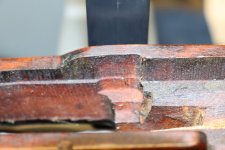
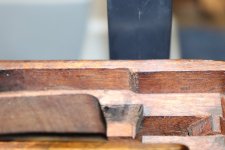
I agree the low cut side wall was to accommodate a magazine cut-off and had nothing to do with bolt release. But and big but is the earlier stocks have an inlet/cutout on the inside of the stock as well. It is located behind the magazine cut- off cutout to accommodate the spring catch bolt release. Let's not compare British and Canadian No.4's on this topic. The Brits had to keep the modification on the inside as they kept the Mk I action. I assume when Long Branch completely switched to the Mk I* action they stopped making the inlet inside the stock for the spring release. Later Long Branch stocks will not work with this action without modifying the inside to give clearance for the spring release to be depressed. If you put this action in a later Long Branch stock (unmodified) the release catch cannot be depressed.


 
Last edited:
Here is a picture of a forend from a Long Branch Mk I action and a later forend from a Long Branch Mk I* action. The cutout/inlet which allows the bolt catch release to be depressed is clearly visible on the earlier forend.
 

Attachments

  • IMG_1289.jpeg
    IMG_1289.jpeg
    87.8 KB · Views: 4
  • IMG_1292.jpeg
    IMG_1292.jpeg
    70 KB · Views: 4
Here is a picture of a forend from a Long Branch Mk I action and a later forend from a Long Branch Mk I* action. The cutout/inlet which allows the bolt catch release to be depressed is clearly visible on the earlier forend.

Yes that is correct the Mk I* stocks did away with the inletting for the bolt head release and the low wall cut out.

even the picts you posted show the low wall and bolt release inletting on the Mk I stock and that both features were omitted on the Mk I*
 
Back
Top Bottom