Old Mauser Identification

oberndorf

CGN Regular
Rating - 100%
27   0   0
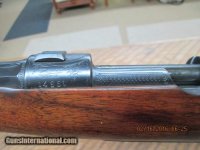
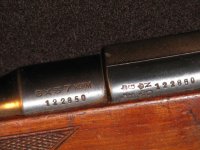
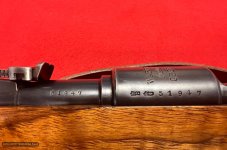
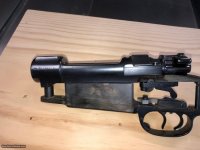
Hello, I have this old Mauser 98 and wondering if this is an old military action. There is no makers name on the rifle. There is a serial# and a few markings that I am sharing pictures of. No calibre marking but it is 8mm

Looking for any information maker, dom, proof marks etc..

Thanks for any help


93ec0626-b280-49b3-9837-37d9b1152d47.jpg


5bc28f18-bdea-401c-8053-0d728faafd22.jpg


afcfcb90-1f9f-41ea-9ef1-e201f5e880a2.jpg


cf7304b4-52b5-4af9-88cf-cf9e01a8cbf8.jpg


e7bb42b1-b2e8-4aa2-b415-2447afcd4221.jpg


ae597880-305c-47d2-be4d-97938689b63c.jpg


2d882ce1-0e7f-4d51-a1f7-39f3c719c94b.jpg


2e570c82-0ba6-4281-ad05-605b71535715.jpg


1fbf15d9-b912-4b46-a934-a13bc21b9f32.jpg


bf7eeb43-2b3b-45bf-98a4-75ba24c81af4.jpg
 
After WWI, there were dozens of small, cottage type shops turning out rifles similar to the one you have.

Check the bore diameter by slugging it with a lead round ball and measuring it with a micrometer. If you don't have the round ball or micrometer, just about any decent gun shop with a smith can do it for you. Or a good buddy with the right tools.

The rifle you have may have a .318 inch diameter bore or a .323 inch diameter bore.

Many of these fine rifles have some very good work put into them, and your double set triggers look very good to me. Learn how to utilize them, and you will come to love them. Don't take them apart, or let anyone else take them apart, unless they know how to set them up again.

A lot of these rifles have had the original manufacturer of the receivers names scrubbed but still retain inspector marks, such as the rifle you show.

It's impossible to tell who built it, but the inspector's marks in your pics.

Google German or British Rifle inspection stamps 1920-1938.

That rifle may have been built up from a left over receiver or on a surplus military receiver.

It may have been done in Germany, Belgium, England, or one of the other western european nations, and it doesn't appear to have anything distinctive about it. They were pretty much all built in a similar version, unless they were special order.
 
It looks like a commercial pre-war Oberndorf action, judging by the pear-shaped bolt knob. The thumb slot and clip bridge mean nothing, because they all had that, even the magnums. The barrel is lacking the steps of a military action, and it has the low-cut tang of a commercial action.

It's odd that the Mauser Werke markings have been scrubbed off. It may not have been completed by Mauser, but somebody used a commercial Mauser action or barreled action.
 
The culmination of Mauser’s efforts was his Model 98 rifle adopted by Germany in April 1898. Mauser 98 commercial sporters were developed soon thereafter and were introduced at about the turn of the century. Made in rifle and carbine versions, they were produced by either Waffenfabrik Mauser (Mauser Arms Co.) in Oberndorf am Neckar, a town in southwestern Germany, and are often called Oberndorf Mauser sporters for genuine high quality Mauser commercial sporters or by small custom gun-makers using factory or military inspection reject actions and or later military surplus actions.

The Mauser firm calls them “genuine” or “original” Mauser sporters to set them apart from the many inferior rifles made up with factory-rejected, out of spec or worn but still usable military parts. Most if not all early original commercial Mauser specimens are marked Waffenfabrik Mauser A.-G. (A.-G. Stands for Aktiengesellschaft, which means Limited or Inc.) on the receiver ring. Those produced later have the markings Waffenfabrik Mauser or Mauser-Werke A.G. on the receiver’s left wall. Some later specimens bear the Mauser banner trademark on their receiver rings. Mauser Co. markings are also on many original Mauser actions used by Rigby and various other reputable gunmakers that produced sporters. The popular term Mauser 98 sporter can be considered generic, but it is often taken to mean an original Mauser sporter.

Smaller gunsmith made inferior rifles made up with factory-rejected or worn military actions tend to be un-marked or scrubbed of markings besides the mandatory proofing marks.

Metal finish of the above action and bolt do not match the higher quality typical of pre-war sporting/commercial Mauser rifles. Also all genuine Mauser made German commercial actions were serial numbered and proofed marked on the left side of the action above the wood line.

And the bolt on this rifle is not fully serial numbered on the top of the bolt handle as was the practice for genuine Mauser commercial bolts.

The “2,75g G.B.P. S.G.” stamp on the receiver means it was proofed with 2.75 grams of Gewehr Blattchen Pulver (Military Flake Powder) Stahl-mantel Geschoss (steel jacketed bullet). This marking was used between 1899 and 1901 specifically at the Suhl proof house and should indicate 8mm Military issue ammo as the calibre and round it was proofed for. This is very likely a surplus rifle that was modified later by a commercial company to be a sporting rifle. It was pretty common in Europe between 1890 and 1960 as so many outdated military rifles existed.

Another reason I know it is not a real commercial Mauser sporter is where it was proofed at. Many custom made up Mauser 98 rifles were produced in Suhl by the many and various gunsmiths located nearby unlike genuine commercial Mauser's (which were all typically proofed at the Mauser factory in Oberndorf), custom or small lot contracted rifles often show Suhl these proofs indicating non Oberndorf heritage.

2.75 grams, which is approximately 42.4 grains is the mark which signifies the rifle was proof tested with a standard service proof charge of 2.75g of flake powder and a steel-jacketed bullet at the time.

The lack of a nitro proof (always seen with crowns over and in front of the N after the “2,75g G.B.P. S.G.” stamp) on the above wood-line also means it was not a commercial proof. The crown over the N on the bottom of the receiver means it was a military made action. This specific marking formula was commonly used before 1912. And it usually designates the earlier 8x57mm (often 8x57I or 8x57J, with a .318" bore).

Pure speculation on my part, but the cartridge it is still chambered for is very probably the time honoured 8x57mm Mauser and if the date we surmise is correct it is most likely the earlier .318 groove diameter rather than the later 1905 military adopted .323 groove diameter unless later changed but then it's proof would have changed too.

Appears to be just another pre-WW1 military surplus or factory reject but still serviceable refinished action.

Here are some examples -


img_9052-1951110887-o-jpg.75520


mauser_receiver_stamp.jpg


dsc02692-jpg.3220487


100664870_30_5799DA392394C3A1.JPG

IMG_9273-1951372819-O.jpg
 

Attachments

  • WAFFENFABRIK-MAUSER-AG-OBERNDORF-A-N-1912-ORIGINAL-COMMERCIAL-SPORTER_102168314_93969_CEAF89D...jpeg
    WAFFENFABRIK-MAUSER-AG-OBERNDORF-A-N-1912-ORIGINAL-COMMERCIAL-SPORTER_102168314_93969_CEAF89D...jpeg
    96.9 KB · Views: 6
The culmination of Mauser’s efforts was his Model 98 rifle adopted by Germany in April 1898. Mauser 98 commercial sporters were developed soon thereafter and were introduced at about the turn of the century. Made in rifle and carbine versions, they were produced by either Waffenfabrik Mauser (Mauser Arms Co.) in Oberndorf am Neckar, a town in southwestern Germany, and are often called Oberndorf Mauser sporters for genuine high quality Mauser commercial sporters or by small custom gun-makers using factory or military inspection reject actions and or later military surplus actions.

The Mauser firm calls them “genuine” or “original” Mauser sporters to set them apart from the many inferior rifles made up with factory-rejected, out of spec or worn but still usable military parts. Most if not all early original commercial Mauser specimens are marked Waffenfabrik Mauser A.-G. (A.-G. Stands for Aktiengesellschaft, which means Limited or Inc.) on the receiver ring. Those produced later have the markings Waffenfabrik Mauser or Mauser-Werke A.G. on the receiver’s left wall. Some later specimens bear the Mauser banner trademark on their receiver rings. Mauser Co. markings are also on many original Mauser actions used by Rigby and various other reputable gunmakers that produced sporters. The popular term Mauser 98 sporter can be considered generic, but it is often taken to mean an original Mauser sporter.

Smaller gunsmith made inferior rifles made up with factory-rejected or worn military actions tend to be un-marked or scrubbed of markings besides the mandatory proofing marks.

Metal finish of the above action and bolt do not match the higher quality typical of pre-war sporting/commercial Mauser rifles. Also all genuine Mauser made German commercial actions were serial numbered and proofed marked on the left side of the action above the wood line.

And the bolt on this rifle is not fully serial numbered on the top of the bolt handle as was the practice for genuine Mauser commercial bolts.

The “2,75g G.B.P. S.G.” stamp on the receiver means it was proofed with 2.75 grams of Gewehr Blattchen Pulver (Military Flake Powder) Stahl-mantel Geschoss (steel jacketed bullet). This marking was used between 1899 and 1901 specifically at the Suhl proof house and should indicate 8mm Military issue ammo as the calibre and round it was proofed for. This is very likely a surplus rifle that was modified later by a commercial company to be a sporting rifle. It was pretty common in Europe between 1890 and 1960 as so many outdated military rifles existed.

Another reason I know it is not a real commercial Mauser sporter is where it was proofed at. Many custom made up Mauser 98 rifles were produced in Suhl by the many and various gunsmiths located nearby unlike genuine commercial Mauser's (which were all typically proofed at the Mauser factory in Oberndorf), custom or small lot contracted rifles often show Suhl these proofs indicating non Oberndorf heritage.

2.75 grams, which is approximately 42.4 grains is the mark which signifies the rifle was proof tested with a standard service proof charge of 2.75g of flake powder and a steel-jacketed bullet at the time.

The lack of a nitro proof (always seen with crowns over and in front of the N after the “2,75g G.B.P. S.G.” stamp) on the above wood-line also means it was not a commercial proof. The crown over the N on the bottom of the receiver means it was a military made action. This specific marking formula was commonly used before 1912. And it usually designates the earlier 8x57mm (often 8x57I or 8x57J, with a .318" bore).

Pure speculation on my part, but the cartridge it is still chambered for is very probably the time honoured 8x57mm Mauser and if the date we surmise is correct it is most likely the earlier .318 groove diameter rather than the later 1905 military adopted .323 groove diameter unless later changed but then it's proof would have changed too.

Appears to be just another pre-WW1 military surplus or factory reject but still serviceable refinished action.

Here are some examples -


img_9052-1951110887-o-jpg.75520


mauser_receiver_stamp.jpg


dsc02692-jpg.3220487


View attachment 1110881

View attachment 1110882

Nice write up! Lots of good info, thanks!
 
Thank you everyone for all the great information ans pics. I was confused by the bolt handle shape, set trigger and the barrel is not stepped like a military barrel.

My gunsmith slugged the barrel confirmed that it is .323.
 
Last edited:
  • Like
Reactions: DGY
The action sports a thumb cut and stripper clip cut. Mig may have the right lead on the .318.
I believe all of the "commercial, as well as military 98s" had the thumb cut outs until after WWII, when scope mounting became an option.

Stripper loading was an accepted and practiced way of carrying spare cartridges and easily loading them into the mag well in those days.
 
Thank you everyone for all the great information ans pics. I was confused by the bolt handle shape, set trigger and the barrel is not stepped like a military barrel.

My gunsmith slugged the barrel confirmed that it is .323.
IMHO, it's not a commercial action. If it were, the manufacturer's name would still be present on the receiver ring and likely a banner on the rear bridge. I've never seen a "scrubbed" commercial receiver, but that doesn't mean it didn't happen.

The bolt handle and barrel could easily have been purchased separately. All of that stuff was available directly from the factory back then, and the cottage makers took great advantage of that policy.
 
It looks like a commercial pre-war Oberndorf action, judging by the pear-shaped bolt knob. The thumb slot and clip bridge mean nothing, because they all had that, even the magnums. The barrel is lacking the steps of a military action, and it has the low-cut tang of a commercial action.

It's odd that the Mauser Werke markings have been scrubbed off. It may not have been completed by Mauser, but somebody used a commercial Mauser action or barreled action.
The barrel has a military front sight and the steps are hidden by the band for the front sling and rear sight ,note step right after the action.
 
I believe all of the "commercial, as well as military 98s" had the thumb cut outs until after WWII, when scope mounting became an option.

Stripper loading was an accepted and practiced way of carrying spare cartridges and easily loading them into the mag well in those days.
Yes, the stripper clips were called "Ladestreifen". Hence the guns were called "Streifenlader".

And no, not all commercial Oberndorf actions before 1914 were "military" actions with thumb cut. Your believe is wrong.

Just so you know and can learn a little.
 
I know the 91/93/95 commercial actions sometimes didn't have the thumb cut out, but I haven't seen an early 98 commercial or military action without them
 
I know the 91/93/95 commercial actions sometimes didn't have the thumb cut out, but I haven't seen an early 98 commercial or military action without them


Yeah Bearhunter, they did make some, but they are very rare and mostly in the Double Square Bridge models (for scope mounting) and some special order Model B and some Carbine versions that were mostly made during the between the wars (ww1-ww2) period but they did keep making them on special order right up until 1945.

They basically were a special order option and because of it very few are seen outside of collections. Because of it there are far more Type B Mausers in the U.S. in collections taken as war souvenirs during WW2 than there now left in Germany

I have seen these stripped actions alone go for over $5,000 USD in auctions when they come infrequently up onto the market.

Here is an example -


Double-square-bridge-Oberndorf-Mauser-action_101591908_85155_F0D4992C149BE0B41.jpg
 
Last edited:
Back
Top Bottom