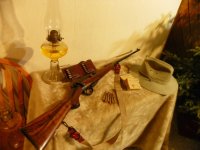
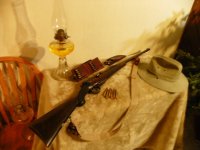
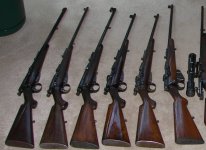
Lee Speed?

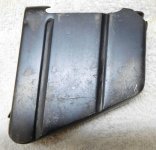
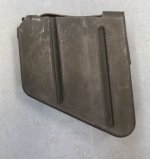
Potashminer is right; that's a #4 magazine that someone stuck in there. Note the rib at the back does not go all the way to the bottom of the magazine, compared to the #1 magazine. Plus, you should notice the bottom extension of the rear magazine locking rib on a #1, while a #4 only goes down about halfway.
 

Attachments

  • #1 magazine.jpg
    #1 magazine.jpg
    131.2 KB · Views: 3
  • #4 magazine.jpg
    #4 magazine.jpg
    110.8 KB · Views: 3
This one is in not bad shape however the barrel is allowing it to keyhole. When I tried to slug it I got .317, it must have seen some corrosive ammo I'm guessing. Not sure how one would go about finding a new barrel so will need to figure out a value and sell it.
It's pretty hard, at least without V-blocks, to slug the barrel of a Lee Enfield, or for that matter, a lot of British rifles, because they used an odd number of lands & grooves.
 
Shoot it first before you decide to do any work to it. It may shoot well. Slugging a Lee Enfield is a waste of time without proper measuring tools. My gauge is a 180 gr round nose bullet which I have used for over 10 years. Bullet goes in the muzzle nose first. If it goes to the crimp groove the barrel is well worn. If the crimp groove is 1/4” above muzzle, tight bore. Use a round nose due to it being fatter out front 0.311 or 0.312.
 
Shoot it first before you decide to do any work to it. It may shoot well. Slugging a Lee Enfield is a waste of time without proper measuring tools. My gauge is a 180 gr round nose bullet which I have used for over 10 years. Bullet goes in the muzzle nose first. If it goes to the crimp groove the barrel is well worn. If the crimp groove is 1/4” above muzzle, tight bore. Use a round nose due to it being fatter out front 0.311 or 0.312.
I am sure the poster knows, but for those readers that do not - "slugging" the "bore" (properly) will tell you the groove diameter of the barrel - inserting something into the muzzle will tell you the "bore" diameter - the diameter of the tops of the rifling - the size of hole that was reamed in there BEFORE the grooves were cut (at least in the old days - I suspect is all done at once with "new fangled" compression and hammer forging, now-a-days). But I whole heartedly agree with the first point - shoot it and find out what it can do - try 0.3105" bullets, 0.311" bullets, 0.312" bullets - various shape rear ends - flat base and boat tail; various shape front ends - Spitzer, Round Nose, FMJ, Soft Point; cast and jacketed - something might work to be just fine.
 
It appears folks are assuming it is chambered in .303 Brirish. Perhaps with good reason. The diameter of the bore and jamesharrison's post suggest it might not. Is there any marking on the barrel that would indicate caliber?
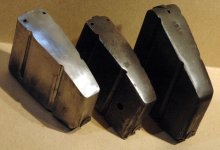
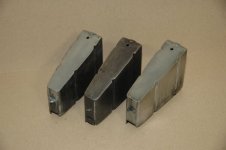
In response to potashminer's post - I have recreated both Lee Speed style fish belly magazines and Cavalry Carbine magazines. No 1 style magazines are the starting point. Never No 4 and I tended to avoid the use of earlier style magazines due to their scarcity.
Commercial fish belly
CM85A.JPG
LMC/LEC
Repro Mags 3.JPG
 
Last edited:
you can see the barrel proof marks, its stamped 303 so that and the fact that a bullet drops through the rifle tells me its worn.

there is the remote possibility it was reamed out but anyone that would do that would have marked it.

I need to dig out my commercial sporter again
 
The .315 that was chambered in the Lees was actually what was called, at least in England & the Empire, the .500/320, but which was nothing other than the 8x50R Austrian Mannlicher.

It is actually much rarer over here than the .375 Fl. N.E. 2 1/2", although not as rare as a Lee Speed chambered for the 7x57 Mauser.

The .32-40 chambered rifles were not actually Lee Speeds & the .256 Fraser Flanged [6.5x53R] complete rifles were never made by B.S.A.Co. or L.S.A.Co.Ld., the only 2 manufacturers of Lee Speed & the later commercial Lee Enfields like the OP's rifle, but were made up on B.S.A.Co. commercial actions by Fraser, McDougall & a couple of other Scottish "makers" for highland stag, as cheaper alternatives than Holland's M1895 Dutch Mannlicher or Farquharson-based single shot rifles in that chambering & to compete with Jeffery's offerings, also based on the same actions.


I would like to find one in 256 Flanged

if reamers weren't so expensive..... :)
 
So what is it worth $100 or $1000? It's in decent shape for it's age other than a very worn/corroded barrel. It has a very nice rear sight and functions.

 
I generally jump on buying these guns, but not because they are particularly great shooting guns, but rather they are classy gals that are lots of fun just to try to get baseball sized groups out of.
I have had two of these commercial BSAs that are pretty well identical to the OP's, but with the proper magazines (they were $450 and $650 for reference). I still have one (gave the other to my buddy so we compete against each other for the "best of the worst" target shooting); the one I kept was at one point little misstreated by Bubba resulting in the standing leaf on the cape sight was filed down and a Williams peep sight added. The peep sight makes it an easier rifle to shoot (the reason I kept that one). Mine has a .314 bore and metford rifling to boot, and keyholed with various types of .311 bullets. My solution was to buy 8mm .323 Speer SP bullets and squish (swage) the bullets to .314 in Lee bullet sizes (https://leeprecision.com/bullet-sizers-punches). At 8 USD for the sizer and a tube of Alox lube, it's a pretty cost effective solution to keep the old girls running. Mine is hardly a target gun but I can keep my groups inside 4" at 100 now and I might just win the little contest...


 
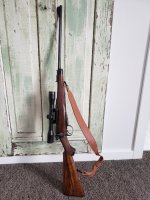
Sacrilege?, maybe. But I got it at a pretty reasonable price as the butt plate was missing, mismatched bolt, and it was drilled and tapped for a weaver side mount. Needs more of and old skool 2.5 on it though. But still light and comes up quick.
 

Attachments

  • 20260321_140449.jpg
    20260321_140449.jpg
    153.8 KB · Views: 15
Back
Top Bottom