- Location
- WMU248 near Edmonton
the one in the photo looks too short to make an exact copy, ie: cutting the barrel down.
yes that is an issue, but I did one with a 14" barrel in 44Rem Mag

but then you need to start with a barrel blank













































the one in the photo looks too short to make an exact copy, ie: cutting the barrel down.
Just realized those service members appear to be WACs.

Really enjoy his military histories. - danJust started into Max Hastings The Korean War and will be keeping an eye open if these trophies are mentioned. BTW the wartime Luftwaffe forbid taking captued Il-2 to flight as it was a accident/failure waiting to happen.

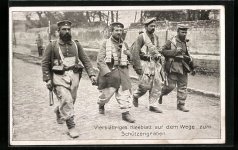
Literal translation of the caption below these 4 soldiers is: "Four leaf clovers on the way to the trenches".View attachment 1111728
Headed up front. Four guys who appear to know what they're about. And twenty years later, their kids will go again.
You'd think we'd fvcking learn.

At the end of the 1950s the Italian Ministry of Defense asked Moto Guzzi to develop a special vehicle for the Alpini. At that time, the only "means of transport" for the Italian Alpine troops was still the mule. General Ferruccio Garbari was indicated as project director and formulated numerous requirements that the vehicle would have to satisfy: it had to carry 500 kg of cargo in all types of terrain, especially in mountainous areas and on very narrow paths. The development was initially entrusted to Antonio Micucci and later elaborated by Soldavini and Giulio Cesare Carcano. Carcano had just built a new V-twin engine, for which Moto Guzzi management saw no practical outlet. There were two versions, a 500 cc, and a 650 cc unit designed for the Fiat Nuova 500, but the Turin house withdrew from the project. Carcano then saw another possibility to put his engine to use.
The "Mechanical Mule" was a very special machine, with three driving wheels and the possibility of varying the wheelbase and track. The 754 cc engine delivered just 20 hp, due to the low compression ratio, made inevitable by the tactical need to consume, when needed, poor quality petrol. However, the maximum torque of 47 Nm was already reached at 2400 rpm. There was a single 26mm Weber carburettor, and the ignition coil was waterproof.
The frame was made of pressed steel tubes and beams. The rear suspension consisted of two girder arms cushioned by rubber blocks. A single-sided telescopic fork with coil springs was applied to the front wheel. Steering was achieved by a steering wheel served by bevel gears. The driver sat on a motorcycle saddle, but all controls were actuated by automotive-type levers and pedals. There was a center differential with a locking device to prevent the wheel with the least grip from bogging down. Traction was distributed 20% to the front wheel and 80% to the rear. Rear wheel drive was accomplished by two universal joints reaching the wheels diagonally from the differential; the front one through another cardan that connected the engine to the wheel through the steering wheel. The rear drum brakes were operated hydraulically, the front one with a Bowden cable. Behind the rear wheels were tension rollers, to which a track could be attached. The front fender left enough room to fit a snow chain. Nonetheless, the Autoveicolo da Montagna disappointed expectations. As long as it was frontal gradients, it was really capable of dealing with very steep slopes, but laterally it was easy to tip over, especially because of the three wheels. On mountain routes, a too tight curve or the presence of boulders was enough to stop the Mechanical Mule, whereas the "real mule" would have continued undaunted. Also for this reason, the production of the three-wheeler ended in 1963.
From 1960 to 1963 the company built 420 mulos - 20 prototypes and 200 each of the 1st and 2nd series.
The heart of the "Moto Guzzi 3x3" is a V-twin engine of 754cc delivering 20 PS at 4,000 rpm, fueld by a Weber carburretor. This engine was developed by Carcano as an experiment, and was subsequently modified to to obtain a maximum speed of 50 km/h. The 6 speed gear box was equipped with a reverse gear which drives the front wheel, with forward transmission delivered to the two rear wheels via cardan shaft, and also to the front wheel giving 3-wheel drive.
A central differential distribute the transmisson between front and rear wheels and has a manual lock-out - also the rear differential has a lock-out.
Additionally, to allow navigation on the narrow pathways common in Italian mountains the rear wheel track may be varied from a maximum of 1300 mm to a minimum of 850 mm.
The Mulo has a maximum load rating of 500 kg.
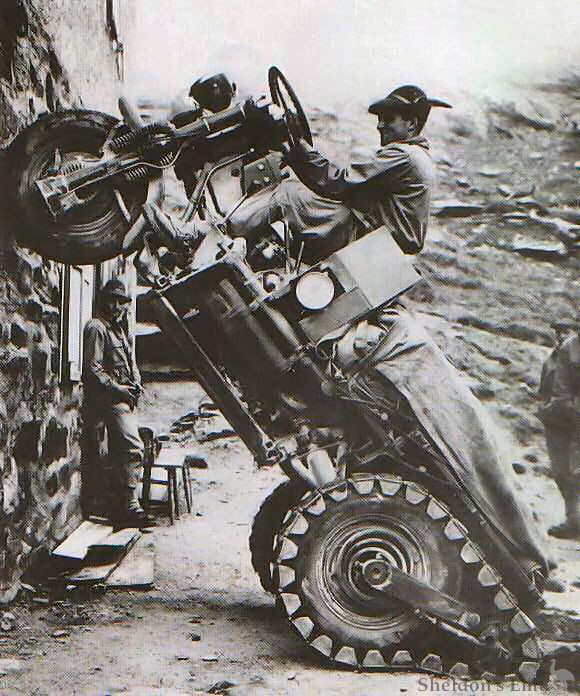
I want that.The Moto Guzzi Mulo Meccanico 3x3:


View attachment 1111728
Headed up front. Four guys who appear to know what they're about. And twenty years later, their kids will go again.
You'd think we'd fvcking learn.
Oooh, want. - danThe Moto Guzzi Mulo Meccanico 3x3:

The TEMU Kettenkraftrad.
That looks very..................Italian.The Moto Guzzi Mulo Meccanico 3x3:
The TEMU Kettenkraftrad.
French sniper with an FRF2 sneaking back into the barracks..........
View attachment 1114351
Well, nicely spotted! My FRF2 has the Scrome J8.Wow! It almost looks like a painting. Thank you for posting that.
Neat FRF2 as well. It has all the stock spacers mounted. This photo is likely pre-1995 as the scope being used is the APX L-806-04, a variant of the older APX L-806, but with a ballistic reticle for 7.62 Nato instead of the earlier 7.5 French. They were phased out in favour of the Scrome J8's circa 1995.
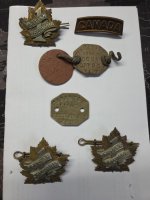

Dont ever loose those. They will tell a story if you do some research.My mother in law has been moved into assisted living now and my wife and I were cleaning out her house over the last week. The house used to belong to my grand-mother-in-law if that's the correct term (my wife's grandparents). In a basement storage room I luckily spotted these in a box that was destined for the landfill so they came home with me instead. My wife or her dad didn't recognize the name on the WW1 era dog tags. As per Google Lens the badges are WW1 era Canadian Expeditionary Force cap badges?
View attachment 1115236