Subsonic .223 with Titegroup

But honestly, rather than making assertions or statements from "feels" or "thinks", go read a few reloading manuals and educate yourself. You'll be better off for it, and truly enjoy reloading and experimenting.
 
Regarding powder burn rates. It's less to do with barrel length than it is with controlling the pressure from ignition to bullet leaving the barrel (leave aside semi automatics, because they add more nuance).

I don't have time to get into an essay about it but PLEASE don't go comparing a given charge in .22LR with one in .223. The case volumes are far too different. That .22LR also uses a soft lead bullet that is lighter than the typically jacketed .223.

I ran into problems years ago using "The Load", which involved a light charge of Red Dot behind a cast bullet in .308.

One shot felt just like every other, except I had to hammer the bolt open, and found the primer pocket had just about doubled in size - no doubt one of those random high pressure events that you can get with small charges of fast powder in a large case.

What I'm saying is that you need to be careful. In fact if you're a new reloader you shouldn't even be playing with strange recipes
 
Thanks for the advice.

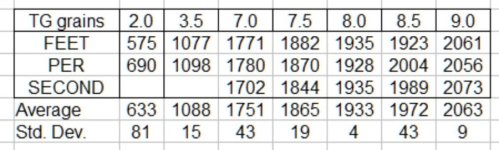
Although I hoped I could find some way around it, I'm going to have to rent a chronograph before I go to the range to shoot a set of reduced loads that starts off with 3.5 grains downward. I should know within a very few shots what amount of Titegroup will propel a Campro 55-grain fmj out of a 9.5" barrel to obtain a speed of between 900 and 1,000 fps.

Thanks again.
 
Thanks for the advice.

Although I hoped I could find some way around it, I'm going to have to rent a chronograph before I go to the range to shoot a set of reduced loads that starts off with 3.5 grains downward. I should know within a very few shots what amount of Titegroup will propel a Campro 55-grain fmj out of a 9.5" barrel to obtain a speed of between 900 and 1,000 fps.

Thanks again.
Sight in your rifle at 40 metres and try to get a drop of 7 inches at 100 metres you will probly be around 1000fps if your scope is 1.5 inches above bore
 
Interesting...might have to try some some .308 now. Also this has got me thinking about trying .22 Hornet level loads since I have a bunch of 4227 powder.
Hey barry , what is the report on 4227

I have been told to use it as Black Powder replacement . 3 1-2 gr of 4227 instead of 20 gr Blk Pwdr in cartridges
.....skwerl
 
If you are after subsonic 223 with TiteGroup with no chronograph start at 4gr and load up a few dropping .1gr per load and listen for super sonic crack.
When you find the load with no crack drop another 1/10 to be sure and load up a bunch.
After that play with seating depth to improve groups if need be.

If you are into reloading a chrono is certainly a nice have though.
 
3.1grs Titegroup is 15% load density

6.2grs would be 24k psi / 1823 fps

9.3grs would be 43k psi / 2240 fps

12.4grs would be 67k psi / 2590 fps (58% load density)

15.5grs would be 95k psi / 2900 fps (72% LD)

18.6grs would be 131k psi / 3174 fps (87% LD)

21.7grs would be 178k psi / 3440 fps (101% LD)

I'm always leary of loads that will take multiple charges and still fit in the case. A guy could think he had H335 in the powder hopper and start charging cases with 23grs Titegroup
todbartell, that's a nice table. I'm particularly interested in the chamber pressures associated with each charge of Titegroup because I'm using Titegroup. Do you remember your source for this information and, if so, can you provide a link to that information? Thanks.

I've pretty much decided on the charge of Titegroup I'm going to use on the low-fps end of the scale. Now I'm turning my attention more to the higher end -- obviously, the more dangerous end, so I'm going to go a bit Off Topic and moderators should simply delete this post if I've gone too far.

In addition to reduced-load, low-fps rounds, I'd also like to produce a much smaller number that are least somewhat similar to the PMC bronze rounds that I have, which are 55 grain and supposedly 3200 fps. Maybe this goal is simply impossible using Titegroup, but maybe I can get close enough.

I found Wikipedia's information on .223 Remington here:

https://en.wikipedia.org/wiki/.223_Remington

Pressures

Remington submitted the specifications for the .223 Remington cartridge in 1964 to SAAMI. The original pressure for the .223 Remington was 52,000 psi with DuPont IMR Powder. A higher pressure of 55,000 psi (379 MPa) resulted from the change from IMR to Olin Ball powder. The official name for .223 Remington in the US Army is cartridge 5.56x45mm ball, M193. If a 5.56×45mm NATO cartridge is loaded into a chamber intended to use .223 Remington, the bullet will be in contact with the rifling and the forcing cone is very tight. This generates a much higher pressure than .223 Remington chambers are designed for.

I notice on the same source that the 5.56 NATO cartridge is designed for a significantly higher chamber pressure, but the only reason I mention that is because my gun is 223 Wylde caliber, which can supposedly shoot both 223 and 5.56 equally safely, which means its chamber (and bolt, etc.) must be designed to accept the higher chamber pressure. (I won't be trying to turn a 223 Remington round into a 5.56 NATO round performance-wise, so don't warn me against trying.)


If the above chart is pretty accurate, it indicates that a 9.3-grain charge of Titegroup in a 223 Remington-caliber case produces a chamber pressure of 43k psi with a resulting bullet speed of 2240 fps (neither the weight of the bullet nor the length of the barrel are mentioned, but that's OK with me because I'd like to focus solely on the chamber pressure at the moment); and that 12.4 grains would produce a chamber pressure of 67k psi with a resulting bullet speed of 2590 fps, which is well above the SAAMI 55K-psi pressure limit for 223 Remington-caliber cartridges.

To those of you who have used or are using Titegroup in 223 Remington, does all of the above boil down to mean that the maximum charge of Titegroup that can safely be used in a 223 Remington cartridge would be roughly 10 grains, or is even 9.3 grains too much Titegroup to be using in a 223 Remington cartridge? Again, I'd prefer to hear from people who are using, or have used, Titegroup in 223 Remington, espcially those who have marched the charge upward in small increments using a chronograph to confirm the corresponding increase in fps and determined for themselves the practical upper limit of the charge of Titegroup for their firearm.

Thanks.
 
Back
Top Bottom