












































You are using an out of date browser. It may not display this or other websites correctly.
You should upgrade or use an alternative browser.
You should upgrade or use an alternative browser.
1893 Mauser action strength
- Thread starter Canadian Bush Sniper
- Start date
- Location
- Western Manitoba
European rifles (including 1893 Mausers made in Germany?) were "proof tested" at the time they were sold to civilians - so "back then" they could be very strong. North America - USA and Canada - never had "proof laws" - so you are free to make whatever and sell it - under threat of getting sued if you mess up, here. So, at one time, a European gov't "proof house" said that rifle met standards, then and at that place - of course, you might hope that a competent person might pick up how the metal or heat treat has been altered since that "proof test"was done - whenever. Amount of corrosion / amount of firing / amount of abuse all affect whether or not the thing is still "in proof" or not. The only way to know, for sure, about the current strength is to have it proof tested now. Your rifle will have a stamped code to show when it was "proofed" - various charts will show what year or years that was.
It is a ovido made in Spain in 1924European rifles (including 1893 Mausers made in Germany?) were "proof tested" at the time they were sold to civilians - so "back then" they could be very strong. North America - USA and Canada - never had "proof laws" - so you are free to make whatever and sell it - under threat of getting sued if you mess up, here. So, at one time, a European gov't "proof house" said that rifle met standards, then and at that place - of course, you might hope that a competent person might pick up how the metal or heat treat has been altered since that "proof test"was done - whenever. Amount of corrosion / amount of firing / amount of abuse all affect whether or not the thing is still "in proof" or not. The only way to know, for sure, about the current strength is to have it proof tested now. Your rifle will have a stamped code to show when it was "proofed" - various charts will show what year or years that was.
It has a vent hole on the left side of the reciever from looking.It is a ovido made in Spain in 1924
Assuming that the rifle is in sound condition, it was manufactured for and used with standard ammunition. Cartridges loaded to duplicate factory should be appropriate.
I have a couple of Boer Mauser rifles in 7x57 that I have fired. These were made in the 1890s. No issues.
When Samco, in the US, imported Spanish FR-7 rifles (7x57 rifles rebuilt in 7.62x51), they sent a quantity to HP White Labs for destruction testing. They were aware of the stories about m1893 rifles being weak. The samples passed the tests with flying colours, and Samco sold the rifles in the litigious US market.
Most Spanish M93 rifles are veterans of the Spanish Civil War. Bolts often (usually?) do not match. The rifles and bolts had been stored separately prior to the outbreak of the War. Many of these rifles appear to have been rode hard and put away wet. So check the condition of your rifle. It was made to use standard ammunition 102 years ago.
Not a rifle to hot rod, but should be OK with reasonable loads. Be sure your handloaded ammunition and the rifle's headspace are in sync.
I have a couple of Boer Mauser rifles in 7x57 that I have fired. These were made in the 1890s. No issues.
When Samco, in the US, imported Spanish FR-7 rifles (7x57 rifles rebuilt in 7.62x51), they sent a quantity to HP White Labs for destruction testing. They were aware of the stories about m1893 rifles being weak. The samples passed the tests with flying colours, and Samco sold the rifles in the litigious US market.
Most Spanish M93 rifles are veterans of the Spanish Civil War. Bolts often (usually?) do not match. The rifles and bolts had been stored separately prior to the outbreak of the War. Many of these rifles appear to have been rode hard and put away wet. So check the condition of your rifle. It was made to use standard ammunition 102 years ago.
Not a rifle to hot rod, but should be OK with reasonable loads. Be sure your handloaded ammunition and the rifle's headspace are in sync.


maple_leaf_eh
CGN Ultra frequent flyer
In the early days of the internet, an acquaintance chased the legend that the FR-7 and -8 were weak, designed for the Spanish CETME cartridge, and not NATO ball safe. He was not an engineer, but a persistent researcher. Eventually, he found someone at the Spanish embassy in Ottawa who was small arms smart and who knew the people to ask in Spain. All the Spaniards were amused and baffled by the tall tales propagated about their rifles. In their opinion and experience, the FR-7 and -8 rifles were perfectly safe with NATO ball. He even created a simple webpage that detailed his findings. I should never have sold mine.Assuming that the rifle is in sound condition, it was manufactured for and used with standard ammunition. Cartridges loaded to duplicate factory should be appropriate.
...
When Samco, in the US, imported Spanish FR-7 rifles (7x57 rifles rebuilt in 7.62x51), they sent a quantity to HP White Labs for destruction testing. They were aware of the stories about m1893 rifles being weak. The samples passed the tests with flying colours, and Samco sold the rifles in the litigious US market.
...
- Location
- Western Manitoba
A bit to the OP of this thread - SAAMI was created in USA circa 1925 - so SAAMI was created AFTER your 1924 OVIDO rifle was made. And, being USA, whatever SAAMI came up with, did NOT apply to most European countries - only to USA things, or "sold in" USA. So, a Swedish or German or British commercial rifle maker, who wanted to sell his product in USA, probably wanted to be able to meet USA standards. Many European countries belonged to C.I.P. - Sweden did not - but had their own Swedish standards that were very similar to C.I.P.
So, chances are good that you will fire store-bought SAAMI compliant ammo in that 7x57, and chances good that you will use a SAAMI compliant reloading manual to reload rounds, and you will use SAAMI compliant gauges to measure stuff related to that chamber and bolt lock up - so their might be some merit to "proving" that the rifle itself is currently SAAMI compliant - I am not sure there is any place in Canada or USA that does that - when I wanted to do so with my Dad's "sporterized" Model of 1917, I would have had to send the thing to a proof house in Europe - I never did so.
Many European countries adopted C.I.P. standards as "law" - USA and Canada never did so, with SAAMI standards. Most militaries had not much to do with civilian proofing requirements - they often had their own standards about what was "good enough" for their soldiers and their standard ball ammo. In the case of Great Britain - most surplus rifles - even ones that had seen much firing with service ball - had to be "proofed" in order to be sold to a civilian to use - the cross over between "good enough" for a soldier, versus "good enough" for a civilian (public customer in peace time) to use. We know what CIP and SAAMI require today - probably, it would take some research to find out what their standard was a 100 years ago. For sure "piezo electric pressure testing" did NOT exist back then, so HOW they tested for "proof" becomes important. I read much confusion on Internet posters between CUP units of pressure and PSI units of pressure - not the same units / not measured the same way / not same ratio or relationship from one cartridge to another cartridge / not even dependably transposable one to other until last 20 years or so.
So, chances are good that you will fire store-bought SAAMI compliant ammo in that 7x57, and chances good that you will use a SAAMI compliant reloading manual to reload rounds, and you will use SAAMI compliant gauges to measure stuff related to that chamber and bolt lock up - so their might be some merit to "proving" that the rifle itself is currently SAAMI compliant - I am not sure there is any place in Canada or USA that does that - when I wanted to do so with my Dad's "sporterized" Model of 1917, I would have had to send the thing to a proof house in Europe - I never did so.
Many European countries adopted C.I.P. standards as "law" - USA and Canada never did so, with SAAMI standards. Most militaries had not much to do with civilian proofing requirements - they often had their own standards about what was "good enough" for their soldiers and their standard ball ammo. In the case of Great Britain - most surplus rifles - even ones that had seen much firing with service ball - had to be "proofed" in order to be sold to a civilian to use - the cross over between "good enough" for a soldier, versus "good enough" for a civilian (public customer in peace time) to use. We know what CIP and SAAMI require today - probably, it would take some research to find out what their standard was a 100 years ago. For sure "piezo electric pressure testing" did NOT exist back then, so HOW they tested for "proof" becomes important. I read much confusion on Internet posters between CUP units of pressure and PSI units of pressure - not the same units / not measured the same way / not same ratio or relationship from one cartridge to another cartridge / not even dependably transposable one to other until last 20 years or so.
Ironically its all numbers matchingAssuming that the rifle is in sound condition, it was manufactured for and used with standard ammunition. Cartridges loaded to duplicate factory should be appropriate.
I have a couple of Boer Mauser rifles in 7x57 that I have fired. These were made in the 1890s. No issues.
When Samco, in the US, imported Spanish FR-7 rifles (7x57 rifles rebuilt in 7.62x51), they sent a quantity to HP White Labs for destruction testing. They were aware of the stories about m1893 rifles being weak. The samples passed the tests with flying colours, and Samco sold the rifles in the litigious US market.
Most Spanish M93 rifles are veterans of the Spanish Civil War. Bolts often (usually?) do not match. The rifles and bolts had been stored separately prior to the outbreak of the War. Many of these rifles appear to have been rode hard and put away wet. So check the condition of your rifle. It was made to use standard ammunition 102 years ago.
Not a rifle to hot rod, but should be OK with reasonable loads. Be sure your handloaded ammunition and the rifle's headspace are in sync.

- Location
- Western Manitoba
I think circa 1900, that the standard military load was sort of 173 grain Round Nose bullet at about 2300 fps for about 41,000 CUP pressure. No doubt those numbers could be increased today. I am sure that would have been considered "flat shooting" in the days of black powder 45-70 and similar.
I took many dozen head of deer with 7x57, 150 grain Nosler Partition bullet, Ruger #1 rifle, RL-19 powder - circa 2800 fps on the old Shooting Chrony.
I took many dozen head of deer with 7x57, 150 grain Nosler Partition bullet, Ruger #1 rifle, RL-19 powder - circa 2800 fps on the old Shooting Chrony.
Last edited:
Thats close to my recipe right there for both my boltys , just h4350. 2820fps. I had a couple loaded up to 2910 with decent accuracy and no pressure signs. Decided that was a bit spicy anyways and backed off.I think circa 1900, that the standard military load was sort of 173 grain Round Nose bullet at about 2300 fps for about 41,000 CUP pressure. No doubt those numbers could be increased today. I am sure that would have been considered "flat shooting" in the days of black powder 45-70 and similar.
I took many dozen head of deer with 7x57, 150 grain Nosler Partition bullet, Ruger #1 rifle, RL-19 powder - circa 2800 fps on the old Shooting Chrony.
So far I absolutely love the cartridge. Fairly flat shooting with a decently heavy bullet. I can't wait to try it for deer season. Amazing what you can do with these old cartridges and a modern action.
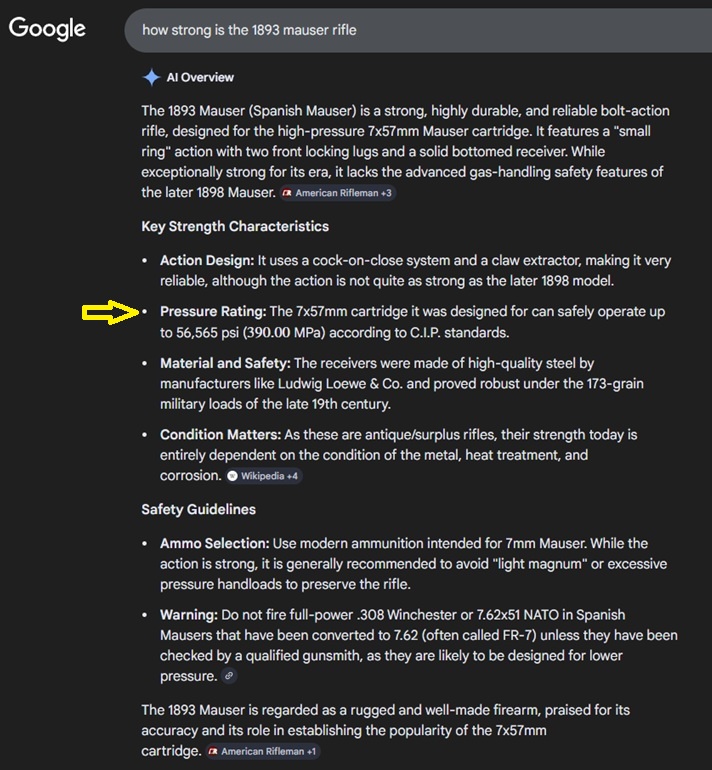
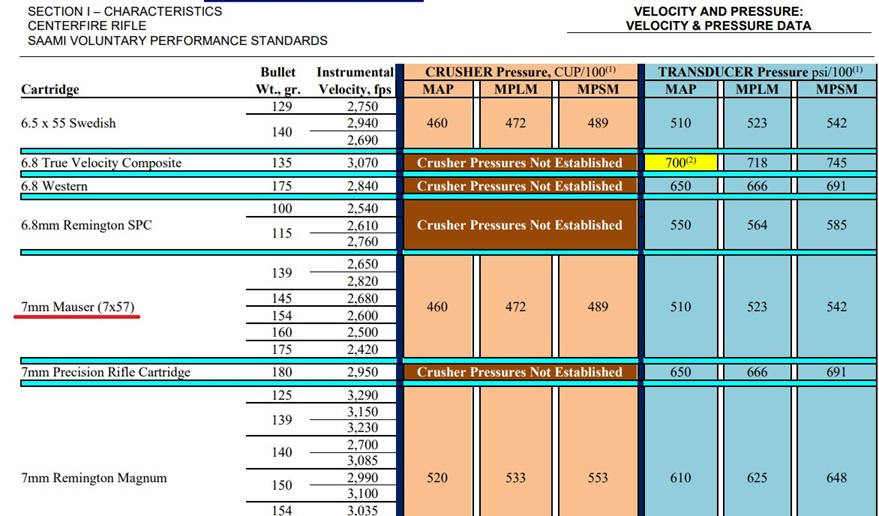
AI would f***ing know for sure; it is smarter than God, you know.Designed for 7x57 round which operates safely up to 56,565 psi according to C.I.P. standards. SAAMI more conservative states 51,000 psi MAP.
A I says -
SAAMI Z299.4 - 2025 -
I have a '95 action based sporter in 7 x 57. Nice Bishop walnut stock with a semi-heavy barrel. I wont go near max book load for several reasons:
1) The gas venting ability is not particularly good. Subsequent Mauser actions (96 and 98) were better in this regard.
2) These guns were made in the early days of steelmaking. The possibility of internal flaws and uneven surface hardening are a vulnerability. With the later advent of heat treated alloy steel and non-destructive examination, these issues were mitigated.
3) Age. Who knows what these guns have endured over the last 130 years???
Finally, a fella has to be mindful of the variance in case volumes amongst brass manufacturers, particularly Federal and Remington.
1) The gas venting ability is not particularly good. Subsequent Mauser actions (96 and 98) were better in this regard.
2) These guns were made in the early days of steelmaking. The possibility of internal flaws and uneven surface hardening are a vulnerability. With the later advent of heat treated alloy steel and non-destructive examination, these issues were mitigated.
3) Age. Who knows what these guns have endured over the last 130 years???
Finally, a fella has to be mindful of the variance in case volumes amongst brass manufacturers, particularly Federal and Remington.
Last edited:






















