SK LRM SD/ES

mmcintyre1220

CGN frequent flyer
Rating - 100%
139   0   0
Question for those more experienced than I am with rimfire ammunition

Put together a tikka t1x 2 years ago to start getting into some precision rimfire. After a bunch of ammo testing I settled in on SK LRM and grabbed two bricks of the same lot number used while testing. All was well right up to the winter when I ran out. Over the winter I gave the rifle a good clean and found another brick of ammo but it was a different lot number. A few weeks ago I took the rifle out and was getting some pretty horrible groups average doubled from 0.3-0.6 at 50 yards. Figuring it just needed to season in again after cleaning, I did not fuss too much about it.

Friday I went out again and was faced with the same issue. In 90% of my 5 shot groups, I would have a flyer that would absolutely ruin the group. I set up my chronograph to see if something was going on with the ammo. Here are the results

Set 1 - 20 rounds
Avg velocity - 1053
SD- 13.3
ES - 40.9

Set 2 - 25 rounds
Average velocity - 1049
SD - 13.3
ES - 40.6

Flipping back through my chronograph, I found 1 group that was from the old lot

30 rounds
Average velocity - 1052
SD - 9.1
ES - 23

Loking at the shot string, it appears the flyers I was getting were the ones responsible for the increased ES number, breaking 40 fps or so outside of the average +/-. For those with more experience, would a 40 fps deviation from average really cause a 0.3-0.4 inch change in impact at 50 yards?

I have 3 bricks of a different lot number that I will be trying. I am hoping this is just down to a bad lot number and not reflective of this ammo as a whole.
 
Welcome to the world of rimfire and lot numbers! The only solution is when you find a lot number your rifle makes friends with, buy cases of it, not bricks. You now have to shoot samples until you find another lot your gun likes. That is the part of precision rimfire that suks! I’ve had some very good lots of the same ammo but also ones that were not very good! Supply of ammo is another reason to buy cases. Get it when you can!!
 
I’ve seen a similar thing with SK where maybe 1 shot out of 10 can be slow. When the lighting is right I’ve seen the bullet flight at the end of a 100 yd shot, saw it drop low below the group, and looked at the chrono to confirm a low fps shot.
 
Welcome to the world of rimfire and lot numbers! The only solution is when you find a lot number your rifle makes friends with, buy cases of it, not bricks. You now have to shoot samples until you find another lot your gun likes. That is the part of precision rimfire that suks! I’ve had some very good lots of the same ammo but also ones that were not very good! Supply of ammo is another reason to buy cases. Get it when you can!!

I have not been able to get more than a few bricks of a set lot number at this point. I have a few requests in at some of distributors. Once I have the opportunity to do so, I will buy a few cases and hope for the best. If my rifle does not like that lot number, I'll sell it any try again lol. Since I started down this journey with rimfire, the days have passed where you can buy a few different lot numbers, find the one your rifle likes and then order cases. Seems like it's sold out the day it's brought in.
 
I’ve seen a similar thing with SK where maybe 1 shot out of 10 can be slow. When the lighting is right I’ve seen the bullet flight at the end of a 100 yd shot, saw it drop low below the group, and looked at the chrono to confirm a low fps shot.
Frustrating lol! I am seeing this in 1/5, never mind 1/10. Rifle shot SK the best but maybe I will go down the rabbit hole again and look for alternatives (aside from center x or tennex).
 
Muzzle velocity can"t and doesn't reliably and consistently predict the POI of a round. In other words, a chronograph isn't always a dependable tool to explain a .22LR bullet trajectory. To illustrate, sometimes a slower round will have a higher POI than faster ones. Sometimes a faster round will have a lower POI than slower ones. This can happen at 50 yards and further out it's quite obvious. This can be confirmed by anyone who has tracked MV/POI.

With regard to the OP's question
Loking at the shot string, it appears the flyers I was getting were the ones responsible for the increased ES number, breaking 40 fps or so outside of the average +/-. For those with more experience, would a 40 fps deviation from average really cause a 0.3-0.4 inch change in impact at 50 yards?

While faster or slower rounds may be the sole reason for a flyer, the causes of flyers is often more complex. Why? A bullet's MV is only one factor in its trajectory.

Consider that if MV were the only or major source of POI, test targets from testing tunnels at ammo testing facilities would show a lot of groups with mostly vertical spread, especially those at 100 meters.

Other factors influence the trajectory of .22LR bullets, including bullet uniformity and center of balance, bullet heel imperfections, bullet-to-casing crimping pressure variation, as well as how a barrel's vibrations change from shot-to-shot.

In short, MV doesn't and can't explain everything.

One further thing. SK ammo is an entry level ammo. Each lot will typically have more variation within it (in box-to-box ES alone plus, perhaps, everything else) than most lots of genuine .22LR match ammo.
 
Frustrating lol! I am seeing this in 1/5, never mind 1/10. Rifle shot SK the best but maybe I will go down the rabbit hole again and look for alternatives (aside from center x or tennex).
Sorry to hear of the 1/5 rate.

Grauhanen’s post has great info about low fps not always meaning a low shot, but in my case what I observed are occasional low fps shots like 30+ fps low. Those definitely drop in my rifle.

I chronoed Lapua Long Range and over 30 shots, it had an ES of 20, with an SD of 5.6. Sweet!

SK Long Range Match, over 20 shots, had an ES of 51, with an SD of 10.9. There were definitely some fliers in there.

This is with a 24” IBI barrel.
 
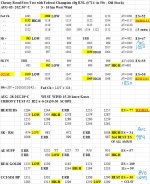
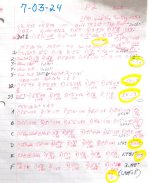
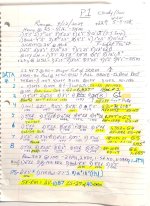
Here's a couple diff dates and data from a Sav B-22FV and a CZ-VMTR. Not 'large' sample groups (5-shot strings) but still relevant IMO. And on the last 2 pages the hits are recorded as N-o'clock on a 3/4" dot target, ie 3*-1.5" from center of dot.
First, the B-22 thru a Caldwell Chrony >
z Range Chrono 2-Tests Aug 2022.jpg

Then my CZ-VMTR with various brands Using MagnetoSpeed Sporter > ( I never made a s-sheet for this )

z Range Notes 7-03-2024 CHRONO.JPG

And another day with the CZ using only SK-RM >
z Range Notes 9-12-24 Pg-1  CHRONO.jpg
 
I have not been able to get more than a few bricks of a set lot number at this point. I have a few requests in at some of distributors. Once I have the opportunity to do so, I will buy a few cases and hope for the best. If my rifle does not like that lot number, I'll sell it any try again lol. Since I started down this journey with rimfire, the days have passed where you can buy a few different lot numbers, find the one your rifle likes and then order cases. Seems like it's sold out the day it's brought in.
I've come to the conclusion that my rifles "like" quality ammo. I've learned that generally quality ammo costs more. And that there are no guarantees. I've found most better types shoot relatively consistently lot to lot with about 10 percent notably better and 10 percent worse. I've learned that it takes a lot of rounds down range to generate robust statistics that really differentiate ammo quality as compared to a couple bad days.

I like your idea. Buy a case as a minimum amount, if buying multiple cases of the same variety specify different lots if possible. Buy with friends to share shipping. Familiarize yourself with the manufacturers product lines. For example, SK Pistol Match, Standard Plus, and Rifle Match are all the same. Same components, same processes and same machines. The difference comes when each lot is tested and they are performance graded with RM being the best. I use the easy button ... buy the Rifle Match.

Last word, ignore 90 percent of what you see on the internet about ammo.
 
Muzzle velocity can"t and doesn't reliably and consistently predict the POI of a round. In other words, a chronograph isn't always a dependable tool to explain a .22LR bullet trajectory. To illustrate, sometimes a slower round will have a higher POI than faster ones. Sometimes a faster round will have a lower POI than slower ones. This can happen at 50 yards and further out it's quite obvious. This can be confirmed by anyone who has tracked MV/POI.

With regard to the OP's question


While faster or slower rounds may be the sole reason for a flyer, the causes of flyers is often more complex. Why? A bullet's MV is only one factor in its trajectory.

Consider that if MV were the only or major source of POI, test targets from testing tunnels at ammo testing facilities would show a lot of groups with mostly vertical spread, especially those at 100 meters.

Other factors influence the trajectory of .22LR bullets, including bullet uniformity and center of balance, bullet heel imperfections, bullet-to-casing crimping pressure variation, as well as how a barrel's vibrations change from shot-to-shot.

In short, MV doesn't and can't explain everything.

One further thing. SK ammo is an entry level ammo. Each lot will typically have more variation within it (in box-to-box ES alone plus, perhaps, everything else) than most lots of genuine .22LR match ammo.

I absolutely agree, muzzle velocity is not the only factor however, it's the easiest and most common one for the average person to measure and understand. While it won't always suggest what poi change it would have, it can indicate that something is not consistent with the ammunition vs just having a bad day. Other detrimental factors to trajectory would be less likely to be captured by a chrograph but would have serious down range effects.

An ES of 40+ in my opinion is horrific lol. My centerfire handloads are all single digit SD and ES in the low teens.
 
I've come to the conclusion that my rifles "like" quality ammo. I've learned that generally quality ammo costs more. And that there are no guarantees. I've found most better types shoot relatively consistently lot to lot with about 10 percent notably better and 10 percent worse. I've learned that it takes a lot of rounds down range to generate robust statistics that really differentiate ammo quality as compared to a couple bad days.

I like your idea. Buy a case as a minimum amount, if buying multiple cases of the same variety specify different lots if possible. Buy with friends to share shipping. Familiarize yourself with the manufacturers product lines. For example, SK Pistol Match, Standard Plus, and Rifle Match are all the same. Same components, same processes and same machines. The difference comes when each lot is tested and they are performance graded with RM being the best. I use the easy button ... buy the Rifle Match.

Last word, ignore 90 percent of what you see on the internet about ammo.


I think determined poor ammo quality is usually easy to tell when you put close to 1500 rounds down range of one lot number, then change lot numbers and things go to hell in a handbasket lol. In fact, through initial ammo testing, the largest grouping I had was 0.545 across multiple different brands and lines. Everyone has bad days but, you should be able to tell when it's you, your equipment or the ammo.

When I am doing load development in centerfire, I try to start my day with a load I know works well. That tells me if I am in point that day or having an off day. If I am having an off day, I won't proceed with load development.

Interesting information about SK ammunition. I didn't know those were all the same. That would explain why I had very similar results. SK rifle match was the second best, just under SK LRM. Eley club, contact, sport was about on par with SK standard plus. SK biathlon sport was on par with SK LRM but I have not seen it since lol!
 
I've found most better types shoot relatively consistently lot to lot with about 10 percent notably better and 10 percent worse.
My experience suggests that this is true. Most lots of good quality .22LR match ammo are very similar and shoot well. A few lots will be better or worse. To illustrate, each lot of Midas I've tested in the last couple of years gives very similar results over five or six different rifles. I've had the good fortune to have one lot of Center X that was particularly good and a few that were among the less than average.

I've learned that it takes a lot of rounds down range to generate robust statistics that really differentiate ammo quality as compared to a couple bad days.
This is an important point. Most lots of match ammo shoot so similarly that it can be quite difficult to distinguish one from another. (The same is true when comparing two or more good rifles with quality barrels.) The lots that are worse seem to be easier to identify.

When buying .22LR match ammo blind -- that is, without testing first -- the odds are that you will get ammo that's average for its grade. Currently this applies to Lapua as in recent years Eley ammo has had it's consistency issues.

There is probably one exception to the idea that Lapua is usually safe to buy blind, and that is X-Act. . Like any tier of .22LR match ammo, some are better or worse. Canada doesn't receive many lots of Lapua's top tier ammo and those we do get don't seem to shine. I've tested three of the lots that have been available in recent years and none was particularly good. The better X-Act lots don't seem to get here.
 
Interesting information about SK ammunition. I didn't know those were all the same. That would explain why I had very similar results. SK rifle match was the second best, just under SK LRM. Eley club, contact, sport was about on par with SK standard plus. SK biathlon sport was on par with SK LRM but I have not seen it since lol!
So to save you the work ... Pistol Match Special, Biathlon Sport and Long Range Match are another related family with LRM being the top tier.
Center X, Midas, Exact ... same deal. Eley top two are Match and Tenex.
 
Back
Top Bottom