We hear it all the time use a certain primer as its the hottest, which is always a parroted comment from a publication posted sometime in the past.
The question is do those old standards hold true with the primers available today?
At my disposal I have CCI 200's, Win WLR's, Fed 210's, CCI 250's, Win WLRM's, and Fed 215's.
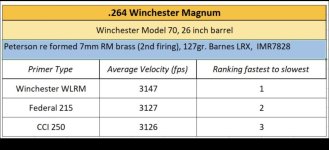
So I threw together some reloads with 3 cartridges I have on hand as well (yes I have more cartridges) I chose the boys .264 Win Mag, Model 70 Super grade with a 26" barrel, The Mrs., 270 Win Remington 700 with a 22" barrel, and my Ruger American Predator in .243 Win, with a 22" barrel.
The ,264 was loaded up with barnes 127grain LRX and IMR 7828 (this is a worked load so I wont give specifics beyond this)
The .270 was loaded up with 55.7 grains of IMR 4831, and 130 grain Winchester Power Points. (this is a low to moderate load in this rifle as this combination has never been tried before)
The .243 was loaded up with 41.5 grains of IMR 4831, and 100 grain sierra gameking's (SPBT) (again like the 270, this was a new to the rifle combo)
All 3 rifles were given a deep cleaning before the test, with a full soak with Wipeout foam, followed by a good scrubbing with Iosso bore paste.
All 3 rifles were fired twice before the testing began.
All 3 rifles started from ambiant temperature before testing, and I followed the same shot sequence for each 3 shot string, from ambiant shot number 1, eject and leave the bolt open, wait 30 seconds, load and shoot shot number 2, eject and leave the bolt open, wait 45 seconds, and fire shot number 3, the rifle was racked and with the help of the worlds smallest leaf blower, was cooled, while the other rifles were tested.

The rifles had their velocities tracked with a LabRadar chronograph.
The rifles were shot on paper, but group size was not a driving factor in this test, it was a velocity tracking endeavour after all.

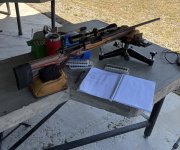
Weather conditions on the day of the test were a staring temperature of 10 degrees Celcius, and a finishing temerature of 15 degress celcius, Relative humidity ranged from 65% to 50%, and the barrometric pressure hung around 1007 hpa. Range elevation is almost spot on 2000 feet ASL.

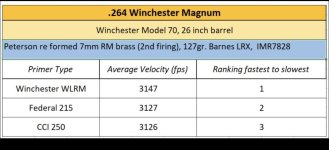

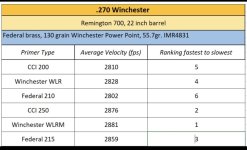

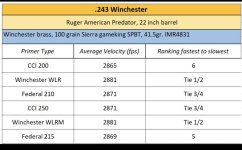
My key take aways from this test:
-Indeed the Federal 215 primers have lost the crown of "hottest" magnum primer, and gave up the title to the Winchester WLRM, while CCI 250's and Federal 215's are a close tie in performance too.
-The differences with magnum primers in the .243 Win are negalgable in this test.
-The difference in the Magnum primers in the true Magnum cartridge is very slim.
-The 270 Win saw the best velocity gains by moving to a magnum primer.
The question is do those old standards hold true with the primers available today?
At my disposal I have CCI 200's, Win WLR's, Fed 210's, CCI 250's, Win WLRM's, and Fed 215's.
So I threw together some reloads with 3 cartridges I have on hand as well (yes I have more cartridges) I chose the boys .264 Win Mag, Model 70 Super grade with a 26" barrel, The Mrs., 270 Win Remington 700 with a 22" barrel, and my Ruger American Predator in .243 Win, with a 22" barrel.
The ,264 was loaded up with barnes 127grain LRX and IMR 7828 (this is a worked load so I wont give specifics beyond this)
The .270 was loaded up with 55.7 grains of IMR 4831, and 130 grain Winchester Power Points. (this is a low to moderate load in this rifle as this combination has never been tried before)
The .243 was loaded up with 41.5 grains of IMR 4831, and 100 grain sierra gameking's (SPBT) (again like the 270, this was a new to the rifle combo)
All 3 rifles were given a deep cleaning before the test, with a full soak with Wipeout foam, followed by a good scrubbing with Iosso bore paste.
All 3 rifles were fired twice before the testing began.
All 3 rifles started from ambiant temperature before testing, and I followed the same shot sequence for each 3 shot string, from ambiant shot number 1, eject and leave the bolt open, wait 30 seconds, load and shoot shot number 2, eject and leave the bolt open, wait 45 seconds, and fire shot number 3, the rifle was racked and with the help of the worlds smallest leaf blower, was cooled, while the other rifles were tested.
The rifles had their velocities tracked with a LabRadar chronograph.
The rifles were shot on paper, but group size was not a driving factor in this test, it was a velocity tracking endeavour after all.
Weather conditions on the day of the test were a staring temperature of 10 degrees Celcius, and a finishing temerature of 15 degress celcius, Relative humidity ranged from 65% to 50%, and the barrometric pressure hung around 1007 hpa. Range elevation is almost spot on 2000 feet ASL.
My key take aways from this test:
-Indeed the Federal 215 primers have lost the crown of "hottest" magnum primer, and gave up the title to the Winchester WLRM, while CCI 250's and Federal 215's are a close tie in performance too.
-The differences with magnum primers in the .243 Win are negalgable in this test.
-The difference in the Magnum primers in the true Magnum cartridge is very slim.
-The 270 Win saw the best velocity gains by moving to a magnum primer.
Attachments
Last edited:


 RJ
RJ
 Rem magnum primers were half way in between which didn’t surprise me at all.