Min Case length minimum

Rhys, I have shot a lot of "short" .38 Special brass in .357 magnum carbines. No problems. And a lot of .22 Shorts in .22 LR chambers.
I can't speak to your specific 6x45 vs 6x47 question, but I recon you're pretty smart, and will figure it out based on what's practical. Best wishes from your buddy in Canada!
 
Alot of good reading here.

I wasn't worried about .010 gaps.. but more seeing if 2 mm was a issue 😁😂😂

DGY knows why...

I'm scared to ask but FK it.

Why can't I shoot 6x45 in the 6x47 ?
Seat out the bullet further - so it's up the chamber enough...
Just the case mouth is a bit short 🫣

The .38 Spcl and .357mag rings a bell.

😂😂😂😂😂
You can, but set your FL sizing die so it leaves a slight shoulder on the case neck, and it will fire form very nicely to the case you need.

It's quite a common practice.

Most folks use a light charge of powder. I load the original case to minimum specs, and that way the fire formed case is perfect every time.
 
Rhys, I have shot a lot of "short" .38 Special brass in .357 magnum carbines. No problems. And a lot of .22 Shorts in .22 LR chambers.
I can't speak to your specific 6x45 vs 6x47 question, but I recon you're pretty smart, and will figure it out based on what's practical. Best wishes from your buddy in Canada!
Both the .22 and the .38's are "rimmed" cases - they headspace on their rim - whereas I think the 6x45 and 6x47 are rimless cases - so they will have a front headspace place on their shoulder. The 6x45 will need something to hold it back in the chamber to fire-form (I think) ...
 
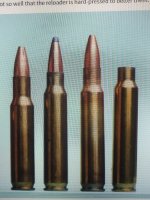
Left to Right should be
222rem, 223, 222rem mag and a 204.

Shoulder look similar - RE Potash miners concern of headspacing?

Thank you all so much for the Info.
(I'm not desperate to do this Right Now... But I think once I smash thru the 200 X 222rem mag Cases I have.. I'll be wanting to do something.. the 204 brass will need turning and reaming I believe unless I can sort something out there)
I figure.... This May be an option to keep Plinking etc.
IMG_20260426_205420.jpg
 
  • Like
Reactions: DGY
You can, but set your FL sizing die so it leaves a slight shoulder on the case neck, and it will fire form very nicely to the case you need.

It's quite a common practice.

Most folks use a light charge of powder. I load the original case to minimum specs, and that way the fire formed case is perfect every time.
Can we get in touch Via email mate?
 
  • Like
Reactions: DGY
Left to Right should be
222rem, 223, 222rem mag and a 204.

Shoulder look similar - RE Potash miners concern of headspacing?

Thank you all so much for the Info.
(I'm not desperate to do this Right Now... But I think once I smash thru the 200 X 222rem mag Cases I have.. I'll be wanting to do something.. the 204 brass will need turning and reaming I believe unless I can sort something out there)
I figure.... This May be an option to keep Plinking etc.
View attachment 1136120
222 Rem Mag is about 0.030" longer to the shoulder. You'll have to expand the neck a little to give it a false shoulder to headspace on. And you will end up with a very short neck. Should work though. - dan
 
222 Rem Mag is about 0.030" longer to the shoulder. You'll have to expand the neck a little to give it a false shoulder to headspace on. And you will end up with a very short neck. Should work though. - dan
I'm quietly excited about this for down the track when I run out of Brass and don't wanna spend heaps for brass!!!

Long live
 
One is excess throat erosion, another is a carbon ring build-up caused by the throat-case gap.

Just to throw a fly in the ointment here, Sinclair makes a chamber length gage to measure the ACTUAL chamber length of your rifle as this length can and does vary from rifle to rifle. If you use the max brass length from a manual it still might be shorter than how your rifle was chambered. This gap from the end of your brass and the end of the chamber is where the dreaded carbon ring is formed.

I bought a set late last year and found that the chambers are in fact longer than what the manuals would suggest.

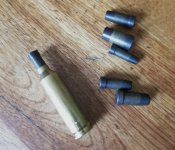
a604664c-c9cb-4b4f-8e76-7f4fa097571c.jpg1b1fb2ce-94ef-42c4-a2fa-0b5d00ddc5ec.jpg369dc381-2262-411b-b4ef-a17b8691cd72.jpg
 
I have been using Lee collet dies for a couple years now, and have seen case longevity increase. I need to do much less trimming as well.
I do also with all other Cals but this i heard is hard to get bits an pieces for down under now, it came with a brand new, "last box of dies" in the country aparently.
so i didnt even think or look at the Neck collet--- typically thes LEE brand stuff we have here-

i have it Partial FL sizing pretty good- i just screwed a few cases in the process- case head seperation very immanent on a few--
seem right to go now!
 
I do also with all other Cals but this i heard is hard to get bits an pieces for down under now, it came with a brand new, "last box of dies" in the country aparently.
so i didnt even think or look at the Neck collet--- typically thes LEE brand stuff we have here-

i have it Partial FL sizing pretty good- i just screwed a few cases in the process- case head seperation very immanent on a few--
seem right to go now!
I bought a brand new set of 6.5 x 55 RCBS dies, and the neck sizer was too big. Bullets were always loose despite attempts to crimp. I bought a set of Lee dies and the problem went away. The only issues is that the brass I use in my Husky M38 has a big chamber, and if I just neck size, they will not chamber in my Zastava. My 1900 M96 does not care, it eats everything and makes tiny groups while doing so. Makes me wonder how big a deal Chambers actually are. LOL.
 
Meroh - you just described "how big of a deal" - chambers tend NOT to be exactly the same, one to another. But, they are all within a minimum and a maximum spec. So, if loads are made to fully minimum spec, they will fit in ANY chamber of that cartridge - not snug or perfectly in some chambers, but they will fit. Old school, one would use steel gauges to check a chamber - what is called "GO" gauge should be ground to minimum spec - what is called "FIELD" gauge should be ground to Maximum spec. For 30-06 cartridge, there is about 0.010" difference between GO gauge and FIELD gauge.
 
Looking at a "Clymer" brand headspace gauge set here for 30-06 Springfield - there is a third gauge in there - labelled as "NOGO" - I can not find that described in the SAAMI Technical information - maybe someone can tell me where to find that - it might not be a Minimum nor a Maximum spec gauge - could be a barrel maker's or gauge maker's invention - not by SAAMI (?). This NOGO gauge is apparently 0.004" longer than 30-06 "GO" gauge, so might be used when chambering a new barrel into an action - bolt must close on GO gauge - so chamber is at least Minimum length, then bolt probably does NOT close on "NOGO" gauge - so you would be within 0.004" of GO - closer to Minimum Length chamber than to Maximum Length chamber - that way there would be some "allowance" for lug seat set-back, wear on chamber shoulders or rear face of bolt lugs, etc. I had read that in WWII, the US military would withdraw a rifle from service and replace it, if the bolt closed on a FIELD gauge, so for them, a chamber that was more than 0.010 longer than Minimum was too long for them and the service ammo that they fired.

Within reason, it is probable that a slopped out chamber could still be fired - if that chamber was worn to be a too large diameter, or if that chamber was too long to the shoulder, it is very possible to fire-form to that size and "keep go" with it - except it is NOT a SAAMI spec chamber any more - I believe such a thing is called a "wildcat" - not to any SAAMI spec.

It will be important "who" set the specs - I had read that the Regimental GO gauges used at the Carl Gustaf armoury in Sweden, were LONGER than a SAAMI FIELD gauge - hence, even brand new CG production 6.5x55 would fail a SAAMI headspace check with SAAMI gauges - likely right within spec using Swedish gauges. There is probably some merit to having a chamber at SAAMI spec, since probably SAAMI spec ammo will be used in North America, and North American Hand Load manuals tend to follow SAAMI pressure specs.

Sweden was using 6.5x55 rifles in the late 1800's - SAAMI did not exist until circa 1925 - I do not know why SAAMI felt compelled to specify different length gauges than the Swedes were using. When the Swedes surplused many of their M94 and M96 rifles in the 1950's and 1960', some were brand new, never issued, by the Swedes - some were essentially straight from the CG Armoury - and would fail a SAAMI headspace check when they were imported to North America - so much gunsmith work created to make the Swede rifles "compliant" with SAAMI standards. I also read that during wartime, Britain, Canada and Australia relaxed their "FIELD" spec for the 303 British cartridge that they used - so, for that period, war time FIELD gauge will be smidgeon different length (different spec) to a SAAMI 303 British FIELD gauge.
 
GO length , for example for a 308 Winchester gauge is 1.630 this is considered minimum
NOGO length is 1.6340 This is considered the maximum length for the chamber.
Field gauge length is 1.680. This is considered " out of spec"
If the the gun closes on a Field gauge , there is a chance of case failure.
This is what I was taught , anyway......
Cat
 
If you have a caliper, open it up to .010" and hold it up to the light to see just how big (small) .010" really is. About the thickness of 3 sheets of paper. In the reloading world .010" on brass length doesn't really matter. In the machining world .010" out of spec might as well be an inch.
It matters on a 450 bushmaster as it headspaces off the case mouth so case length is critical
 
I got bored one day and drilled out the primer pocket of a case so the expander ball could fit through the hole. By doing this I could size the casr, pull it over the ball, put case back in the die and reinsert the decapper assembly. This let me size the neck again and pull the ball through over and over. (You’ve got to be pretty bored for this to qualify as entertainment🤣)

The up-shot was that after the first sizing of the body (only one really) there was no further increase in case length even after pulling the ball through the neck 20 times. To me, that would indicate that the sizing ball doesn’t stretch cases.

Is it proof? Don’t know. Is it important? Probably not. Was it marginally less boring than whatever I was bored about before? Probably.
Yep, that is pretty high on the 'what can I do when I'm bored' scale :LOL: I am in full agreement with you, though, that lengthening comes from FL sizing. I've described this to many as squeezing a ballon - squeezing the diameter, which is most of what's happening when FL sizing, forces material to the only place it can go, which is axially.

I think most of the theory that pulling the expander ball back through the neck comes from either dirty / carboned necks (which makes an awful squawk & damn near lifts the bench as you struggle to raise the press handle), and/or the absence of cartridge headspace measuring tools that would reveal the details of what really happens to the case when resizing.

Personally, I think a much bigger risk when using an expander in the die is a crooked or offset & rigid stem that is set low in the die. Drawing that ball back through where the case has the least support from the die has some potential to #### that case neck off axis especially if there is significant resistance. Deprime in a separate operation, set that ball high so that it engages just after the neck comes back out of the die neck, and leave the stem loose so it can float a bit. Brush the necks prior to, and ensure the expander ball is clean-ish and free of galling.
 
GO length , for example for a 308 Winchester gauge is 1.630 this is considered minimum
NOGO length is 1.6340 This is considered the maximum length for the chamber.
Field gauge length is 1.680. This is considered " out of spec"
If the the gun closes on a Field gauge , there is a chance of case failure.
This is what I was taught , anyway......
Cat
Go here - https://saami.org/wp-content/upload...rfire-Rifle-Approved-2-10-2025-2026-04-27.pdf - SAAMI specs - chamber drawing on lower part of page; cartridge on upper part of page - Page 117 has 308 Winchester. Look for the "X" in a circle - that is the headspace dimension for the chamber - Minimum is shown as 1.630"; Maximum is shown as 1.640" - so 0.010" difference. I do not see reference there to a 1.680" dimension for headspace - that is WAY past Maximum. What I believe is the Minimum plus about 0.003" or 0.004" is what a NOGO gauge is ground at - but I can not find reference to that in SAAMI literature - maybe someone else can show me where it says that. If a 308 Winchester gauge says it is 1.6340", then that is 0.004" longer than GO - not the Minimum dimension, nor the Maximum dimension for the chamber. That might be the desired target for a newly installed barrel onto an action (between Go and NOGO gauges), but is not "Maximum" to determine if a used rifle is safe to fire.
 
I think a lot of where where the idea of the expander ball pulling necks out of alignment comes from is additional factors that we are measuring but not considering.

OK, we size our cases and spin them up on our concentricity gauges to check for run-out right? What else are we measuring at the same time? Besides misalignment we are also seeing the effect of uneven neck thickness, neck displacement from center, and out of roundness of the case body itself. Heck, there’s even some out of roundness in the bullet itself and we are measuring it all at the same time. All those variables can stack, or alternately they can cancel each other somewhat on the next cartridge or the same case the next time its loaded.

Cases fired in a straight and round chamber tend to come out pretty darn straight and round, and if they don’t there’s likely something wrong with that case. Those straight and round cases tend to come out a straight and round FL with no expander ball looking pretty good too. Straighter than with my bushing dies on average. At least a FL die is trying to center up the neck, whereas a bushing floats and the best it can do is make the neck smaller and round but located wherever the path of least resistance takes it. A FL die without the expander will make the outside of the neck look pretty good, but uneveness of the neck thickness is just temporarily moved to the inside. Pull or push the expander through and it comes back to where we can measure it. Skip the expander all together and the seated bullet will do the same thing because its an expander too. Normally not a very good one, but with the right floating chamber seater it can get quite a bit better. With the wrong one it will be worse than a standard seater, or at least some of those.

I’m overcoming my inner torment by deciding that cocentricity might not have been all that important in the first place. Helps me sleep at night😀 Well, that and sorting a pile of ammo for straightness and taking it out to 700 yards to see if I could tell the difference. I couldn’t, so I moved onto other things to obsess about.🤣

 
Back
Top Bottom