












































You are using an out of date browser. It may not display this or other websites correctly.
You should upgrade or use an alternative browser.
You should upgrade or use an alternative browser.
A Comparison of Target Results by Lot and Rifle
- Thread starter grauhanen
- Start date

Thanks for posting your results! Great variety of rifles. More variety than Lapua and Eley use for testing.
Seems like a lot of sour grapes coming from a jealous person that can’t afford either the guns tested or the higher end ammo!
It’s nice to see someone that knows how to properly measure targets as well. Maybe it was your 100 yard targets that really messed with his cornflakes.
When the swelling goes down, hopefully he is able to fit through a standard doorway again.
Seems like a lot of sour grapes coming from a jealous person that can’t afford either the guns tested or the higher end ammo!
It’s nice to see someone that knows how to properly measure targets as well. Maybe it was your 100 yard targets that really messed with his cornflakes.
When the swelling goes down, hopefully he is able to fit through a standard doorway again.
- Location
- Northeastern Ontario
For posterity.A considerable amount of effort to demonstrate effectively nothing, unfortunately.
Simply listing extreme spread values either as individual groups or as averages tells an outside observer nothing of value for how the ammo is actually performing in each rifle. Showing the actual targets without the measurements would have been much more informative.
The number of rifles/barrels used is very small, and I presume the barrel profiles/diameters to be similar. Failure to include a diverse set of barrel diameters and profiles limits the conclusions that may be drawn from any generated data, restricting the extrapolation of results.
Only one brand of ammo was used, where the manufacturer uses the same load recipe then grades the resultant product according to internal standards. Consistency of lots may indeed vary, however the overall behaviour of each lot will be similar, no drastic change to the recipe occurs lot-to-lot. Failure to test multiple brands of ammo, which is the only way to test different load recipes, restricts conclusions to "The particular tested barrels shot similar group size ES values with one ammo recipe". A conclusion of limited utility.
This experiment doesn't come close to making any sort of definitive determination about how different barrels shoot different ammo, because different ammo was not used. Only one type was, and the ES values could simply be coincidental, though they are more likely the result of vertical due to velocity variation. Velocity variation is only one factor in vertical, the other is barrel launch angle. Barrels with similar profiles could be presumed to have similar min/max launch angles, so similar ES values on target also make sense considering this. Not actually seeing the resultant groupings again limits how an outside observer can analyze and interpret results. They can't.
You are welcome for the peer review on your research project. It was my pleasure.
- Location
- Northeastern Ontario
I have all the target images without measurements. Unfortunately this idea is not very well thought out. It's unrealistic and senseless.Simply listing extreme spread values either as individual groups or as averages tells an outside observer nothing of value for how the ammo is actually performing in each rifle. Showing the actual targets without the measurements would have been much more informative.
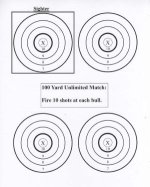
Why? It's simply not practical. There are around 660 target sheets for over 2000 ten-shot groups. One lot alone would have an average of about 66 target sheets. (See below for an example of a target.)
Comparing these targets would be a mind-numbing overload of information. No one would compare 60 plus targets for a single lot let alone a total well over 600. It's absurd.

I love this! Great work!A statistically valid sample?
Ten-shot groups are much more robust than five-shot groups. They are a more accurate measure because they reduce the element of luck, whether good or bad, that can more easily distort five shot groups. While five shot groups can tell you “this rifle can sometimes shoot small,” ten shot groups tell you much more about “this is what the rifle actually does.”
Comparing thirty or more groups per rifle is a strong sample size. The more groups shot, the “steadier” or more reliable the average becomes. In short, the more groups compared, the more good or bad luck is “smoothed” out. The more mathematically and statistically inclined would say the “standard error” becomes small and the average is reliable.
It has been a long time since I had anything to do with Statistics. The work I did was efficacy studies for agricultural feed ingredients.
The number of Reps for each test group (in this case, a particular rifle with a particular ammo) can skew data; I agree, too few reps can result is very random results, while too many will artifically smooth data; that is, the effect of "fliers" becomes negated, yet the fliers can tell a lot about what is happening. I performed the trials and contracted out the analysis. There are statistical formulae that statisticians use to determine the optimal number of repps per group, and the optimum number of groups included with a trial. If only two groups, I believe they will apply "Students T Test". If three or more, "ANOVA" (analysis of variation) is used to determine statistical signficance. In this case, these "tests" could be used to predict the frequency of results (how often you get a big one, an average and a minimal, sized the groups for both the individual rifles and the types of ammo.
That would be a daunting task indeed.
Two types of ammo actually, I agree that there was a small number of rifles, but they were "comparable" rifles, so that is good.A considerable amount of effort to demonstrate effectively nothing, unfortunately.
Simply listing extreme spread values either as individual groups or as averages tells an outside observer nothing of value for how the ammo is actually performing in each rifle. Showing the actual targets without the measurements would have been much more informative.
The number of rifles/barrels used is very small, and I presume the barrel profiles/diameters to be similar. Failure to include a diverse set of barrel diameters and profiles limits the conclusions that may be drawn from any generated data, restricting the extrapolation of results.
Only one brand of ammo was used, where the manufacturer uses the same load recipe then grades the resultant product according to internal standards. Consistency of lots may indeed vary, however the overall behaviour of each lot will be similar, no drastic change to the recipe occurs lot-to-lot. Failure to test multiple brands of ammo, which is the only way to test different load recipes, restricts conclusions to "The particular tested barrels shot similar group size ES values with one ammo recipe". A conclusion of limited utility.
My issue is with the number of reps in each test group smoothes data too much. This would greatly diminish any signifigant difference that might have been demonstrated where the number of reps in each sample group had been smaller.
What this does show us is that these rifles are similar, and the ammo is consistent. No more, no less.
Last edited:
Loved this data. Good job. I have nowhere near the same data set, but I did swap the barrel for my CZ457 from the CZ MTR barrel to an L3I barrel. I found that some ammo (Center-X, SK Std+) shot the same from both. Agree with your observation that statistical variation from wind alone limits the value of saying "this barrel is 10% better than that". But, as Leuchtkaffer hinted at, I did find other ammo (RWS Special Match, SK Rifle Match) that did seem to prefer one barrel over the other. One lesson I have learned, and maybe addresses Leuctkaffer's other point; analysing Mean Radius seems to give me better trend data than extreme spread.
Newbie here; be kind. Not trying to start a fight!
Newbie here; be kind. Not trying to start a fight!
An ANOVA with some other controlled variables (rifles, barrels, the already established lots) would be interesting to examine.I love this! Great work!
It has been a long time since I had anything to do with Statistics. The work I did was efficacy studies for agricultural feed ingredients.
The number of Reps for each test group (in this case, a particular rifle with a particular ammo) can skew data; I agree, too few reps can result is very random results, while too many will artifically smooth data; that is, the effect of "fliers" becomes negated, yet the fliers can tell a lot about what is happening. I performed the trials and contracted out the analysis. There are statistical formulae that statisticians use to determine the optimal number of repps per group, and the optimum number of groups included with a trial. If only two groups, I believe they will apply "Students T Test". If three or more, "ANOVA" (analysis of variation) is used to determine statistical signficance. In this case, these "tests" could be used to predict the frequency of results (how often you get a big one, an average and a minimal, sized the groups for both the individual rifles and the types of ammo.
That would be a daunting task indeed.
A question for you all: what sort of (consistent) difference in MOA would be enough for you to "care"? My feeling would be something around a 5% difference (so .05" for a 100 yard). When I get a chance ill do some power analysis to see what would be enough to target sets to capture whatever number makes sense.
Need to sit down and have a think on what # of shots per target does to that, it's been a thought of mine since I started into shooting and this is a good exercise to examine it more closely
A commonality among some. lol I think there’s meds for small man syndrome!!I have all the target images without measurements. Unfortunately this idea is not very well thought out. It's unrealistic and senseless.
Why? It's simply not practical. There are around 660 target sheets for over 2000 ten-shot groups. One lot alone would have an average of about 66 target sheets. (See below for an example of a target.)
Comparing these targets would be a mind-numbing overload of information. No one would compare 60 plus targets for a single lot let alone a total well over 600. It's absurd.
View attachment 1142931
Maybe but next time maybe not! Only shooting it will show its potential! Like asking what ammo works best!! Whatever lot number you can find of whatever ammo that happens to be!! To say this gun shoots this brand best is just “It has shot this well before.” but maybe not as great the next time. Lot number are sometimes not miles apart but many times many miles apart. Extremely frustrating when it’s Lapua Exact. Ask Jerry from Mystic, he knows firsthand of what I speak.I did find other ammo (RWS Special Match, SK Rifle Match) that did seem to prefer one barrel over the other.
It’s actually one of the biggest variations I’ve seen in any kind of ammo testing !! Like I said before, even the top tier ammo manufacturers don’t use this variety for testing!! I’d like to see another example with this variety as well as the amount of lot numbers and the number of rounds and targets to complete this!I agree that there was a small number of rifles,re,
I think many are missing the point of what this actually all about. It was not an ammo shootout! Rimfires are all about lot number so saying Lapua ABC is the best is wrong. Lapua ABC lot XX1 may be extremely consistent and very accurate in a few different rifles but lot XX2 might be not nearly as consistent or accurate in the same few rifles. It’s the variables of rimfire shooting! Hair loss is a given.
Last edited:
Valid point. I should have said that I was comparing the same lots from one barrel to the other BUT, when I was lot testing Center-X I had variations that were of a similar order, lot to lot. One problem is that 10 shot groups is a good indicator but maybe not good enough to spearate lots definitively. As most of you know, Bryan Litz recommended 30 rd groups as the minimum statistically significant, but does anyone have the time or cash for that?Maybe but next time maybe not! Only shooting it will show its potential! Like asking what ammo works best!! Whatever lot number you can find of whatever ammo that happens to be!! To say this gun shoots this brand best is just “It has shot this well before.” but maybe not as great the next time. Lot number are sometimes not miles apart but many times many miles apart. Extremely frustrating when it’s Lapua Exact. Ask Jerry from Mystic, he knows firsthand of what I speak.
Funny you say that. I only tried 1 lot of X-Act and it was terrible in my gun. I tried it in different weather and different ranges; never performed. I believe it to be a poor lot, but I am reluctant to spend the money to prove it!Maybe but next time maybe not! Only shooting it will show its potential! Like asking what ammo works best!! Whatever lot number you can find of whatever ammo that happens to be!! To say this gun shoots this brand best is just “It has shot this well before.” but maybe not as great the next time. Lot number are sometimes not miles apart but many times many miles apart. Extremely frustrating when it’s Lapua Exact. Ask Jerry from Mystic, he knows firsthand of what I speak.
I have tried quite a few lots of Lapua Exact and have never been impressed with any of them. One was what Id consider OK and thats being generous. Center X can be amazing but more often its lack lustre. Ive had more success with SK LRM and the last time I was able to lay hands on Lapuas Long range variants, it performed very well. Ive also had an exceptional lot of Eley Semi Auto Benchrest thats great in my custom semi as well as a Vudoo and an Anschutz. The only real way to know is shooting a bunch of rounds and finding out what ur gun likes to eat. Distance also matters so thats another factor for consideration.Funny you say that. I only tried 1 lot of X-Act and it was terrible in my gun. I tried it in different weather and different ranges; never performed. I believe it to be a poor lot, but I am reluctant to spend the money to prove it!
- Location
- Northeastern Ontario
Some may wish that this testing included other ammo. I would have liked that also. But there's the real problem of the availability of .22LR match ammo other than Lapua. There have been some quantities of top tier true match ammo made by Eley and RWS ammo available, such as Eley Tenex and Match and RWS R50 and Special Match. But they haven't been available in the same quantities as Lapua.
With any effort such as this, keep in mind that there are real limitations imposed by budgets. Few shooters can buy enough quanties of all true match ammos to compare a statistically significant number of rounds over five or six rifles. I can't.
I have some quantities of Eley and RWS .22LR match ammo but not nearly enough to compare with the Lapua.
As for other ammos giving a different conclusion than the one I reached, I simply ask why would they? Does anyone think they work differently? Does anyone suppose that when good lots of Lapua shoots very similarly in different good barrels that good Eley or good RWS will behave otherwise? Barrel and ammo doesn't work that way.
With regard to large sample sizes smoothing out averages, that is true to some extent. The alternative is to rely on smaller sample sizes which risk distorting the validity of results. Additionally the standard error increases. (Standard error (SE) tells you how precisely you have estimated the mean of something.) It's a case of trying to have your cake and eating it too.
With large sample sizes it is not easy to see the impact or frequency of errant rounds (flyers). But the differences are told in the averages themselves. When averages are different, there's usually a good reason for it.
With any effort such as this, keep in mind that there are real limitations imposed by budgets. Few shooters can buy enough quanties of all true match ammos to compare a statistically significant number of rounds over five or six rifles. I can't.
I have some quantities of Eley and RWS .22LR match ammo but not nearly enough to compare with the Lapua.
As for other ammos giving a different conclusion than the one I reached, I simply ask why would they? Does anyone think they work differently? Does anyone suppose that when good lots of Lapua shoots very similarly in different good barrels that good Eley or good RWS will behave otherwise? Barrel and ammo doesn't work that way.
With regard to large sample sizes smoothing out averages, that is true to some extent. The alternative is to rely on smaller sample sizes which risk distorting the validity of results. Additionally the standard error increases. (Standard error (SE) tells you how precisely you have estimated the mean of something.) It's a case of trying to have your cake and eating it too.
With large sample sizes it is not easy to see the impact or frequency of errant rounds (flyers). But the differences are told in the averages themselves. When averages are different, there's usually a good reason for it.
Yes, he frequently suggested shooters shoot six groups of five shots to begin to reach valid conclusions.Bryan Litz recommended 30 rd groups as the minimum statistically significant
- Location
- Northeastern Ontario
A few thoughts about the Lapua X-Act that's been available in Canada.
I've tried four different lots, the earliest made in 2019, two from 2020, and the fourth made in 2022. I don't know of other lots that have been available here.
The lot from 2019 (last three digits 042) was a lousy lot. It had a Jekyll and Hyde character. Sometimes it would give a few very good five shot groups at 50 and then it would go to pot and become ruined. The chrono numbers were surprising, with some box extreme spreads of 50 fps and more and double digit SD values. All this in a couple of rifles. The other three were better but not good.
What accounts for the top tier grade of Lapua performing this way?
It's proof that there's variation in lot-to-lot quality. It's not a case of rifles not "liking" X-Act. Why? It's made during the same production runs, on the same machinery as Midas and Center X. Except for the grading it's indistinguishable from the other Lapua ammos.
Most X-Act lots perform very well, just as most Midas does. The thing is that poor lots of X-Act (corrected, originally had "Midas") must still get sold. But offering them to prestige markets isn't good for the ammo maker. They send abroad to small markets where it matters much less in the whole scheme of things. Canada is certainly such a market.
The fact that none of the four lots of X-Act I have tested shoots particularly well has me thinking that I probably won't be getting any more of it. Buying X-Act blind in Canada isn't worth the risk.
I've tried four different lots, the earliest made in 2019, two from 2020, and the fourth made in 2022. I don't know of other lots that have been available here.
The lot from 2019 (last three digits 042) was a lousy lot. It had a Jekyll and Hyde character. Sometimes it would give a few very good five shot groups at 50 and then it would go to pot and become ruined. The chrono numbers were surprising, with some box extreme spreads of 50 fps and more and double digit SD values. All this in a couple of rifles. The other three were better but not good.
What accounts for the top tier grade of Lapua performing this way?
It's proof that there's variation in lot-to-lot quality. It's not a case of rifles not "liking" X-Act. Why? It's made during the same production runs, on the same machinery as Midas and Center X. Except for the grading it's indistinguishable from the other Lapua ammos.
Most X-Act lots perform very well, just as most Midas does. The thing is that poor lots of X-Act (corrected, originally had "Midas") must still get sold. But offering them to prestige markets isn't good for the ammo maker. They send abroad to small markets where it matters much less in the whole scheme of things. Canada is certainly such a market.
The fact that none of the four lots of X-Act I have tested shoots particularly well has me thinking that I probably won't be getting any more of it. Buying X-Act blind in Canada isn't worth the risk.
Last edited:





















