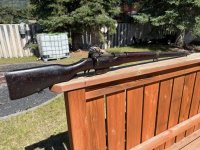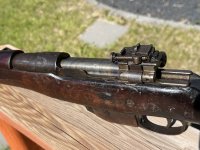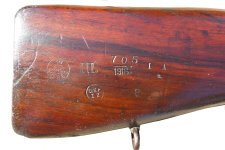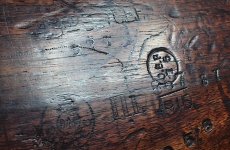












































A well storied Ross MkIII

flying pig

CGN Ultra frequent flyer
Uber Super GunNutz
Rating - 100%
115   0   0
Saw this rifle on TP a while ago, and it resurfaced on another site shortly after. When it disappeared from TP I kicked myself for not springing on it, but it had the stacking swivel removed and had the rear sling swivel replaced with half of a LE sling swivel at some point. Also, it’s a sewer pipe! But, sometimes it’s just the way a rifle talks to you that brings it home…

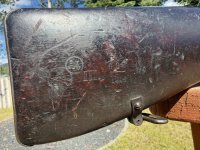
This one is marked to the 16th Battalion CEF ‘Canadian Scottish’, and being 1914 dated there is a good chance it was at Kitchener’s Wood during the Second Battle of Ypres. I used chlorine detection strips on it, and was not able to find any traces of gas, but the rifle has had upgrades and been filled full of cosmoline. So, it may still have been there. The serial could not be traced to an individual soldier according to another member at milsurps site.

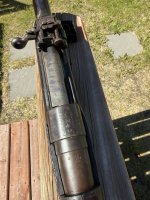
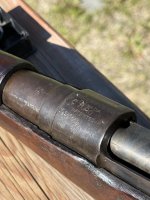
It has had a couple updates: the larger bolt stop and the bolt pin are present. It retains the early stock and nosecap though, so that’s a bonus. It has an E chamber, and the larger rear aperture scroll plate.

The case hardening on this bolt is gorgeous.

The rifle also served the Royal Marines as it has a CRB Crombie stamp and UK proofs.
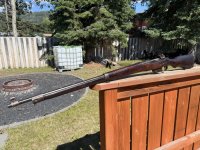

IMG_5941.jpegIMG_5943.jpegIMG_5944.jpegIMG_5947.jpegIMG_5950.jpegIMG_5949.jpeg
 
I, too, have a 16th Bn. Mk. III. Mine went to the RN aboard HMS Canada, eventually sold off surplus when Chile scrapped the battleship. May have been present at 2nd Ypres and aboard at the Battle of Jutland.
 
Also have a 15th Bn. Mk. III, with its RN modified bayonet with scabbard and RN frog. Ex-HMS Canada; bayonet serial (Chilean) matches the DA serial number. 15th Bn. exchanged their Mk. III rifles for SMLEs on the 15th of June, 1915. Easy to remember.
Lots of history in these rifles.
 
The "16" is most likely the year of issue to the CEF. MkIIIs that I've seen with that CEF stamp always either have a 15 or a 16 stamped, I think I may have seen a 14 before too. Otherwise there's a serious overepresentation of Ross rifles from only the 15th and 16th battalions (very unlikely in my personal opinion). Individual units would mark them afterwards with more detailed stamps, or not, it really depended on how the unit armorers felt. That one clearly made it at least to England in WW1, not only by the proofs but I can also tell from the enlarged safety, this mod was done in the UK starting 1917 and onwards.

CRB is a British depot stamp, I don't recall which one. There's also some marked "PLY" (Plymouth), another depot. CRB does not stand for "Canadian Railway Brigade" as I've seen some collectors suggest. These rifles were used by the UK home guard and were traded by the CEF to the Brits on a 1 to 1 basis for No.1 MkIIIs.
 
CRB is for Crombie which was a Royal Marines depot. I looked it up and it’s still operating as a Royal Navy resupply depot.

This one is right close to other rifles known issued to the 16th in records another collector mentioned on another site, just this particular rifle isn’t listed as issued to a certain man. I have no doubts that it was issued to the 16th. I think if there are an over abundance of rifles issued to the 16th it’s more of how the supply chain trickled down after they were moved out of front line service than anything. For example maybe all the rifles turned in from the 16th went for Royal Marines use after a light overhaul and then were in turn surplussed through the same channels.
 
I suspect the rifles from a given Bn. were exchanged for SMLEs en masse, and were subsequentially reissued for second line use as a group. Ones that went to HMS Canada were just about guaranteed to survive until sold off as surplus. Century Arms offered them with or without bayonets as well as sported. There are the Rosses that went to CRB and PLY. These too seem to have hit the surplus market in the UK as a group. Many of these got sported, barrels cut to 24", front sights remounted.
 
CRB is for Crombie which was a Royal Marines depot. I looked it up and it’s still operating as a Royal Navy resupply depot.

This one is right close to other rifles known issued to the 16th in records another collector mentioned on another site, just this particular rifle isn’t listed as issued to a certain man. I have no doubts that it was issued to the 16th. I think if there are an over abundance of rifles issued to the 16th it’s more of how the supply chain trickled down after they were moved out of front line service than anything. For example maybe all the rifles turned in from the 16th went for Royal Marines use after a light overhaul and then were in turn surplussed through the same channels.
I highly doubt this, this doesn't explain why I've only seen a 14, 15s and 16s. If this stamp was used by the 15th and 16th CEF why wasn't it used by others? They got standard stamps made for two battalions only? This makes no sense, unit armourers usually stamped the unit marks with individual stamps. I'm personally convinced it's an issue date. Please share the info you are basing your conclusions on because nothing I've seen leads me to that, be it the many unit marked rifles I've observed or The Ross Rifle Story. CEF units were equipped with the Rosses when they passed through Valcartier, they came sequetially straight from the factory but were they issued sequentially? There's just no way, it was random. It being close by to another rifle issued to the 16th doesn't remove my doubtfullness.
 
I highly doubt this, this doesn't explain why I've only seen a 14, 15s and 16s. If this stamp was used by the 15th and 16th CEF why wasn't it used by others? They got standard stamps made for two battalions only? This makes no sense, unit armourers usually stamped the unit marks with individual stamps. I'm personally convinced it's an issue date. Please share the info you are basing your conclusions on because nothing I've seen leads me to that, be it the many unit marked rifles I've observed or The Ross Rifle Story. CEF units were equipped with the Rosses when they passed through Valcartier, they came sequetially straight from the factory but were they issued sequentially? There's just no way, it was random. It being close by to another rifle issued to the 16th doesn't remove my doubtfullness.
https://www.milsurps.com/threads/if-you-have-a-ross-mkiii-marked-to-the-16th-battalion-cef.56596/
 
I highly doubt this, this doesn't explain why I've only seen a 14, 15s and 16s. If this stamp was used by the 15th and 16th CEF why wasn't it used by others? They got standard stamps made for two battalions only? This makes no sense, unit armourers usually stamped the unit marks with individual stamps. I'm personally convinced it's an issue date. Please share the info you are basing your conclusions on because nothing I've seen leads me to that, be it the many unit marked rifles I've observed or The Ross Rifle Story. CEF units were equipped with the Rosses when they passed through Valcartier, they came sequetially straight from the factory but were they issued sequentially? There's just no way, it was random. It being close by to another rifle issued to the 16th doesn't remove my doubtfullness.
 
Hello well intentioned gents. Brandon you are incorrect and Pelcat you are fairly correct. Allow me to convince you with a pic
attached of a 12 in the CEF circled stamp. It is true that Unit marks on Mk III service rifles are seldom seen. Most of the early 1914 and 15 rifles got battle field scrapped or turned over in the 100K rifle swap initiated 1916 but problably completed just before Vimy Ridge. The circular stamp is a depot inspection mark stamped on rifles that were sent to the Brits in the rifle swap.There were 5 armourer shops in the U.K. in WW1 which probably is an indicator which shop past the rifle's muster. Rifles from all divisions as can be released go back to a shop from the front for serviceable repair or inspection to ensure the Brits get seviceable weapons relegated as secondary service. Unit marks on Mk III rifles were always individual stamps put on by a unit designate (possibly armourer) and most always the unit marks do not match up with other unit stamps. It is always possible that the 1914 rifle in question was issued to the 16th but no one should take the encircled stamp as an indicator. The circular stamp is more of an inventory inspection mark proved by the attached pic whose inspection mark number is not a Battalion mark to a rifle made fall 1916. If one wants has the initiative museums in the U.K. sometimes have early Ross Mk III rifles on display or in store with unit marks. Ross Mk III serial DA5/1914 (5th rifle accepted) was in a Scotland museum. Most if not all WW1 Canadian used only rifles were not returned by Canadian troops. That is why you never see pics of returning soldiers disembarking armed. The same with SMLEs. Almost all of the Canadian SMLEs in collections today were depot serviced by Brit armourers that were sent over after inspection and servicing after the war. I hope I never have to deal with this marking issue again. John T.
 

Attachments

  • 1916 butt CEF 12.jpg
    1916 butt CEF 12.jpg
    108.4 KB · Views: 26
Hello well intentioned gents. Brandon you are incorrect and Pelcat you are fairly correct. Allow me to convince you with a pic
attached of a 12 in the CEF circled stamp. It is true that Unit marks on Mk III service rifles are seldom seen. Most of the early 1914 and 15 rifles got battle field scrapped or turned over in the 100K rifle swap initiated 1916 but problably completed just before Vimy Ridge. The circular stamp is a depot inspection mark stamped on rifles that were sent to the Brits in the rifle swap.There were 5 armourer shops in the U.K. in WW1 which probably is an indicator which shop past the rifle's muster. Rifles from all divisions as can be released go back to a shop from the front for serviceable repair or inspection to ensure the Brits get seviceable weapons relegated as secondary service. Unit marks on Mk III rifles were always individual stamps put on by a unit designate (possibly armourer) and most always the unit marks do not match up with other unit stamps. It is always possible that the 1914 rifle in question was issued to the 16th but no one should take the encircled stamp as an indicator. The circular stamp is more of an inventory inspection mark proved by the attached pic whose inspection mark number is not a Battalion mark to a rifle made fall 1916. If one wants has the initiative museums in the U.K. sometimes have early Ross Mk III rifles on display or in store with unit marks. Ross Mk III serial DA5/1914 (5th rifle accepted) was in a Scotland museum. Most if not all WW1 Canadian used only rifles were not returned by Canadian troops. That is why you never see pics of returning soldiers disembarking armed. The same with SMLEs. Almost all of the Canadian SMLEs in collections today were depot serviced by Brit armourers that were sent over after inspection and servicing after the war. I hope I never have to deal with this marking issue again. John T.
Thanks for the clarification John. I stand corrected. I was hoping you’d chime in on it.

I had one other once that was marked something more like ‘15th Batt. CEF’ (I can’t remember the exact unit). That sounds more like what you are describing than this 16 CEF mark as being a unit marking.
 
A good conversation given how few battalion markings are on Mk III Ross rifles compared to the profusion seen on the Mk II rifles, and the desire of Ross fans to find any sense of history for their rifle. And congrats on the purchase of your new Mk III, FP.

Posted previously in a thread here (I'm sure) here's an image of the markings on my 1915-dated Mk III, Ex-HMS Canada. It has a circled "CEF 15" marking and, above that, a stamped marking to the "43rd Bn CEF" over a rack number. As my grandfather served in the 43rd Cameron Highlanders of Canada in the Great War, it is a very special example for me.

marking zoom-1.jpg
 
A good conversation given how few battalion markings are on Mk III Ross rifles compared to the profusion seen on the Mk II rifles, and the desire of Ross fans to find any sense of history for their rifle. And congrats on the purchase of your new Mk III, FP.

Posted previously in a thread here (I'm sure) here's an image of the markings on my 1915-dated Mk III, Ex-HMS Canada. It has a circled "CEF 15" marking and, above that, a stamped marking to the "43rd Bn CEF" over a rack number. As my grandfather served in the 43rd Cameron Highlanders of Canada in the Great War, it is a very special example for me.

View attachment 1189757
Hi RangeRover. You are totally correct. That is a proper CEF Battalion stamp and to have your grandfather in that unit - PRICELESS. Even if that rifle must be eventually made a dewat it is still a family treasure for infinitum. John
 
Back
Top Bottom