












































You are using an out of date browser. It may not display this or other websites correctly.
You should upgrade or use an alternative browser.
You should upgrade or use an alternative browser.
Barrel - Rifle Tuners
- Thread starter remington jim
- Start date

- Location
- Northumberland
I have the Redd Nobb Tuna and sushi roll on my 22lr prs rifles (rimx and 457) and I like the added weight at the front of the gun. But I have yet to get it to work for me, by which I mean that I have been unable to get get repeatable smaller groups at a specific setting and larger at others. I found i just burned through a large volume of ammo trying to hit a specific node when all the groups were acceptable for 22 prs shooting. I also have an insite tuner brake on my CF prs gun but I found that after initial load development the groups where small enough that I would not require any tuning.
So I guess my 2 cents are that although I have nothing against tuners I have not noticed any benefits.
So I guess my 2 cents are that although I have nothing against tuners I have not noticed any benefits.
Those changes would have to be pre-determined too I suppose, a match isn't the time to dial the wrong directionMoving the tuner a fraction of a turn at a time to will help it stay there through temperature or barometric pressure changes of the day.
Cortina knows where the money is
EC tuners and tuner brakesso what brand tuner on what rifle - cartridge did you try it out with no good results ?
Spearheard machine tuner and tuner brakes.
6 Dasher
284Win
22 LR
And did not see obvious differences during load development and tuner testing at 100 and 300.
I did not do an intensive testing on each tuner and tuner brake due to primer shortage and time, if something I missed or miss read the test result, it is possible.
I've always considered buying All The Barrel to be the primary strategy for accuracy, weight forward, and absorbing centrefire heat. Maximize length and thickness and kilograms! Also, not all disciplines allow muzzle devices.

More USELESS DRIVEL - thanksI've always considered buying All The Barrel to be the primary strategy for accuracy, weight forward, and absorbing centrefire heat. Maximize length and thickness and kilograms! Also, not all disciplines allow muzzle devices.
 All allow tuners but lots such as f Class - NO BRAKES ,
Last edited:
- Location
- Quesnel B.C.
I agree the tuners are not required for accurate shooting. Best the shooter spends more time on the range.
That cannot be argued, more time = better accuracy. A tuner will not overcome this, so get off the easy chair head for RANGE.
That cannot be argued, more time = better accuracy. A tuner will not overcome this, so get off the easy chair head for RANGE.
Another total way off the Base line answer ! DrivelI agree the tuners are not required for accurate shooting. Best the shooter spends more time on the range.
That cannot be argued, more time = better accuracy. A tuner will not overcome this, so get off the easy chair head for RANGE.

So No you know NOTHING also about Tuners or there useage . Great
 Lots of You Guys !

This is probably the best answer on here… especially considering the products and lingo that he has either re-invented, or at least re-introduced. And Jim, he took your money, so there is that.Cortina knows where the money is
As mentioned, tuners work well if a feller decides to make factory ammo a constant in the rifle. That is why they are considered essential on .22 match rifles in certain disciplines.
For a hand loader, who develops ammo for a specific rifle under specific parameters, a tuner is another piece of marketing junk to hang on your rifle.
They do work on a centre fire rifle, if one wants to invest a significant amount of time and effort into making it work. The data logging would be phenomenal.
It really depends on where you want to spend your time….
Waiting for your response, Jim!

R.
Last edited:
Lots of TUNERS on rifles including the WINNERSWere any present at the recent F-class match RJ ?
One sort of tuner or harmonic dampening or another has been used for well over a century by different manufacturers, engineers, or private shooters.
The Brits and other nations included harmonic dampeners under their Lee Enfield No1 barrels in the form of a saddle on a pedestal riding in a compression spring about ten inches behind the muzzle to put upward pressure on the barrel, and if not improving accuracy, at least maintaining what they had.
Germany went a different route and stepped the tapers on their barrels to keep harmonics under control, under different temperature conditions, as well as slightly different load conditions.
Jim and I had a mutual friend years ago, called Al Forslund. Jim grew up with him, and I met him later in life at the Cancer ward, during chemo treatments.
Anyway, we did some experiments with Harmonic dampening on heavy barrels, from 20-30 inches long, and a few custom hunting barrels that were 23 inches long.
Like the video, all were chambered for 308Win, but we used a 7.62 Palma Match reamer, which is very close.
Both barrels came from HART and had 1-15 twist rates, and worked best with good bullets, 155 grains or less, especially the Sierra Match King 155 grain, built for the twist rate and used widely in Palma matches at the time.
We made up a "floating cup" that rode in an inverted "T" slot from an inch in front of the receiver to the tip of the fiberglass stock about half the length of the barrels. The stock was made by McMillan, and we glass bedded it to fit the receiver both barrels were fitted to during testing, a Remington 700 LA, that had been blue printed.
We used BR2 primers, Sierra Match 155 grain bullets, W748 powder (same charge for both barrels), and Wilson arbor press/dies, with same size collars as the chambers were cut with the same reamer.
The LA rifle was chosen so we could fit longer cartridges into the magwell.
We used the dampener with six pounds of upward pressure at half inch intervals, to 1/2 inch in front of the receiver.
We had very similar results, with both barrels as those shown in the video, until we got to the tip of the fore end. It really started to make a difference, about 2 inches back from the fore end tip, slight at first, then increasingly aggressive as it moved forward.
Many commercial manufacturers used a "pad" close to the tip of the fore ends in their barrel channels for decades, but it was only effective under certain conditions and unadjustable, without removing wood or adding wood.
We used external upward pressure. The fellow in RJ's video only used the extreme tip of the barrel, which is fine for specific types of shooting.
We chose the Brit style of Harmonic stabilizing, which was locating the most serious harmonic stability point, where the barrel was used as a sort of fulcrum point to contain the "whip" from that point forward, which automatically decreased the whip coming up from just in front of the receiver.
There was some difference, but not enough in either of our opinions to get excited about.
It did make enough difference in the heavy bbl groups, if used properly, depending on the conditions of the day, it may have made the difference between placing second and winning.
The damper we used on the hunting barrel had much more effect, especially when 1/2 inch moves were made. It responded to small/tiny moves much more quickly. Conditions of the day made it a pain in the butt to rely on.
I decided I didn't want to keep records and continuously play with positioning, but Albert couldn't leave it alone. He retired due to his heart, and I was working, so personal time had a lot to do with it.
He finally used the same receiver and stock to build a 257 Roberts, with a 1-14 twist, for long range Coyotes. He located two screws at 30 degree points off the center of the barrel at what he determined to be the "stress point." He also developed a chart based on one load for 87 grn Remington FB/HP.
He made some incredible shots with that rifle, but he was also constantly fiddling with the adjustable pressure point.
The Brits and other nations included harmonic dampeners under their Lee Enfield No1 barrels in the form of a saddle on a pedestal riding in a compression spring about ten inches behind the muzzle to put upward pressure on the barrel, and if not improving accuracy, at least maintaining what they had.
Germany went a different route and stepped the tapers on their barrels to keep harmonics under control, under different temperature conditions, as well as slightly different load conditions.
Jim and I had a mutual friend years ago, called Al Forslund. Jim grew up with him, and I met him later in life at the Cancer ward, during chemo treatments.
Anyway, we did some experiments with Harmonic dampening on heavy barrels, from 20-30 inches long, and a few custom hunting barrels that were 23 inches long.
Like the video, all were chambered for 308Win, but we used a 7.62 Palma Match reamer, which is very close.
Both barrels came from HART and had 1-15 twist rates, and worked best with good bullets, 155 grains or less, especially the Sierra Match King 155 grain, built for the twist rate and used widely in Palma matches at the time.
We made up a "floating cup" that rode in an inverted "T" slot from an inch in front of the receiver to the tip of the fiberglass stock about half the length of the barrels. The stock was made by McMillan, and we glass bedded it to fit the receiver both barrels were fitted to during testing, a Remington 700 LA, that had been blue printed.
We used BR2 primers, Sierra Match 155 grain bullets, W748 powder (same charge for both barrels), and Wilson arbor press/dies, with same size collars as the chambers were cut with the same reamer.
The LA rifle was chosen so we could fit longer cartridges into the magwell.
We used the dampener with six pounds of upward pressure at half inch intervals, to 1/2 inch in front of the receiver.
We had very similar results, with both barrels as those shown in the video, until we got to the tip of the fore end. It really started to make a difference, about 2 inches back from the fore end tip, slight at first, then increasingly aggressive as it moved forward.
Many commercial manufacturers used a "pad" close to the tip of the fore ends in their barrel channels for decades, but it was only effective under certain conditions and unadjustable, without removing wood or adding wood.
We used external upward pressure. The fellow in RJ's video only used the extreme tip of the barrel, which is fine for specific types of shooting.
We chose the Brit style of Harmonic stabilizing, which was locating the most serious harmonic stability point, where the barrel was used as a sort of fulcrum point to contain the "whip" from that point forward, which automatically decreased the whip coming up from just in front of the receiver.
There was some difference, but not enough in either of our opinions to get excited about.
It did make enough difference in the heavy bbl groups, if used properly, depending on the conditions of the day, it may have made the difference between placing second and winning.
The damper we used on the hunting barrel had much more effect, especially when 1/2 inch moves were made. It responded to small/tiny moves much more quickly. Conditions of the day made it a pain in the butt to rely on.
I decided I didn't want to keep records and continuously play with positioning, but Albert couldn't leave it alone. He retired due to his heart, and I was working, so personal time had a lot to do with it.
He finally used the same receiver and stock to build a 257 Roberts, with a 1-14 twist, for long range Coyotes. He located two screws at 30 degree points off the center of the barrel at what he determined to be the "stress point." He also developed a chart based on one load for 87 grn Remington FB/HP.
He made some incredible shots with that rifle, but he was also constantly fiddling with the adjustable pressure point.
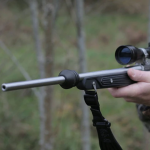

Three match rifles that come to mind that were built with " tuning screws" or bedding screws angled upwards in the firend to apply presdure on the varrrl were the model 52 Winchester 22LR, Martini Intrrnational 22LR, and the Remington 300 meter International Match 40x in 7.63x51 NATO.
If you look closely you can see the screw holes on this Remington Intl' Match
Cat
If you look closely you can see the screw holes on this Remington Intl' Match
Cat
Attachments
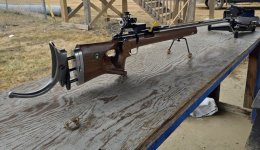
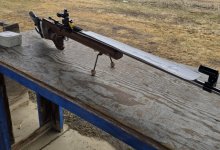

Yup, two different approaches with tighter groups the goal.Varying barrel bedding points has been around forever. The current attached barrel tuners are a more recent method.
Cat
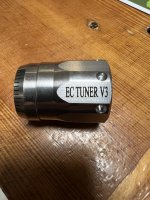
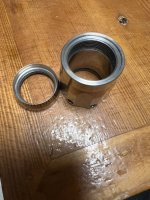

I decided to give a tuner a try on my 6 dasher. My range time is limited so the option of tuning loads and trying 1000 different ways to make the perfect tuned round for that particular day is not available with my schedule. I have a load that shoots good enough for my expectations and ability. My gun is set up with a muzzle brake but I am shooting a local match where muzzle brakes are not allowed, so I decided to try a tuner.
I bought a Spearhead tuner, shot 6 rounds of 3 shot groups while moving the tuner 2 full turns for each group. So I started at 0, then 2, then 4,6,8,10. and shot left to right.
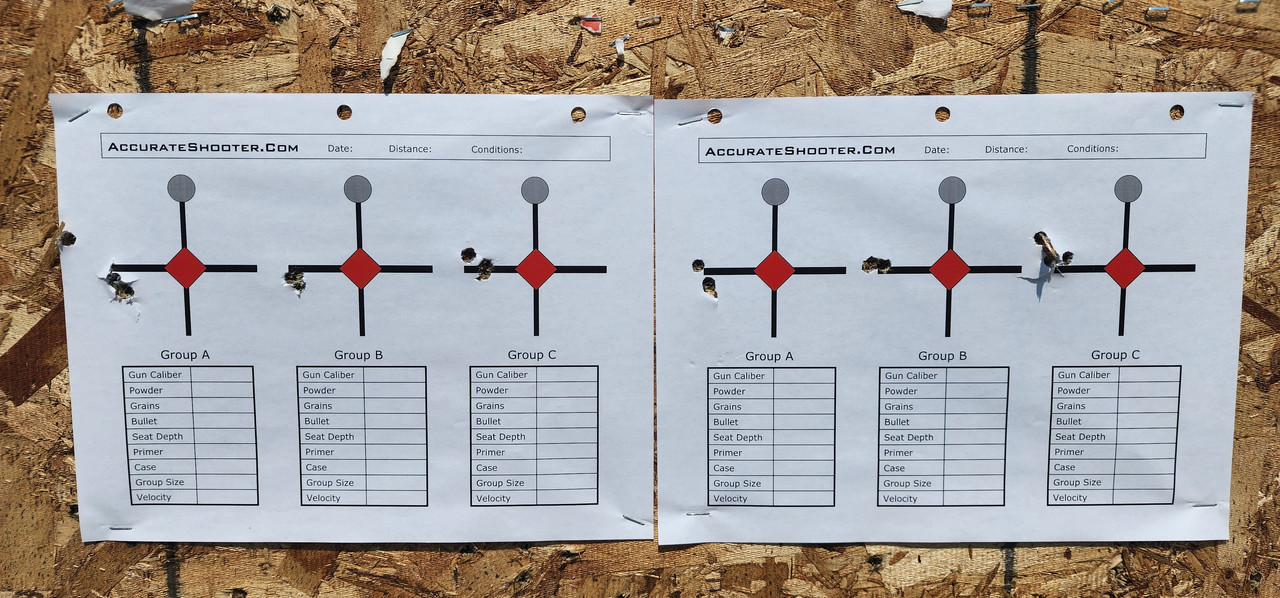
You can see the trend of impact shift for the adjustments I made. The choice of 2 groupings to try again was #2 (setting 2) and #5 (setting 8).
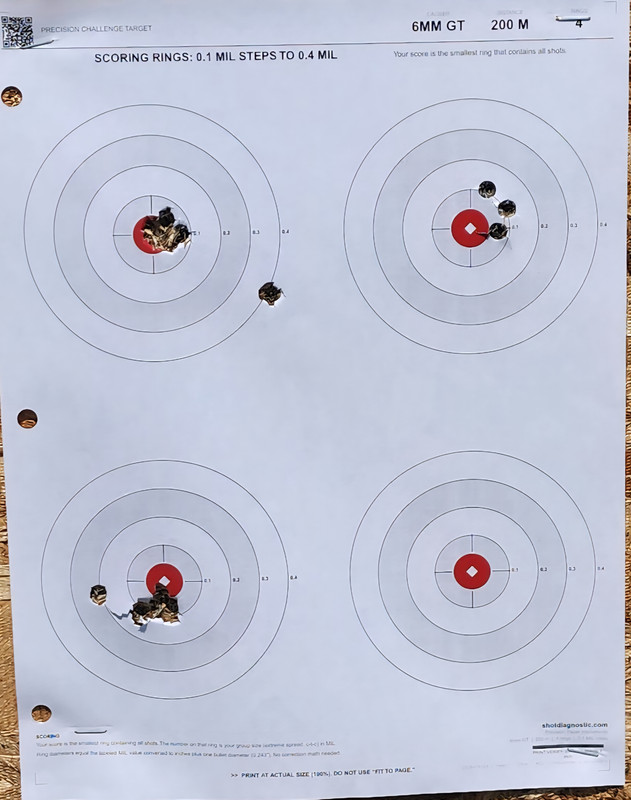
I shot 2 more 3 shot groups on another target (top 2 targets, ignore the 30 cal hole). Left was setting 2 right was setting 8. To confirm setting 2 I put 2 more shots on the left target for a 5 shot group. These are 1cm rings for refrence.
The results are good enough for me and I can't shoot better then this. No wind adjustments and mirage making the target move 1/2" around the reticle.
I bought a Spearhead tuner, shot 6 rounds of 3 shot groups while moving the tuner 2 full turns for each group. So I started at 0, then 2, then 4,6,8,10. and shot left to right.
You can see the trend of impact shift for the adjustments I made. The choice of 2 groupings to try again was #2 (setting 2) and #5 (setting 8).
I shot 2 more 3 shot groups on another target (top 2 targets, ignore the 30 cal hole). Left was setting 2 right was setting 8. To confirm setting 2 I put 2 more shots on the left target for a 5 shot group. These are 1cm rings for refrence.
The results are good enough for me and I can't shoot better then this. No wind adjustments and mirage making the target move 1/2" around the reticle.
Not bad at all, but out of curiosity, were the "flyers" your fault?
Tuners will not induce any rifle to shoot a bad load well, but they will often help a barrel to shoot a very good load just a bit better.
This is just IMHO, of course.
I had a 29 inch, new take off barrel, chambered for the ubiquitous 7x57 Mauser, that came from a Brazilian M1935 back in 1975, that was new in the crate. The original owner, bought the rifle off a local smith, Les Viel, then told him to take the action for a custom build he wanted done.
Anyone who has seen these rifles in NIB condition knows how beautiful they were and how well they were finished. The Brazilians spared no expense on their rifles.
I had just gone through a right shoulder replacement, and wanted something with less recoil for hunting that fall.
I had been told by Les Viel, back in the day, why Mauser barrels were stepped at such precise locations, so after cutting the barrel back to 22 inches, I weighed the bit that was taken off, made up a muzzle brake that weighed the same, within a few grams, then soldered it to the muzzle.
No, I didn't shoot it before adding the brake. In 20-20 hindsight, I regret not doing so.
I built the rifle with the idea that I could shoot a substantial load and keep recoil to a minimum, so as not to damage my new shoulder joint.
I only used the rifle for one season, and it shot sub moa groups, with 139grn, Hornady SSTIL bullets, doing 2800fps.
I'm mentioning this because, well over a century and a half back, militaries went to great lengths to increase accuracy, but it had to be cheap enough to incorporate into a contract for extremely large numbers of rifles, to keep the costs within the contract agreement.
Paul Mauser got the idea of finding the spots on barrels where harmonics had the most effect on accuracy. Whether it was his idea or not, he had the resources to do it, and did it quite well IMHO. Usually, Mauser rifles with stepped barrels will shoot very well when their barrels aren't worn, with issue ammo.
There is something to "harmonics" having an effect on accuracy.
Most people do not like the "look" of stepped barrels, so manufacturers of modern rifles don't make them. The stepped barrel will work well, but each caliber has its own sweet spots. I remember another smith, Walt Rogers, who would turn the steps off the barrels, at customer request, and the accuracy would fall off every time.
Tuners will not induce any rifle to shoot a bad load well, but they will often help a barrel to shoot a very good load just a bit better.
This is just IMHO, of course.
I had a 29 inch, new take off barrel, chambered for the ubiquitous 7x57 Mauser, that came from a Brazilian M1935 back in 1975, that was new in the crate. The original owner, bought the rifle off a local smith, Les Viel, then told him to take the action for a custom build he wanted done.
Anyone who has seen these rifles in NIB condition knows how beautiful they were and how well they were finished. The Brazilians spared no expense on their rifles.
I had just gone through a right shoulder replacement, and wanted something with less recoil for hunting that fall.
I had been told by Les Viel, back in the day, why Mauser barrels were stepped at such precise locations, so after cutting the barrel back to 22 inches, I weighed the bit that was taken off, made up a muzzle brake that weighed the same, within a few grams, then soldered it to the muzzle.
No, I didn't shoot it before adding the brake. In 20-20 hindsight, I regret not doing so.
I built the rifle with the idea that I could shoot a substantial load and keep recoil to a minimum, so as not to damage my new shoulder joint.
I only used the rifle for one season, and it shot sub moa groups, with 139grn, Hornady SSTIL bullets, doing 2800fps.
I'm mentioning this because, well over a century and a half back, militaries went to great lengths to increase accuracy, but it had to be cheap enough to incorporate into a contract for extremely large numbers of rifles, to keep the costs within the contract agreement.
Paul Mauser got the idea of finding the spots on barrels where harmonics had the most effect on accuracy. Whether it was his idea or not, he had the resources to do it, and did it quite well IMHO. Usually, Mauser rifles with stepped barrels will shoot very well when their barrels aren't worn, with issue ammo.
There is something to "harmonics" having an effect on accuracy.
Most people do not like the "look" of stepped barrels, so manufacturers of modern rifles don't make them. The stepped barrel will work well, but each caliber has its own sweet spots. I remember another smith, Walt Rogers, who would turn the steps off the barrels, at customer request, and the accuracy would fall off every time.






















