











































300 Savage: SST Bullet, Headspace, Bulged Primers & Load Development

drew_

New member
EE Expired
Rating - 0%
0   0   0
Looking for some experienced .300 Savage / Savage 99 reloaders’ opinions.


Rifle: Savage 99F, .300 Savage, 22" barrel
Components: Hornady 150gr SST #30303, H4895, CCI Large Rifle Primers, Federal brass (headstamp + weight sorted)


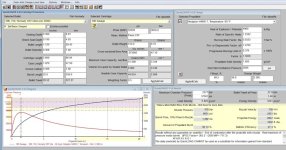
I recently did an H4895 ladder and got the following results:


36.8 gr — 2422.5 fps — SD 12.5 — ES 33.2 — 2.23" group
37.2 gr — 2478.6 fps — SD 9.0 — ES 26.9 — 2.41" group
37.6 gr — 2512.6 fps — SD 6.4 — ES 19.2 — 2.51" group
38.0 gr — 2551.5 fps — SD 8.6 — ES 24.2 — 3.99" group
38.4 gr — 2586.9 fps — SD 7.1 — ES 21.3 — 2.29" group
38.8 gr — 2633.4 fps — SD 12.0 — ES 31.8 — 2.39" group
39.2 gr — 2656.0 fps — SD 2.9 — ES 8.0 — 2.93" group
39.6 gr — 2670–2680 fps — stopped testing

A 5-shot group with factory Federal 180gn shot 1.55" 2343fps Avg, 18.3 ES, 7.9SD (only last 3 shots of these were chronographed)


I stopped at 39.6 gr because extraction became sticky.


Groups were generally in the 2–3" range, unfortunately with 38.4 gr giving the best group at 2.29". I'd ultimately like to get closer to 1" if the rifle is capable of it.


I have powder for 15 rounds of the H4895 load left, so I'm planning to experiment with seating depth with those. After that I'll probably try another suitable powder, such as Varget, and do another load-development test.


The thing I'm still trying to understand is the primer appearance.


Some of the fired primers have a noticeable bulge approx. 0.010" proud of base of the brass, but they aren't flattened. I'm seeing it across the different H4895 charges, and interestingly, I'm also seeing the same thing on factory Federal 180gr powershok ammunition (all 5 test shots bulged), while some 150gn factory federal powershok ammunition with brass that had a different headstamp dis not have the bulged primers (4 test shots)


So I'm wondering what exactly could be causing that and how much significance I should attach to it. Does the fact that it also occurs with factory ammunition point more toward something with the rifle/chamber/primer rather than necessarily being a pressure indication?


I can post photos of the fired primers/cases and targets if that would help.
 
Last edited:
Back in the day, I had a friend with Savage 99 in 243 Win that did same thing - lots of "backed out" primers - proud of the case head. He thought his hand loads were border line "too hot", but it did same with factory ammo. Took a bit and some fussy measurement - turns out that rifle had excessive headspace - longer than FIELD length. His "fire-formed" cases fit to that chamber - so we just reloaded them and fired again - no issues as I recall. I never did discover WHAT was making the headspace too long - wear in chamber or wear on bolt lugs or on receiver, or perhaps bolt compression?.

He was a typical small Sask town deer hunter - the gun might have seen 20 rounds during an unusually busy year - more often one or two shots per year. I think he fired his 22-250 a LOT more than the 243.

I believe now that the firing pin strike was driving the case forward until the case stopped - that created an "air gap" between bolt face and case head (I think) - then with pressure rise on firing, the primer popped rearward to sit on the bolt face - as pressure continued to rise, the brass case "stretched" until it was also on the bolt face - no proud primer - or sometimes no stretching, therefore primer was proud - case held tight to chamber walls - I interpreted that to show "LOW" reloading pressure, not "High pressure" that he was concerned about. But I might have got that all messed up - the guy is passed on now - I have no clue where is that rifle.
 
Last edited:

I had a 99E with significant excess headspace. It was a real beater, a project rifle. Sent cases to SCBS, got a custom FL die. Had basically no .300 brass, so I made cases from an assortment of brass with the correct head diameter. Installed a peep sight, never scoped it. Tried a variety of .30 bullets, but loaded most rounds with surplus Gevelot flat nosed 170gr .30-30 bullets. Those things were almost cylindrical, hardly any ogive taper. Shot quite well. Killed caribou like the hammer of Thor. Loaned it to a chap, 5 caribou with 5 shots. He really wanted to buy it; I wouldn't sell it because he didn't handload and I didn't think the rifle should be used with factory ammunition.
If you look at the 99 action, you will see how the bolt locks and what holds it in place. There are contact surfaces at both top and bottom of the receiver. With wear, the rear of the bolt can drop a bit and this results in excess headspace. Handloading cartridge to fit the rifle is the easiest solution.
 
First off, I agree with Potashminer's & Tiriaq's comments above with regard to excess headspace. Full disclosure; I have NEVER worked with Savage 99's. Dad was a Winchester man [pre-war 94 EWC that my Mom bought him for an Anniversary present with her Eaton's employee discount after he got back from "The European Tour" in '46] & that is what I started with].

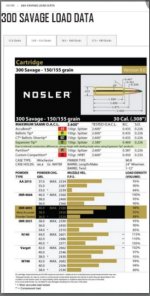
This is what Nosler recommends for loads for their 150-155 gr. bullets in the .300 Savage. While it's not exactly the same as H4895 [which is actually the Australian-made AR2206H], the Canadian made IMR4895 is pretty darn close. Of note is that velocities in their 24" custom barrel are ~100 fps slower than the velocities you obtained with your 22" barrel. I believe part of the reason is your use of Federal brass, versus their use of Winchester. My belief is based on case capacities in a number of different cartridges when comparing Federal [FC] & Winchester [albeit the older W-W Super] cases. Offsetting that is their use of WLR primers vs. your use of CCI LR primers. With the old white-box Winchester LR primers [boxes marked with "FOR STANDARD OR MAGNUM LOADS"], velocities using those primers were the highest I ever chronographed with non-magnum primers & even some magnum primers [R-P 9 1/2M].

Given Nosler's comment that 36.0 grs. of IMR4895 was their most accurate load , if it was me, I'd reduce the charge to 35.5 & work up to 36.6 grs. [you already know what 36.8 grs. will do, although a sample of one [group] is, as well all know, statistically worthless.

Another thing to note is that the Federal 180 gr. load is a flat-base bullet, whereas the SST is a BT bullet. While I do not know your C.O.A.L., it is pertinent to note that using the SAAMI max. length of 2.600", your case neck is only holding onto 0.190" of the bullet because of the SST's boat-tail, which, in terms of internal ballistics, accomplishes nothing other than taking up valuable powder space.

Yet something else to note is that the Federal 180 gr. bullet might fit your rifle's throat better, whether due to its initial chambering, or wear, allowing it to be centred in the barrel's throat.

My $0.02 Cdn. 300 Savage 150 Hdy SST H4895.jpg300 Savage 150 grain.jpg300 Savage 150 Hdy SST H4895.jpg300 Savage 150 grain.jpg
 
First off, I agree with Potashminer's & Tiriaq's comments above with regard to excess headspace. Full disclosure; I have NEVER worked with Savage 99's. Dad was a Winchester man [pre-war 94 EWC that my Mom bought him for an Anniversary present with her Eaton's employee discount after he got back from "The European Tour" in '46] & that is what I started with].

This is what Nosler recommends for loads for their 150-155 gr. bullets in the .300 Savage. While it's not exactly the same as H4895 [which is actually the Australian-made AR2206H], the Canadian made IMR4895 is pretty darn close. Of note is that velocities in their 24" custom barrel are ~100 fps slower than the velocities you obtained with your 22" barrel. I believe part of the reason is your use of Federal brass, versus their use of Winchester. My belief is based on case capacities in a number of different cartridges when comparing Federal [FC] & Winchester [albeit the older W-W Super] cases. Offsetting that is their use of WLR primers vs. your use of CCI LR primers. With the old white-box Winchester LR primers [boxes marked with "FOR STANDARD OR MAGNUM LOADS"], velocities using those primers were the highest I ever chronographed with non-magnum primers & even some magnum primers [R-P 9 1/2M].

Given Nosler's comment that 36.0 grs. of IMR4895 was their most accurate load , if it was me, I'd reduce the charge to 35.5 & work up to 36.6 grs. [you already know what 36.8 grs. will do, although a sample of one [group] is, as well all know, statistically worthless.

Another thing to note is that the Federal 180 gr. load is a flat-base bullet, whereas the SST is a BT bullet. While I do not know your C.O.A.L., it is pertinent to note that using the SAAMI max. length of 2.600", your case neck is only holding onto 0.190" of the bullet because of the SST's boat-tail, which, in terms of internal ballistics, accomplishes nothing other than taking up valuable powder space.

Yet something else to note is that the Federal 180 gr. bullet might fit your rifle's throat better, whether due to its initial chambering, or wear, allowing it to be centred in the barrel's throat.

My $0.02 Cdn. View attachment 1196407View attachment 1196358View attachment 1196407View attachment 1196358
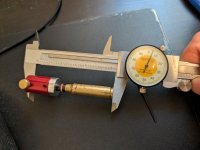
I seated to hornadys spec of 2.565" COAL on my loads. I measured with Hornady 8-30 ogive comparator tool/bushing and got 2.036" with my 150gn sst vs factory 150gn federal 2.020" vs factory federal 180gn at 2.013"
I will probably check distance to the lands with my sst bullet, but you make a good point about the neck contact on the SST BT.

No point for me going below the 36.8gn as those velocities were too low for what I'm trying to get.

Interesting thought about the cases vs the velocity I was getting--i was quite surprised at the velocity I was able to get, very efficient for the powder charge.

I actually have two groups of differently stamped FC cases, one group around 168-171gn (the ones I used here) and one set around 153-155gn.

Theoretically there is less case capacity in the brass I used.
 
Last edited:

Looking for some experienced .300 Savage / Savage 99 reloaders’ opinions.


Rifle: Savage 99F, .300 Savage, 22" barrel
Components: Hornady 150gr SST #30303, H4895, CCI Large Rifle Primers, Federal brass (headstamp + weight sorted)


I recently did an H4895 ladder and got the following results:


36.8 gr — 2422.5 fps — SD 12.5 — ES 33.2 — 2.23" group
37.2 gr — 2478.6 fps — SD 9.0 — ES 26.9 — 2.41" group
37.6 gr — 2512.6 fps — SD 6.4 — ES 19.2 — 2.51" group
38.0 gr — 2551.5 fps — SD 8.6 — ES 24.2 — 3.99" group
38.4 gr — 2586.9 fps — SD 7.1 — ES 21.3 — 2.29" group
38.8 gr — 2633.4 fps — SD 12.0 — ES 31.8 — 2.39" group
39.2 gr — 2656.0 fps — SD 2.9 — ES 8.0 — 2.93" group
39.6 gr — 2670–2680 fps — stopped testing

A 5-shot group with factory Federal 180gn shot 1.55" 2343fps Avg, 18.3 ES, 7.9SD (only last 3 shots of these were chronographed)


I stopped at 39.6 gr because extraction became sticky.


Groups were generally in the 2–3" range, unfortunately with 38.4 gr giving the best group at 2.29". I'd ultimately like to get closer to 1" if the rifle is capable of it.


I have powder for 15 rounds of the H4895 load left, so I'm planning to experiment with seating depth with those. After that I'll probably try another suitable powder, such as Varget, and do another load-development test.


The thing I'm still trying to understand is the primer appearance.


Some of the fired primers have a noticeable bulge approx. 0.010" proud of base of the brass, but they aren't flattened. I'm seeing it across the different H4895 charges, and interestingly, I'm also seeing the same thing on factory Federal 180gr powershok ammunition (all 5 test shots bulged), while some 150gn factory federal powershok ammunition with brass that had a different headstamp dis not have the bulged primers (4 test shots)


So I'm wondering what exactly could be causing that and how much significance I should attach to it. Does the fact that it also occurs with factory ammunition point more toward something with the rifle/chamber/primer rather than necessarily being a pressure indication?


I can post photos of the fired primers/cases and targets if that would help.
Looks like headspace might be your trouble.

Tiriaq has a good answer - adjusting your brass to fit the rifle is easier than adjusting your rifle to fit the brass.
 
Last edited:

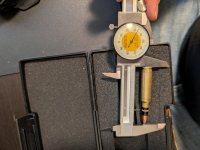
I just measured the length to my lands using a case with a split neck, and chambering a cartridge (using the lands to seat the 30303 bullet)

I have a COAL OF 2.734" and an ogive measurement of 2.204" with the Hornady comparator tool (8-30 bushing)

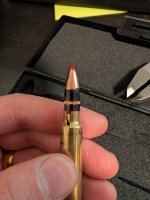
Obviously, 2.734" is not usable in the M99 for one, (2.600" max), but on top of that, at that seating depth, the case neck only has about 0.050" of engagement length on the bearing surface of the bullet, with the boat tail extending another .150" or so into the neck.

I'm wondering if this much jump and lack of neck support is causing poor groups. Do you think I should just give up my development for the 30303 bullet in my particular rifle? (I do have 165 of these bullets on hand still).

Would a flat base Hornady 3031 interlock SP or Sierra Pro-Hunter 2130 SPT be a better choice? Or something like the 160gn FTX, like the 30395, 30396, or the 165gn 3040 interlock sp.
 

Attachments

  • PXL_20260829_141215958.jpg
    PXL_20260829_141215958.jpg
    92.7 KB · Views: 4
  • PXL_20260829_142258745.jpg
    PXL_20260829_142258745.jpg
    112.4 KB · Views: 4
  • PXL_20260829_141514363.jpg
    PXL_20260829_141514363.jpg
    119.4 KB · Views: 4
I’m running Varget and Speer 150 BTSP’s in the Son in-laws .300 Savage, 99eg….

Good accuracy and it puts whitetail’s on the ground just fine.

99’s and top end loads don’t mix, rear lock up on the bolt and all that stuff lends itself to lotsa issues around case life and incipient case head separation …..


Even my .308 99C gives better case life and better accuracy when loaded shy of max loads.

Also don’t make a habit of mashing your brass back to minimum dimensions with your sizing die, just bump the shoulder enough for ease of chambering……
 
Back
Top Bottom