












































Smoothbore Sound Difference

bfj91

New member
Rating - 0%
0   0   0
Howdy fellas,

I've always shot a .595cal homemade round ball from my .62cal trade gun, which feels very tight going down, and produces a satisfying "thump" sound.

Today, I tested a shot load, and it produced a very sharp "crack" sound like a whip, and noticeably more recoil.

The load is such:
55gr FFG
2x beeswax coated cardstock discs (⅝" diameter)
A ball of compressed beaver underfur
55gr #6 shot
1x beeswax coated card
Another ball of beaver underfur

All rammed home nice and tight.

Patterned good enough for me, but the noticeable difference in sound was a bit unnerving.

Is this just a function of a tighter seal, do shot loads just sound different, or did I just experience something go wrong?

On visual inspection the gun is in good condition before and after the shot.

I appreciate everyone's time
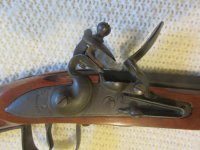
 
Albeit i dont shoot shot in my musket, I definitely notice a difference in sound from a tight .735 patched ball to a loose fitting 69cal ball paper cartridge...
Im sure velocity and compression is different... shot has a column where a ball has a narrow contact band.
 
55gr of shot? That is a really light load. Supersonic?
Even if you mean shot equal in volume to 55gr of powder, that is still light, so I suspect supersonic.
Basically beaver felt wads... Never tried (or had access) that wadding. Have used wool felt. A natural wadding I have used is paper wasp nest.
Yes that's correct, equal in volume. It's something I pulled from an old black powder book as a "20ga" load, and seemed right to me... And, economical for grouse hunting.

Is supersonic going to be a safety concern, or is that more about blowing patterns?
 
A "square" load like that should be just fine. I use about the same load in my 24ga NW gun.
If it is patterning to your satisfaction, fine.
IMG_0805.JPG
 
55gr FFG
2x beeswax coated cardstock discs (⅝" diameter)
A ball of compressed beaver underfur
55gr #6 shot
1x beeswax coated card
Another ball of beaver underfur


I'm weighing in on your shot load not as an expert but more as a shooter that's early along the learning curve and has questions about the 'why' of things.

Unless I misunderstand, you're not using a thin paper card over your shot, like cereal box material, but are using a heavy lubed card? (begging another question about why the beaver furball on top of that). I know about Skychief but that is a wet cushion wad on top, this is something else. Did you shoot a pattern board?
 
Howdy fellas,

I've always shot a .595cal homemade round ball from my .62cal trade gun, which feels very tight going down, and produces a satisfying "thump" sound.

Today, I tested a shot load, and it produced a very sharp "crack" sound like a whip, and noticeably more recoil.

The load is such:
55gr FFG
2x beeswax coated cardstock discs (⅝" diameter)
A ball of compressed beaver underfur
55gr #6 shot
1x beeswax coated card
Another ball of beaver underfur

All rammed home nice and tight.

Patterned good enough for me, but the noticeable difference in sound was a bit unnerving.

Is this just a function of a tighter seal, do shot loads just sound different, or did I just experience something go wrong?

On visual inspection the gun is in good condition before and after the shot.

I appreciate everyone's time
The increased recoil, along with the sonic 'crack' is something to be concerned with. If I had to guess, your load is too tight. If it's a modern steel gun, no real concern. If it's an ancient damascus weld, yea; don't do that.
 
Howdy fellas,

I've always shot a .595cal homemade round ball from my .62cal trade gun, which feels very tight going down, and produces a satisfying "thump" sound.

Today, I tested a shot load, and it produced a very sharp "crack" sound like a whip, and noticeably more recoil.

The load is such:
55gr FFG
2x beeswax coated cardstock discs (⅝" diameter)
A ball of compressed beaver underfur
55gr #6 shot
1x beeswax coated card
Another ball of beaver underfur

All rammed home nice and tight.

Patterned good enough for me, but the noticeable difference in sound was a bit unnerving.

Is this just a function of a tighter seal, do shot loads just sound different, or did I just experience something go wrong?

On visual inspection the gun is in good condition before and after the shot.

I appreciate everyone's time
That’s similar to the load I use in 16 and 12 ga, BP, 60gr fff with 7/8iz shot. I don’t “wad” like you but the powder, shot charges are close and mine shoot relatively soft and boom rather than crack. Not sure why you are experiencing what you describe.
 
Last edited:
Same as I'd be concerned about a steel load in a Damascus barrel, or smokeless in a black powder barrel. I'd rather look stupid on the Internet than look stupid in the emergency room 🤷
You are concerned about the equivalent of shooting subsonic 22rf in a rifle and then switching to supersonic high velocity 22rf in a rifle. As if a few hundred extra feet per second is somehow going to change anything? Do you actually think that in the last 400 years, no muzzle loader has ever exceeded the speed of sound ... ever? And if you do it, the gun is just going to explode because the projectile breaks the speed of sound? ts an absolutely ridiculous thing to be concerned about.


Out of muzzleloaders???
Why would that make a difference? Do muzzle loaders suddenly blow up if a supersonic load is fired? As above, do you think in the last 400 years that no muzzle loader projectile has ever exceeded the speed of sound? If so, I've got news for you.


I believe the Brown Bess ball was launched well up into the supersonic. Enfield bullets were slower- just into the supersonic.

milsurpo
My .54 cal flinter pushes roundball to around 1500 fps. A lot of muzzle loading long guns operate in the supersonic realm. Apparently this is news to people who have instant access to the entire accumulated history and information for all of human existence. It would seem the internet is not making us smarter. :rolleyes:
 
I've always shot a .595cal homemade round ball from my .62cal trade gun, which feels very tight going down, and produces a satisfying "thump" sound.
Patched or not? Tight does not necessarily mean sealed.... I don't patch for my Brown Bess (Indian repo) and expect a 'whomp' sound, for PRB in my rifles I expect a crack - in fact, when I can I wear foam ear plugs so I can listen for the 'correct sound'
I would say the sound you are getting is a sign of a good load!

as a side note, I always thought ML velocities were much-much lower than what they are (for no reason in particular) - a friend had one of them Garmin cronys out a few weeks back & I asked to try it out (too bad so expensive, I would really like one!!) set it up and got a consistent 1900f/s out of a .450 PRB over 65g FFF - I was quite surprised!
 
Patched or not? Tight does not necessarily mean sealed.... I don't patch for my Brown Bess (Indian repo) and expect a 'whomp' sound, for PRB in my rifles I expect a crack
My bet is the sound difference you hear is a result of the frequency mix of the muzzle blast, which would be altered by the bore size. A larger bore will produce lower frequencies which we perceive as a thump rather than a crack.


I always thought ML velocities were much-much lower than what they are (for no reason in particular) - a friend had one of them Garmin cronys out a few weeks back & I asked to try it out (too bad so expensive, I would really like one!!) set it up and got a consistent 1900f/s out of a .450 PRB over 65g FFF - I was quite surprised!
I'd be interested to see what caliber produces the highest muzzle velocity. I'd bet max BP muzzle velocity is not a lot over 2000 fps given the limitations of a patched round ball. Smaller bores use lighter balls, which should produce higher velocities.
 
My bet is the sound difference you hear is a result of the frequency mix of the muzzle blast, which would be altered by the bore size. A larger bore will produce lower frequencies which we perceive as a thump rather than a crack.
Oh it's definitely more 'throaty' but it will crack if I patch the ball :)

I'd be interested to see what caliber produces the highest muzzle velocity. I'd bet max BP muzzle velocity is not a lot over 2000 fps given the limitations of a patched round ball. Smaller bores use lighter balls, which should produce higher velocities.

I'd only be mildly surprised it it was coming up on 22/2300 ... I had a .36 at one point ...
yes - I would certainly be interested myself!
 
From my reading it seems like the 2,000 fps muzzle velocity was the holy grail and rarely if ever achieved with BP shooting with m-l rifles. Shotguns never approached the velocities we see these days with smokeless waterfowl loads. Cant speak for cannons, but I doubt it.
 
I find myself wondering if the beaver fur is the reason for extra recoil. Unless it is totally saturated with a lard/beeswax combination, it is probably a little big compressible. I would have used one of those commercial muzzleloading cushion wads with a card wad on top then the shot and finally either a card wad or 1/3 thickness of a cushion wad just to keep the shot in the barrel. I would expect the beaver fur on top of the shop might disperse the shot more than a card wad on top

cheers mooncoon
 
My bet is the sound difference you hear is a result of the frequency mix of the muzzle blast, which would be altered by the bore size. A larger bore will produce lower frequencies which we perceive as a thump rather than a crack.

Hmm, I think you are basically right, I think we are actually hearing 2 things, the report from the expanding gas and the crack of the projectile going supersonic, - I like my foamies ear 'protection' so I can hear the crack, always thought it was an indication of a "good seal" - which in a roundabout way it is...
An unpatched 69/75 cal ball may not hit supersonic speeds hence "no crack" and for reasons you say.. the gas report would be at a lower frequency
 
Back
Top Bottom