The allure of the British gun

I'm keeping this thread going because the view count keeps steadily rising despite the lack of new posts. Are these just AI-scraping bots zipping in, or real readers? My pessimism on that score is from the continuous stream of new CGN members, yet the few actual contributors to any serious discussion threads. Some new members profess an interest in history in their intro posts, but where are they? Trying to get into the EE is my guess. Thanks, as always, to the stalwarts who help this thread along. I've only covered a small fraction of the topic (admittedly an important selection), but there is still the entirety of the 20th and 21st (so far) centuries to cover, isn't there? New visitors, show off your British guns! Ask your questions here!

My latest in The Vintage Gun Journal is on the age-old obsession with gun prices, and how the Birmingham firm of J&W Tolley tried to undercut the breech-loading market by offering their basic gun at half the price of anyone else, without significantly lowering the quality, and keeping that low price for almost 10 years. I suppose a number of Turkish companies today are trying to do the same price-wise, but the fit, finish and materials are clearly not up to B-gun standards (though the latter seem to be slipping a bit, as the bean-counters take control). Imagine getting a nice double at bottom-level Turkish prices, but not being able to tell the difference, quality-wise and performance-wise, from a Beretta or Browning. That is what J&W Tolley was trying to do.

J&W Tolley's Loss Leader
A delve into early breech loaders.

In the latest issue, there's also an account of a percussion Purdey rifle that was picked up at auction in Canada. Yes, there are some historical gems to be found in our own backyard, if we're willing to look.
 
Quality pieces do come out of the woodwork, particularly shotguns. Guns that may have been expensive originally get passed along and as the years go by, become just another old shotgun. One muzzleloading gun (double, originally flint, converted to caplock) that I acquired was in a cottage on a lake that changed hands. It had been part of the decor. The new cottage owners didn't want it, took it to a shop to get rid of it. At least they didn't turn it in to the police. The shop manger knew I'd be interested, gave me a call. Made by a business last active in 1812, the silver thumbpiece had the arms of an earl. Did a websearch, found a portrait of the gentleman. He'd been a young man when he acquired the gun. Fortunately the gun was never abused, must have been cleaned every time it was used. Who knows how it got to Canada.
While I appreciate a gun for what it is, I always find a gun more interesting if some of its provenance, its history, has survived. I have a P'08, made 1938. When I disassembled it for a thorough cleaning, on the inside of one grip I found "JULY 10 1943 AVOLA SICILY". First day of Operation Husky. So, I know the when. I think I know the who. The gun came from the estate of a chap I knew; he was the first to register it. Pretty sure I know where he got it, his friend had served in the British Army.
 
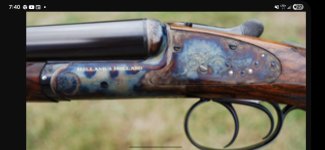
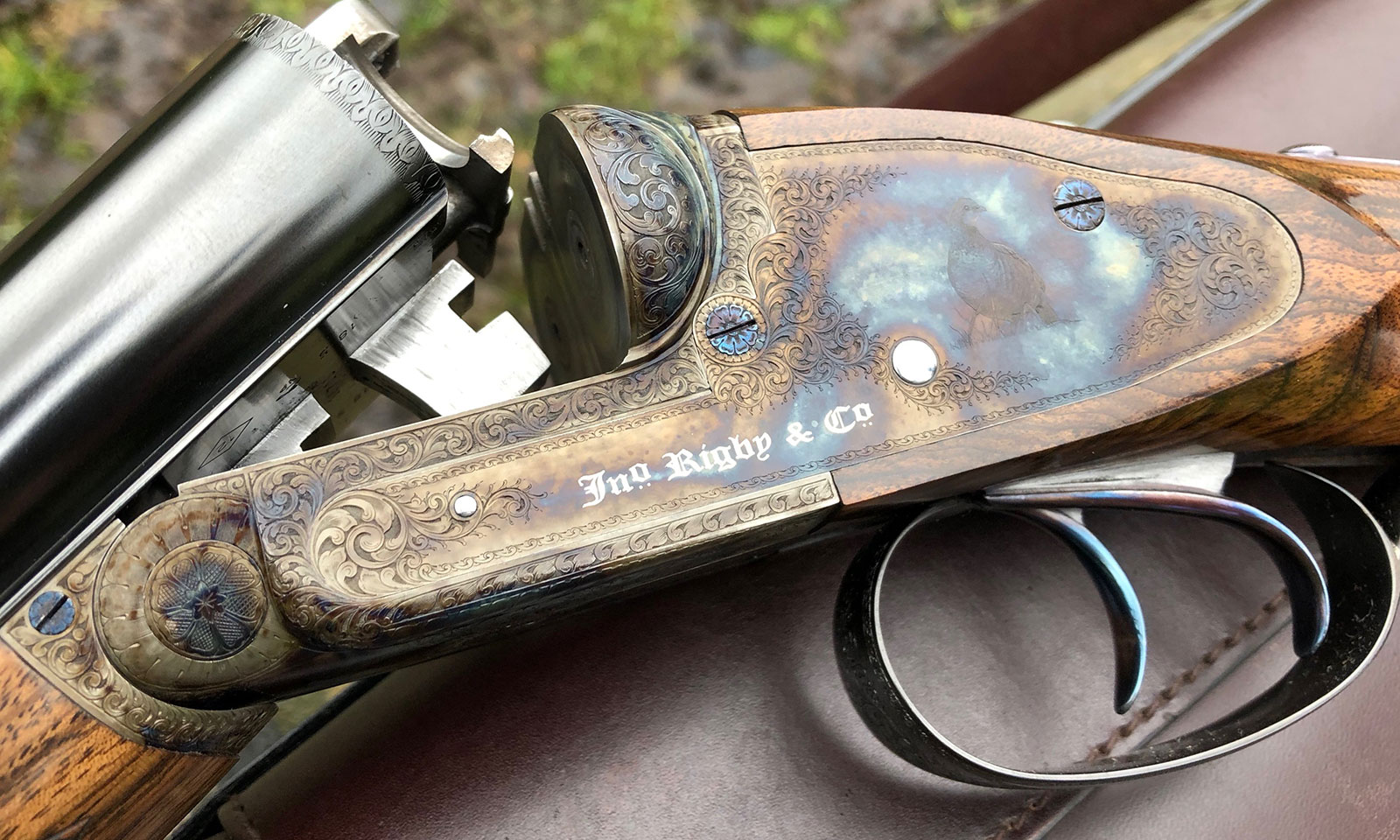
With such the vast array of patents and designs if you could piece together your ultimate dream gun what would you include and how would it be styled?
Now that's an interesting question. Some patents and designs are fiendishly clever and represent the highest, and I mean highest, pinnacle of handmade gunmaking. But they wouldn't necessarily be the strongest, or most reliable over a lifetime, a concern if access to skilled gunsmiths is limited. Some designs have an unmistakable beauty to them, either as a classic form, or dazzling simplicity. As quality goes, it would have to be a 'best,' not defined by geography, but by excellence in materials and craftsmanship. Before production went from workbenches to factory production, just about any serious maker was capable of producing 'best' guns, if the client was willing to pay, so I'm not excluding any particular makers.

I've handled and studied more mid-19th century British guns than most, I suppose, so I have a certain bias. It's not so much about wanting a gun from that period, but using what I've learned about what constitutes excellence in gunmaking, to judge where real improvements were made where it counts. So my 'ultimate' gun was probably made between about 1880 and 1914, though I'd be ready to accept anything up to the 1960s.

If I could have any one gun at all, it would probably be a James MacNaughton 'Skeleton' bar-in-wood trigger-plate round-action double gun. Google it, and weep. Though MacNaughton 'borrowed' the idea of the trigger-plate action from the German gunmaker Coster, his was the best; Dickson copied the design from MacNaughton. Only a few hundred MacNaughtons were made. The sheer beauty of MacNaughton's 'Skeleton' is amazing, though I've never handled one in person. But if I could, I'd get one, and hire a reconstructive surgeon to make my body fit the gun. Being a Scottish gun, I would be happy with whatever fanciful engraving it left the shop with.

Second on my list would be a classic British hammergun, with beautifully sculpted fences, made by any competent maker. Standard acanthus scroll engraving all the way. Figured walnut stock, flat top chequering. I like hearing the locks 'speak' as I ready on my quarry. Top-lever Scott spindle with Purdey double underbolt action out of preference, but I wouldn't discount any snap-action, or an inert action like the double screw-grip. I prefer back-action locks to bar-action locks, but not enough to turn down what could be a 'perfect' gun.

But for a more modern gun, in truth I would be equally happy with any well-made British hammerless sidelock. If money were no object, then a Holland & Holland Royal, or a Beesley/Purdey, a Boss & Co., or anything that went through the hands of James Woodward. Or, a well-made British boxlock from the same 1880-1914 period. Though simple in design, the British boxlock is still a gorgeous gun, and a true delight to own. Again, with a straight-hand figured stock and acanthus scroll. I tip my hat to the ingenuity of ejectors, but I'm perfectly fine with extractors.

While some of these are reserved for the private-jet-owning, champagne-swilling crowd, beautifully well-made British guns, boxlocks and sidelocks, can be had from Intersurplus and others for $400-$2000, or less than what a new factory-produced modern gun goes for. A 'dream gun' does not have to be impossibly expensive. Or rare (except for that MacNaughton). It just has to be one you'll keep for a lifetime, one that will give you joy whenever it is in your hands. IMO.

Oh, and if I couldn't have a British gun, then it would have to be a top-grade Darne or Charlin. Yep.

But if I reach the end of my life with what I have now, which includes a Charles Lancaster 'best' hammergun, a William Ford boxlock, and two early Browning Superposeds, I will still die happy and not feel like I've missed out (except for that MacNaughton).

 
Looks wise im stuck on the round body back action lock holland however a trim Lil hammergun with long top tang and jones under lever or side lever with fine pattern damascus in 410 or 28ga would be a dream to

The round body macnaughtons are truly a thing of beauty

Bright bone charcoal case coloring and well figured walnut with dark mineral lines and smooth trim elegant lines get me every thing no matter the maker
 

Attachments

  • Screenshot_20260905_194050_Chrome.jpg
    Screenshot_20260905_194050_Chrome.jpg
    44.1 KB · Views: 5
Quality pieces do come out of the woodwork, particularly shotguns. Guns that may have been expensive originally get passed along and as the years go by, become just another old shotgun. One muzzleloading gun (double, originally flint, converted to caplock) that I acquired was in a cottage on a lake that changed hands. It had been part of the decor. The new cottage owners didn't want it, took it to a shop to get rid of it. At least they didn't turn it in to the police. The shop manger knew I'd be interested, gave me a call. Made by a business last active in 1812, the silver thumbpiece had the arms of an earl. Did a websearch, found a portrait of the gentleman. He'd been a young man when he acquired the gun. Fortunately the gun was never abused, must have been cleaned every time it was used. Who knows how it got to Canada.

While I appreciate a gun for what it is, I always find a gun more interesting if some of its provenance, its history, has survived. I have a P'08, made 1938. When I disassembled it for a thorough cleaning, on the inside of one grip I found "JULY 10 1943 AVOLA SICILY". First day of Operation Husky. So, I know the when. I think I know the who. The gun came from the estate of a chap I knew; he was the first to register it. Pretty sure I know where he got it, his friend had served in the British Army.
Provenance matters to me as well. Makes an already interesting thing more interesting. A friend purchased a Luger from a North Shore Regiment WW2 vet here in NB some 30 years ago. When a deal was struck the vet handed it over pronouncing, " You are now the third owner, the first owner didn't need it no more."
 
Last edited:
With such the vast array of patents and designs if you could piece together your ultimate dream gun what would you include and how would it be styled?
In the July Holt's auction video, Jonny (TGS Outdoor) was talking with Simon about building such gun...
- From Simon's point of view: It's probably better to have all your favorite features on different guns :)
 
For what it's worth... as of late, I've found myself staring at action screws and fore-end latch/lever/buttons...

68.jpg
 
Fwiw, I added a Webley & Scott 700 to the fold recently. It needs a good strip and clean, but it still locks up tight and the ejectors are in time. The checkering is worn on the fore end, and needs to be refreshed. I haven't shot it yet, but grouse season opens here in a couple of weeks.
 
I appreciate Mr Nash and the others for pointing out some fine looking pieces which I would probably never have stumbled upon without their direction.True art in the finest kind of display, but alas one cannot aspire to buy such on a a working person wage. I appreciate the English ,French ,Canadian (Malin) and yes US side by side's that I have acquired over the years and although some do not rate in the best class they are all to me great works which I continually marvel at. My last British was a Midland hammer gun which is I believe entry level works and shoots flawlessly is in very good condition and am eager to take to my favourite widgeon field.This is a great thread always look forward to it.
 
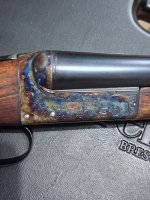
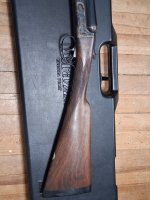
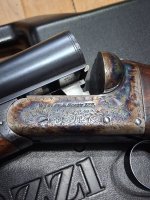
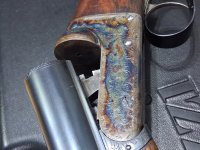
Here is my Webley & Scott. Im told its a 701 but I bought it as a 700. No ears or drop points but it does have nice wood and the case colors are vivid. Its 12ga 2.5"
 

Attachments

  • 20260907_173113.jpg
    20260907_173113.jpg
    130.8 KB · Views: 7
  • 20260907_173059.jpg
    20260907_173059.jpg
    132.6 KB · Views: 7
  • 20260907_173045.jpg
    20260907_173045.jpg
    165.2 KB · Views: 6
  • 20260907_173006.jpg
    20260907_173006.jpg
    132.3 KB · Views: 6
  • 20260907_172854.jpg
    20260907_172854.jpg
    153.5 KB · Views: 6
  • 20260907_172845.jpg
    20260907_172845.jpg
    134.8 KB · Views: 7
Here is my Webley & Scott. Im told its a 701 but I bought it as a 700. No ears or drop points but it does have nice wood and the case colors are vivid. Its 12ga 2.5"
Yours is in much nicer condition than mine. The blacking on mine is still strong, but most of the colour has faded. Made in 1961, according to serial and proofs, with factory 2 3/4" chambers. Your wood is much nicer too.
 
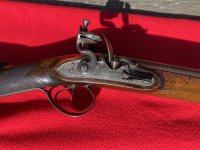
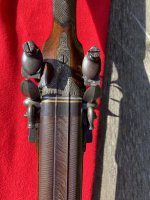
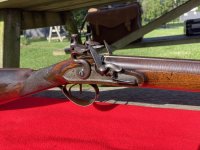
More and more these days I'm as enthralled with period double ML's as with the high quality breechloaders we all admire. I've shot patched ball and a round of clays with this 20 bore this summer. More than most I have made good use of the wisdom of Mr. Nash and others on CGN. In offline conversations Steve assures me it is no bother at all when I ask him about a gun I'm interested in - he enjoys spending my money and convinces me of the logic that I should be the next owner.
IMG_2650.JPGIMG_2651.JPGIMG_2652.JPG
 
I cant recall the year mine was made. Its a touch high in the comb so I have to remember to hold my head back a touch. It patterns an ounce of #5 beautifully. Not near the class as some featured here but it is a well made birmingham workhorse. However it only sees the occasional round of skeet nowadays. Perhaps a bird hunt this fall
 
Back
Top Bottom