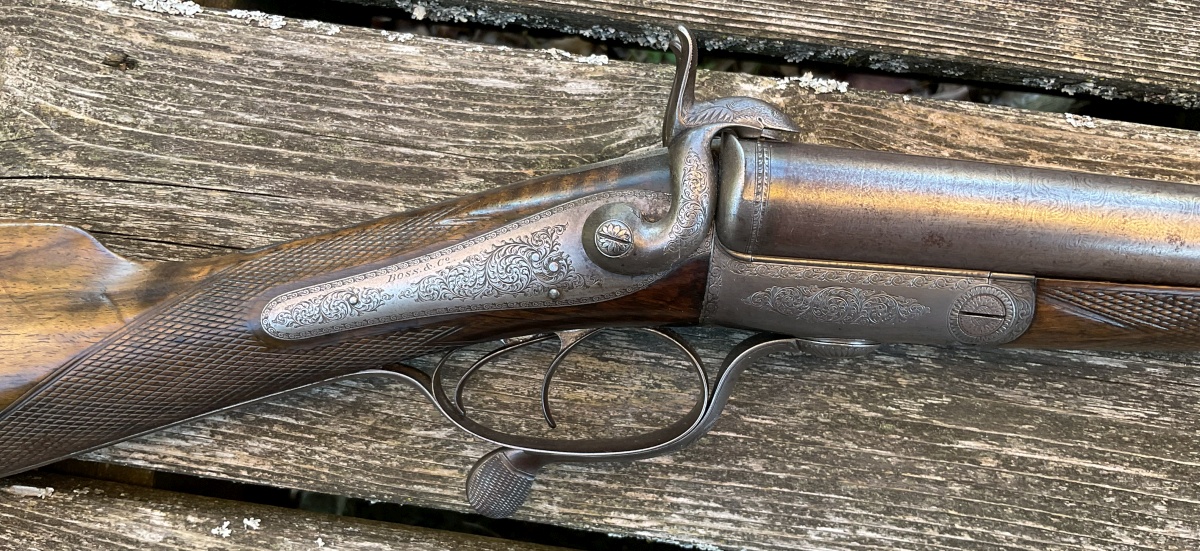
He is a welcome wealth of knowledge and a true gentleman. Even if his friendship leads to bying things we didnt know we needed. Lol.More and more these days I'm as enthralled with period double ML's as with the high quality breechloaders we all admire. I've shot patched ball and a round of clays with this 20 bore this summer. More than most I have made good use of the wisdom of Mr. Nash and others on CGN. In offline conversations Steve assures me it is no bother at all when I ask him about a gun I'm interested in - he enjoys spending my money and convinces me of the logic that I should be the next owner.
View attachment 1203630View attachment 1203631View attachment 1203632













































You are using an out of date browser. It may not display this or other websites correctly.
You should upgrade or use an alternative browser.
You should upgrade or use an alternative browser.
The allure of the British gun
- Thread starter Stephen Nash
- Start date

sillymike
CGN Ultra frequent flyer
Always interesting to know how some things came about
- WR droplocks
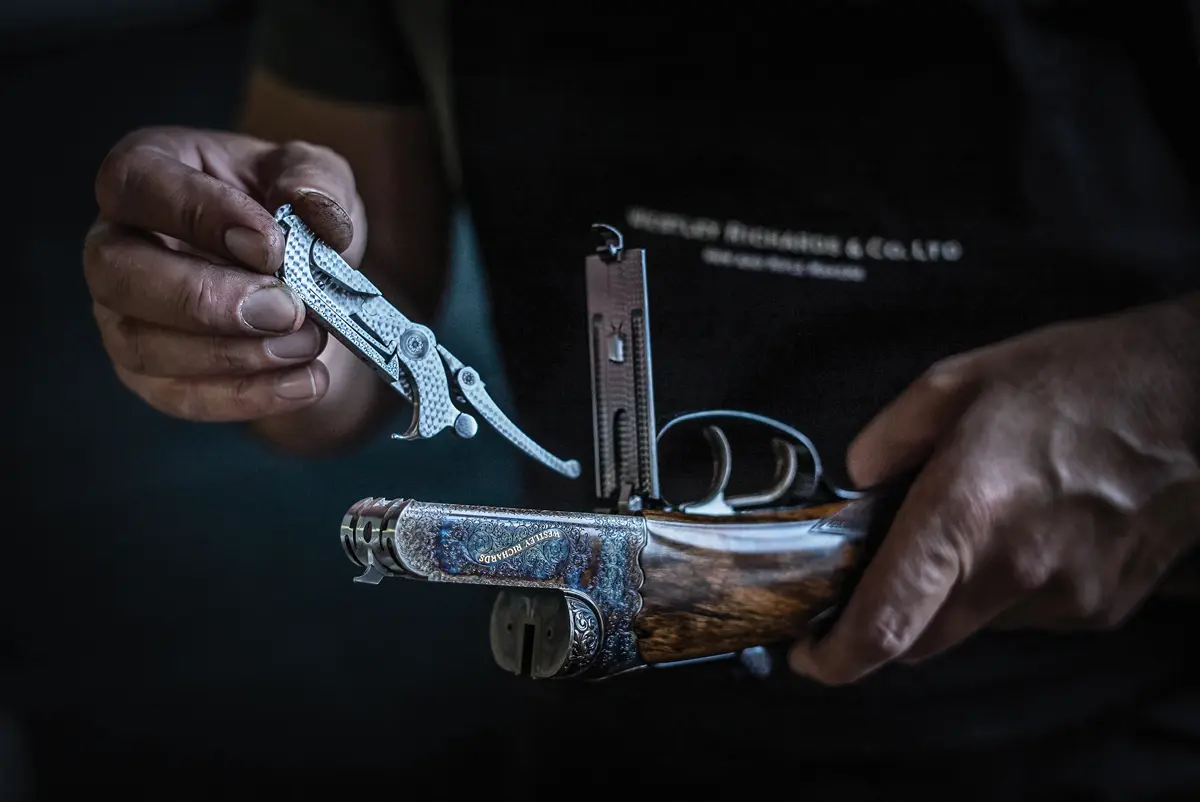
I thought this was kind of interesting (and funny)
- WR droplocks
The droplock action was invented here—patented in 1897 by Leslie Taylor and John Deeley. This was 22 years after Westley Richards had revolutionized sporting-gun design with its Anson & Deeley (A&D) “boxlock” action
I thought this was kind of interesting (and funny)
The droplock may have been an accidental breakthrough. According to company lore, Taylor asked the foreman if he somehow could hide the heads of the lock pins that pierced the sides of the action body—protrusions that Taylor thought ugly. The foreman’s solution was ingenious: Essentially, he turned the sidelock concept outside-in. Instead of mounting the lockwork onto sideplates, Deeley and his team attached the A&D’s simple lockwork—hammer, mainspring, sear, sear spring, cocking dog—to two small vertical plates that were then inserted through the bottom of the action body. Fastened to the plates as they were, the locks didn’t need supporting pins across the width of the action or holes to support the pins. Furthermore, if they could be slid into place from below, the locks could be dropped out again, too, for repair or replacement.
The advantages of a removable cover plate and hand-detachable locks soon became apparent and were spelled out in the 1897 patent.

The only droplock I've ever had my mitts on was at the Brandon Gun Show in '89. It was a beautifully engraved Gold Name Westley Richards in .450/400 with a spare set of locks. It was cased in an oak & leather case, and came with all of the original accoutrements; even had a spare "night bead" front sight in the trap grip-cap. Sadly, I did not have an extra $6k at the time, but convinced myself that another would come along some time. [Spoiler Alert: It never did!] That plus I do not care for the "swiveling"[?] styled Westley Richards opening lever.
It was owned by an elderly [although he was probably younger than I now am!] gentleman from eastern Alberta who was selling off his collection as he had just been diagnosed with The Big "C". He had a table full of English double rifles, one of British [English & Scottish at least] magazine rifles & another of English & Scottish double guns. Every one was top of the line, although the only shotgun on his table that I really lusted after was a Holland & Holland Royal in 12 bore. Still do.
It was owned by an elderly [although he was probably younger than I now am!] gentleman from eastern Alberta who was selling off his collection as he had just been diagnosed with The Big "C". He had a table full of English double rifles, one of British [English & Scottish at least] magazine rifles & another of English & Scottish double guns. Every one was top of the line, although the only shotgun on his table that I really lusted after was a Holland & Holland Royal in 12 bore. Still do.
That is stunning!Meanwhile in 1886
- George Gibbs Lever Cocking Sidelock Non-Ejector


Ah, just short of 50,000 views to this thread, and still no success as a sticky...
The story about the invention of the WR drop locks is a good one, Sillymike, and summarizes pretty well the philosophy behind British gun invention. Trying to streamline surfaces to be pleasing to the eye is what has given us perfectly shaped and timed screw heads, perfectly flush or curved to fit curved surfaces. Moving hammers inside, while retaining the engineering of the sidelock and backlock, took some real doing in the last quarter of the 19th century, and the A&D boxlock brought engineering simplicity and perfection (the WR drop lock lets us appreciate both). Eliminating protruding pins and bolts allows a place for trigger-plate actions like a Dickson or MacNaughton. Wanting to appreciate hand-detachable locks resulted in the Holland & Holland Royal, pretty much the epitome of the fine double (James Harrison, you're right on that score!), and a pattern copied by others. (Yes, folks with 6-figure gun budgets can opt for the Beretta SO series if they want to gaze at non-British locks, but there are no other options). Instead of going the route of the mechanical autoloader, the Brits increased their firepower with rebounding hammers, snap-actions, ejectors, self-opening actions, choke-boring, and, where warranted, matching pairs and a trusty manservant.
I know there's a lot of love on this site for the Winchester 21, but the protruding rounded screw heads and hinge screw hurt my eyes when compared to the shaped (and decorated) hinge pin on the Gibbs shown above, and completely hidden on Bill's Westley Richards, also above. British gunmakers brought a level of artistry and respect of form to the gun world that was enthusiastically copied in Belgium, France, Germany, Spain and Italy, but only rarely in American makers of the past (and none that I'm aware of today).
My focus has always been on the earliest days of breech-loading, when ideas were first being explored and tested, and sadly before the exquisite creations of the late-Victorian and Edwardian periods and the early 20th century (like the guns pictured above by Sillymike and Cow Town Bill). My collecting/research window ends before the lever-cockers, rising-bites, coil springs, and the many, many other clever inventions and advances that have shaped the sporting gun story. Aficionados of interesting guns and inventions, and new readers to this thread, should drop by the Vintage Gun Journal, a free online source of articles. Also, an enthusiastic shout-out to British Guns, another online source of great writing on the subject.
There are plenty of great British guns about, so I hope this thread continues. I get it that the majority of CGN interests lie elsewhere, and I acknowledge (note: I didn't say understand) that most CGNers would rather spend their money on a new Turkish-made gun than spend the same or less on a second-hand British gun. But I do hope there is a place for gun-writing and gun-discussion on CGN, especially as we are bombarded with AI-written promotional videos and advertisements and product-placements pushed by paid influencers. The demise of so much gun writing is distressing, replaced by a lot of social-media slop. (My timing has been impeccable: retire and devote my time to writing, just when the demand for original writing falls off the cliff... Dang.)
I am encouraged, however, by posts from new followers of our sport, and there is a lot of collective experience here to be tapped and mined. Let's keep the discussions going.
The story about the invention of the WR drop locks is a good one, Sillymike, and summarizes pretty well the philosophy behind British gun invention. Trying to streamline surfaces to be pleasing to the eye is what has given us perfectly shaped and timed screw heads, perfectly flush or curved to fit curved surfaces. Moving hammers inside, while retaining the engineering of the sidelock and backlock, took some real doing in the last quarter of the 19th century, and the A&D boxlock brought engineering simplicity and perfection (the WR drop lock lets us appreciate both). Eliminating protruding pins and bolts allows a place for trigger-plate actions like a Dickson or MacNaughton. Wanting to appreciate hand-detachable locks resulted in the Holland & Holland Royal, pretty much the epitome of the fine double (James Harrison, you're right on that score!), and a pattern copied by others. (Yes, folks with 6-figure gun budgets can opt for the Beretta SO series if they want to gaze at non-British locks, but there are no other options). Instead of going the route of the mechanical autoloader, the Brits increased their firepower with rebounding hammers, snap-actions, ejectors, self-opening actions, choke-boring, and, where warranted, matching pairs and a trusty manservant.
I know there's a lot of love on this site for the Winchester 21, but the protruding rounded screw heads and hinge screw hurt my eyes when compared to the shaped (and decorated) hinge pin on the Gibbs shown above, and completely hidden on Bill's Westley Richards, also above. British gunmakers brought a level of artistry and respect of form to the gun world that was enthusiastically copied in Belgium, France, Germany, Spain and Italy, but only rarely in American makers of the past (and none that I'm aware of today).
My focus has always been on the earliest days of breech-loading, when ideas were first being explored and tested, and sadly before the exquisite creations of the late-Victorian and Edwardian periods and the early 20th century (like the guns pictured above by Sillymike and Cow Town Bill). My collecting/research window ends before the lever-cockers, rising-bites, coil springs, and the many, many other clever inventions and advances that have shaped the sporting gun story. Aficionados of interesting guns and inventions, and new readers to this thread, should drop by the Vintage Gun Journal, a free online source of articles. Also, an enthusiastic shout-out to British Guns, another online source of great writing on the subject.
There are plenty of great British guns about, so I hope this thread continues. I get it that the majority of CGN interests lie elsewhere, and I acknowledge (note: I didn't say understand) that most CGNers would rather spend their money on a new Turkish-made gun than spend the same or less on a second-hand British gun. But I do hope there is a place for gun-writing and gun-discussion on CGN, especially as we are bombarded with AI-written promotional videos and advertisements and product-placements pushed by paid influencers. The demise of so much gun writing is distressing, replaced by a lot of social-media slop. (My timing has been impeccable: retire and devote my time to writing, just when the demand for original writing falls off the cliff... Dang.)
I am encouraged, however, by posts from new followers of our sport, and there is a lot of collective experience here to be tapped and mined. Let's keep the discussions going.
One must acknowledge that the majority of us who grew up hunting in the last 6 decades in North America were only exposed to pumps, and semi autos.I recall the odd model 21 but to say there were any amount of British guns in all the hunting clubs I was exposed to as a youth was to my knowledge almost nil.Were there some I'm sure but the price and popularity was in my recollection to be slim to none.I did recall a Westley Richards shot by a elderly scot who took great pains to keep his Gordon setter from eating most of his bag.However as time marches on and we broaden our horizons the British guns became more commonplace probably as the price and importation became affordable.I myself only had one some decade ago but after trying them out found most to be a delight to shoot and have expanded that number. .So am I a convert yes would I give up all others No but there is a place in my gunroom for some well balanced guns built by craftsman from another era.I read with great interest about Dan and Richard Meinertzhagen and there adventures in punt gunning in the late 1890's and thought that would have been quite an experience with a custom built shotgun.Perhaps there will be an even bigger following as some discover what a lot of us have in British firearms.
Last edited:
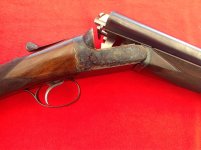
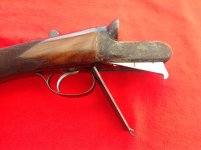
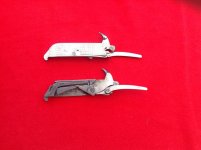
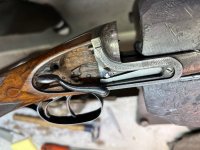
A number of years ago I got a beautiful Atkin from Londonshooter. My attraction to this gun was the sidelever. I took the gun to Martin Hagn (unfortunately now deceased) and he marvelled at the workmanship involved in making the sidelever. He disassembled the gun and I took a number of pics which I now share with followers of this fine post that Stephen so skillfully administers.
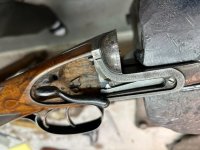
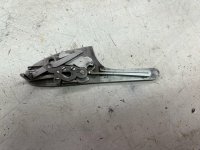
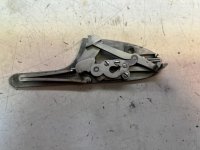
Licensed to kill
CGN Regular
- Location
- Peace Country Alberta
I picked up a Reilly side lever hammer 16ga this spring. I rather like the side lever, way handier than a top lever IMO. I suspect mine is early as it also uses a wedge to fasten the forend which is another feature I love. Those locks look very nice as does the rest of the gun. Simply beautiful congrats. 
The Atkin gun was built about 1890. Another interesting feature of this gun is that the barrels were replaced around 1920 with nitro proofed damascus barrels---rather surprising that the owner didn't use steel rather than damascus---guess he was a tradionalist. The barrels were in beautiful condition after re-browning by Nick Makinson. Also it is an ejector gun---ejectors were becoming common at the time it was made.I picked up a Reilly side lever hammer 16ga this spring. I rather like the side lever, way handier than a top lever IMO. I suspect mine is early as it also uses a wedge to fasten the forend which is another feature I love. Those locks look very nice as does the rest of the gun. Simply beautiful congrats.
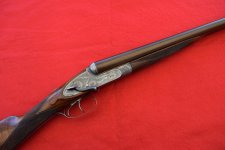
What a stunning gun!The Atkin gun was built about 1890. Another interesting feature of this gun is that the barrels were replaced around 1920 with nitro proofed damascus barrels---rather surprising that the owner didn't use steel rather than damascus---guess he was a tradionalist. The barrels were in beautiful condition after re-browning by Nick Makinson. Also it is an ejector gun---ejectors were becoming common at the time it was made.
View attachment 1223457
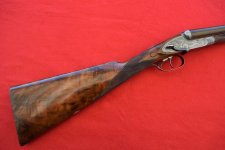
And it has a stunning piece of walnut. Refinished by Chris Dawe.What a stunning gun!
Licensed to kill
CGN Regular
- Location
- Peace Country Alberta
If it wasn’t TOO much more money, I would have gone with Damascus barrels over fluid steel in a heartbeat as well.And it has a stunning piece of walnut. Refinished by Chris Dawe.
View attachment 1223467
I suspect back in that era steel barrels were far more expensive than damascus. Stephen can help us out here, I'm sure.If it wasn’t TOO much more money, I would have gone with Damascus barrels over fluid steel in a heartbeat as well.
Licensed to kill
CGN Regular
- Location
- Peace Country Alberta
Likely so. When considering the labour that goes into Damascus barrels one would think they would be more expensive but, unlike today, labour was the minor cost and materials the main cost.I suspect back in that era steel barrels were far more expensive than damascus. Stephen can help us out here, I'm sure.
Licensed to kill
CGN Regular
- Location
- Peace Country Alberta
So Stephen, I have a couple EM Reilly 16ga hammer guns. One is earlier I suspect as it utilizes a wedge to hold the forend and is a side lever, the other, a top lever, both back action. Question, the earlier one has the hammers quite close together, much like my Henry double .500BPE. Is there a reason to put the hammers so close together ( compared to most others) ?. Is it to reduce the angle of the firing pins, or perhaps close together to make it easier to sweep both hammers with one motion……or just a style choice ?
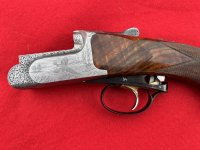
The concept of a drop out trigger was made popular by Perazzi back in the 60's and remains popular to this day. The drop out trigger made it easy to clean and repair the trigger unit. Also, many competition shooters carry a spare trigger---if their gun breaks down it likely is the trigger which can be replaced in minutes and get the shooter back on the firing line. Other makers like Beretta have adopted this style of trigger as well.
Pictured below is a Perazzi MX8, SC3 grade, 28 gauge with a drop out trigger.
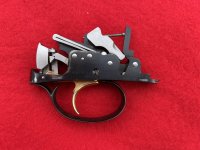
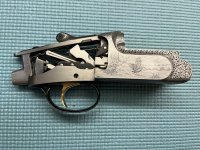
Pictured below is a Perazzi MX8, SC3 grade, 28 gauge with a drop out trigger.
The switch from damascus and twist-steel barrels to fluid steel was gradual, for a lot of different reasons. There were various techniques and types of steel-making processes involved, and at the Birmingham Proof House, they did successive testing to figure out which type of steel was strongest. It's a long, convoluted story.I suspect back in that era steel barrels were far more expensive than damascus. Stephen can help us out here, I'm sure.
Date-wise, I believe cold-drawn steel barrels were made as early as 1865, but they were not popular and probably not very good. Henry Bessemer’s process (1856) removed the impurities plaguing British steel, and Joseph Whitworth started making gun barrels with Bessemer steel in 1857. However, it wasn't until Whitworth patented his method for fluid compressed steel in 1874 that steel barrels started to be in demand. It is claimed that sportsmen couldn't tell the difference between cheap steel barrels and better-quality ones, and this kept the demand limited. Once Whitworth marked his fluid compressed steel barrels with a 'wheatsheaf' logo, buyers could be reassured. Still, fluid steel barrels didn't become commonplace until the 1880s, in part because sportsmen thought damascus and laminated barrels were more beautiful (understandable). In 1880, the Birmingham Proof House tests showed laminated damascus as stronger than fluid steel, but by 1895, fluid steel surpassed all. It was not unusual for pre-WWI guns to be built with damascus barrels out of aesthetic preference. Gunmakers also kept supplies of damascus tubes on hand, and it would take time to use these up (a few makers probably still have some stashed away for demanding customers). However, the war wiped out the working class with the knowledge to make damascus barrels, existing supplies of damascus barrel tubes were largely used up, and steel processes were probably improved. A 1920s gun with damascus barrels is unusual but not unheard of, especially if the gunmakers kept a treasured supply and the client wanted damascus. Damascus barrels that hadn't endured years of abuse and negligence would have no problem passing nitro proof!
In the second-hand market around 1900-1905, I can't find much difference in price between damascus and Whitworth steel, though the sellers specified the construction of the barrels so the buyers could choose their preference. Advertisements for new guns at this time pushed Whitworth fluid steel and Krupp steel (slightly different process). In discussions in The Field newspaper in 1891, gunmakers could buy pairs of quality damascus tubes for 25-35 shillings (£1 5s-£1 15s), whereas a pair of Whitworth tubes cost the gunmaker 70 shillings, or £3 10s, or double. Whether this led gunmakers to greatly increase their prices, or accept a lower profit margin, I can't say without looking into it further.
LTK, first off, dating Reilly guns has been made much easier by the research of Gene Williams. Here is a link that will help:So Stephen, I have a couple EM Reilly 16ga hammer guns. One is earlier I suspect as it utilizes a wedge to hold the forend and is a side lever, the other, a top lever, both back action. Question, the earlier one has the hammers quite close together, much like my Henry double .500BPE. Is there a reason to put the hammers so close together ( compared to most others) ?. Is it to reduce the angle of the firing pins, or perhaps close together to make it easier to sweep both hammers with one motion……or just a style choice ?
Dating your Reilly
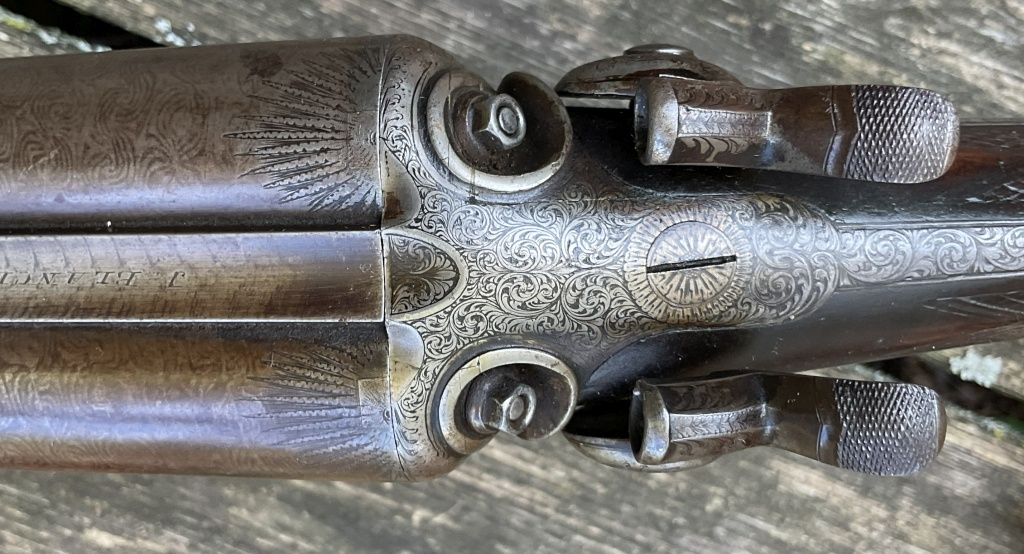
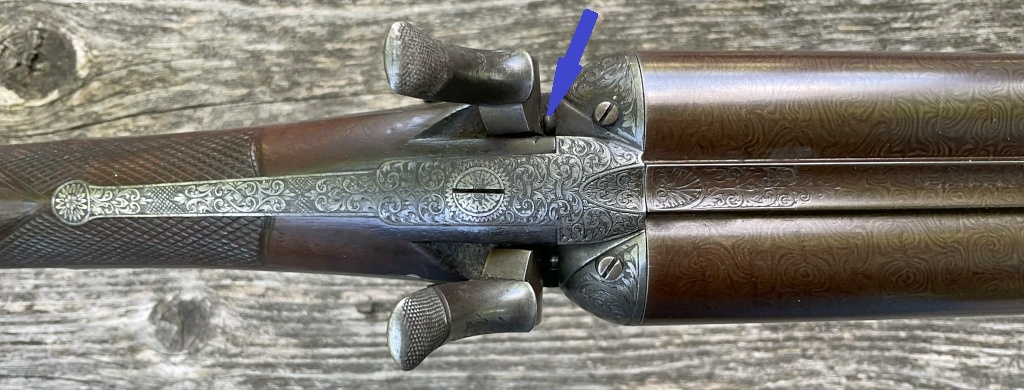
As to the position of hammers, there was a bit of an evolution in hammer placement. It might have been due to frustrations with the early central-fire cartridges, due to light primer strikes (it seems many thought pin-fire cartridges were more reliable!). Earlier guns have strikers (firing pins) very much in line with the barrels/chamber, in as straight a line as possible. This means that for the noses of the hammers to be in line with the strikers, they have to be 'inward' when seen from the back, resulting in hammers appearing close together. Either as a result of thicker fences, better cartridges, or something else, makers could slant the strikers through the fences, meaning the hammer noses could be wider apart. I suspect the lowering of the hammer pivot point in later hammerguns, which allowed hammers, when c_o_c_k_e_d, to disappear altogether from the sighting plane (and not look like looking through rugby goalposts), probably also had something to do with changes in hammer shapes and profiles.
Here is a Blanch conversion from pin-fire (original gun dated 1862), showing the hammer noses in line with the strikers; from behind, the hammers seem close together:
Here is an 1858-dated central-fire, from Charles Lancaster. In this design, the noses are hidden inwards, in line with the strikers (blue arrow), so the hammers seem farther apart.
I think I've scoured every British book, treatise and pamphlet on shooting hammer guns, and poured over endless newspaper discussions. Not once has there been any description of 'sweeping back hammers' with one hand. I think that is cowboy fiction, probably invented in Hollywood, or by someone imagining it looks cool. I can almost assure you that no one in Britain ever did so, or contemplated doing so. The delight in hammerguns is hearing the locks 'speak.' First one hammer, then the other. Victorians judged the quality of locks by that wonderful noise. Sweeping hammers with the hand means taking your hand from the gun, which is contrary to preparedness and aiming, and pulling the hammer back with the thumb while watching the game is far more secure and certain.