I would stain it with ferric nitrate (aqua fortis) so the light color of the natural wood does not stand out in sharp contrast to the darker color of the stock. I would then oil it with whatever oil finish I am using and finish off with a good coat of wax. Striping is a modern thing that is not historically correct and is strictly a matter of personal preference. It is something I would never consider doing - but that is just my preference.













































You are using an out of date browser. It may not display this or other websites correctly.
You should upgrade or use an alternative browser.
You should upgrade or use an alternative browser.
Let's talk ram rods.
- Thread starter Painkillers
- Start date

Painkillers
CGN Ultra frequent flyer
This is a great take on the question. I didn't understand the history of candy striping. Thank you.I would stain it with ferric nitrate (aqua fortis) so the light color of the natural wood does not stand out in sharp contrast to the darker color of the stock. I would then oil it with whatever oil finish I am using and finish off with a good coat of wax. Striping is a modern thing that is not historically correct and is strictly a matter of personal preference. It is something I would never consider doing - but that is just my preference.

Ram rods are basically disposable, broken, lost, shot down range, worn out - the earlier period "original gun" the lower the probability the ram rod is also original, so to say that it is historically inaccurate is debatable as there are not enough examples to prove or disprove and you would need to be more specific to era - as you do start to see striping mid 1800s.
Furthermore, striping is purely aesthetic, wears through fairly quickly (I can attest), is not easy to do well and has a good chance of warping the rod (I can attest as well)
Did Issac Haines ever stripe a ram rod, probability seems low, but not zero.
I like the look so I stripe all of mine ... (they get much darker over time through use)
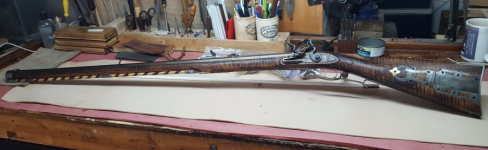
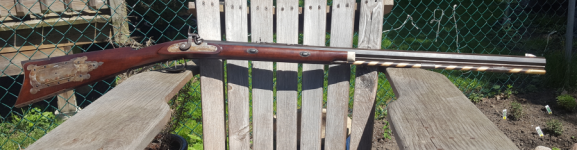
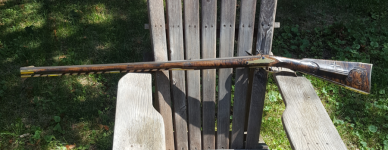
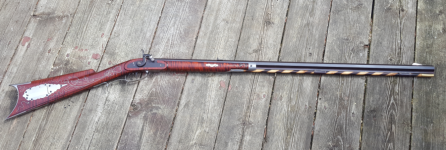
Furthermore, striping is purely aesthetic, wears through fairly quickly (I can attest), is not easy to do well and has a good chance of warping the rod (I can attest as well)
Did Issac Haines ever stripe a ram rod, probability seems low, but not zero.
I like the look so I stripe all of mine ... (they get much darker over time through use)

Londonshooter
CGN frequent flyer
- Location
- SW Ontario
some dandy rifles there.
Sean makes a good point, but I seriously doubt much, if any striping was applied to ramrods before the fourth quarter of the 19th century, at the earliest. I cannot recall seeing a striped ramrod on a single gun attributed to an earlier date. I am firmly in the camp that holds striping to be something that was popularized during the eatly stages of the 20th century revival of muzzleloading. Ramrod replacement further muddies the waters in that, if one does encounter a striped ramrod, is it contemporary to the gun, or a later replacement.
I cannot recall what rifle the OP is getting, but if it is an SMR, stiping would, in my opinion, be even more out of place. Those tend to be very utilitarian firearms and, for the most part, are completely lacking in ornamentation. Their beauty lies in their rugged simplicity, their slimness and graceful architecture.
I cannot recall what rifle the OP is getting, but if it is an SMR, stiping would, in my opinion, be even more out of place. Those tend to be very utilitarian firearms and, for the most part, are completely lacking in ornamentation. Their beauty lies in their rugged simplicity, their slimness and graceful architecture.
I saw one auction photo stating the ram rod was original ... more of a bar patter on that, not a helical stripe... also 2 auction listings stating striped rods being original but no photos.Sean makes a good point, but I seriously doubt much, if any striping was applied to ramrods before the fourth quarter of the 19th century, at the earliest. I cannot recall seeing a striped ramrod on a single gun attributed to an earlier date. I am firmly in the camp that holds striping to be something that was popularized during the eatly stages of the 20th century revival of muzzleloading. Ramrod replacement further muddies the waters in that, if one does encounter a striped ramrod, is it contemporary to the gun, or a later replacement.
I cannot recall what rifle the OP is getting, but if it is an SMR, stiping would, in my opinion, be even more out of place. Those tend to be very utilitarian firearms and, for the most part, are completely lacking in ornamentation. Their beauty lies in their rugged simplicity, their slimness and graceful architecture.
In my camp we say you can't definitively say it was never done particularly when accounting for the incredibly small sample of surviving guns from just as small a sample of makers - there are literally tens of thousands of missing guns... !
Popularized in (North America) in the late 1800s ... sure, but I have difficulty believing that in the 700/800/whatever years of muzzle loading firearms 1850 was the first time it occurred to someone to paint a stripe on that thing ...

Painkillers
CGN Ultra frequent flyer
Beautiful wire work.Ram rods are basically disposable, broken, lost, shot down range, worn out - the earlier period "original gun" the lower the probability the ram rod is also original, so to say that it is historically inaccurate is debatable as there are not enough examples to prove or disprove and you would need to be more specific to era - as you do start to see striping mid 1800s.
Furthermore, striping is purely aesthetic, wears through fairly quickly (I can attest), is not easy to do well and has a good chance of warping the rod (I can attest as well)
Did Issac Haines ever stripe a ram rod, probability seems low, but not zero.
I like the look so I stripe all of mine ... (they get much darker over time through use)
View attachment 1206509
View attachment 1206510
View attachment 1206511
View attachment 1206513
This will be the next thing I attempt on my next build.
I finished off both a 3/8 x 4' brass range rod, and a hickory field rod for the gun today. I treated the hickory with aqua fortis, and finished it with hardwax oil.
I'm ready to burn powder!

I'll be the heathen in the room, I guess. My range rod is 3/8 brass round stock, with.. wait for it.. a golf ball drilled and epoxied to the top end.
I looked around for a few days for a sensibly priced wood ball, which I'd have done the same thing to. I didn't find anything readily available, and so a golf ball got pressed into service.
It's unlikely to get fired down range, because it's big enough to obstruct the view past the front sight. Even I'm going to notice that.
The rifle kit came with a half decent wooden rod that I've used once or twice. The brass abomination gets used when I'm going to be shooting at the range. You can even yell "Fore!" before you fire the shot if you want..
Easy on the hand when seating a ball. Like some of you, I filed a small groove around the rod so I can tell at a glance if the rifle is loaded or not.
I hadn't thought about using the short starter as a handle for the original rifle rod's rounded end. Thanks for that! I don't think mine has a shallow hole in it.. yet, but it soon will have.
I looked around for a few days for a sensibly priced wood ball, which I'd have done the same thing to. I didn't find anything readily available, and so a golf ball got pressed into service.
It's unlikely to get fired down range, because it's big enough to obstruct the view past the front sight. Even I'm going to notice that.
The rifle kit came with a half decent wooden rod that I've used once or twice. The brass abomination gets used when I'm going to be shooting at the range. You can even yell "Fore!" before you fire the shot if you want..
Easy on the hand when seating a ball. Like some of you, I filed a small groove around the rod so I can tell at a glance if the rifle is loaded or not.
I hadn't thought about using the short starter as a handle for the original rifle rod's rounded end. Thanks for that! I don't think mine has a shallow hole in it.. yet, but it soon will have.
I have switched from antler sections to billiard balls, which are smaller than pool balls, for my handles. Picked two sets up at local thrift stores and have enough to keep my friends supplied. They machine and take a thread beautifully and are, in my opinion, just the right size.
I've seen antique glass and porcelain door handles repurposed to this use - I have a few largish drawer pulls both glass and porcelain that I keep meaning to turn to that purpose ... priorities ....I have switched from antler sections to billiard balls, which are smaller than pool balls, for my handles. Picked two sets up at local thrift stores and have enough to keep my friends supplied. They machine and take a thread beautifully and are, in my opinion, just the right size.
Painkillers
CGN Ultra frequent flyer
It came as a shock. So much, that I refused to pay a dime to have it shipped. It was local, so I picked it up.how much for the brass rod in that length... these days????
I've also opted for pool/ billiard balls (golf balls never occured to me). I was surprised as to how well it took to a thread. I was anticipating having to helicoil, but I think it'll be just fine as is. No jam nut, just a thread stop and the thread is just slightly over half way through the ball. Solid I tell you.
I may add a jam nut. The ball is right hand thread. In the odd instance that I dry ball, I'm confident that I can drive a puller screw into the lead ball, but if (if) I can't pull the lead ball out and have to unscrew the driven screw out of the lead ball, my handle may unthread? A jam nut would invariably be the solution to this nonexistent problem.
The trickiest part was centering a 10-32 hole in the business end, and getting it plumb straight when drilling by hand. It should be done horizontally on a lathe, but that's beyond me currently. After a few failed attempts, I got what I'm happy with. When assembled, the jag is only very slightly canted. maybe a degree or at most two, but the shoulder sits on the rod end 99%. It's one of those things that I know is there, it'll bug me, but if anyone else were to pick up the rod, they wouldn't notice.
Ideally, if i had a lathe, one would start with say .5" bar stock and turn the entire rod down leaving the jag as one end, so a solid bar. That would turn the piece into a $300-$400 range rod though once you calculate set up time. 10x's that if you take tooling into account.
Mine at a third of that works just fine.
Painkillers
CGN Ultra frequent flyer
"FORE"! Love it!!I'll be the heathen in the room, I guess. My range rod is 3/8 brass round stock, with.. wait for it.. a golf ball drilled and epoxied to the top end.
I looked around for a few days for a sensibly priced wood ball, which I'd have done the same thing to. I didn't find anything readily available, and so a golf ball got pressed into service.
It's unlikely to get fired down range, because it's big enough to obstruct the view past the front sight. Even I'm going to notice that.
The rifle kit came with a half decent wooden rod that I've used once or twice. The brass abomination gets used when I'm going to be shooting at the range. You can even yell "Fore!" before you fire the shot if you want..
Easy on the hand when seating a ball. Like some of you, I filed a small groove around the rod so I can tell at a glance if the rifle is loaded or not.
I hadn't thought about using the short starter as a handle for the original rifle rod's rounded end. Thanks for that! I don't think mine has a shallow hole in it.. yet, but it soon will have.
I have marked some of my rods before, but I marked them at the point of that rifles favourite load (so what it is loaded rather than at the breech). I did this so I knew by looking, when the projectile was about to reach the powder. I could ease up and anticipate the 'crunch'. Then verify with the line at the muzzle.
Licensed to kill
CGN Regular
- Location
- Peace Country Alberta
Billiard balls for loading rod handle……..is that more historically correct than barber poling the ram rod ??I have switched from antler sections to billiard balls, which are smaller than pool balls, for my handles. Picked two sets up at local thrift stores and have enough to keep my friends supplied. They machine and take a thread beautifully and are, in my opinion, just the right size.

Painkillers
CGN Ultra frequent flyer
With some things, function over form wins. A good range rod fits that category perfectly.No, I'd have to say it is even less historically correct
Then again, doubt there is anything historically correct about range rods period.
Licensed to kill
CGN Regular
- Location
- Peace Country Alberta
I agree with the first sentence, not the second IMO, no harm in thinking that way, just doesn’t hold water in my world.With some things, function over form wins. A good range rod fits that category perfectly.
Painkillers
CGN Ultra frequent flyer
Range report:
What a tonne of fun. I brought the Kibler Woodsrunner to the range and whoa, just wild. The "thwap" on a steel plate at 50 meters was so, so, very satisfying. You gotta work for it though. After about 8 or 10 rounds, I had ignition problems. Flash in the pan. After a bunch of pick digging, I got the concrete (fouling) out of the vent liner, and I was back in business. To my surprize, one has to, no debate on this, clear that vent hole every shot or every other shot to keep it going.
Broke a flint, had issues with accuracy using R.E.A.L bullets and Minnie bullets, but PRB...not problem (1-72 twist). I bought off the shelf bore butter to keep the fouling soft (vent liner aside) and all went really well.
I never used the wooden ramrod I made, but the brass one is a gawd send. Perhaps a bit too long? With a charge in, I have maybe 12 -18 inches outside the barrel. I'll probably cut 6" and rethread it, making another short starter. I have some mini pool balls that will work great for that.
Anyhow, I can still smell the powder on my face and hair, and I have a grin from ear to ear. Also, there are plenty of guys who go through a lot of effort to age the rather obnoxious bright brass on these rifles, but i'll tell you what. One range session with black soot stained greasy hands all over the rifle and the brass took a fantastic patina. This thing will only get better with age and usage.
What a tonne of fun. I brought the Kibler Woodsrunner to the range and whoa, just wild. The "thwap" on a steel plate at 50 meters was so, so, very satisfying. You gotta work for it though. After about 8 or 10 rounds, I had ignition problems. Flash in the pan. After a bunch of pick digging, I got the concrete (fouling) out of the vent liner, and I was back in business. To my surprize, one has to, no debate on this, clear that vent hole every shot or every other shot to keep it going.
Broke a flint, had issues with accuracy using R.E.A.L bullets and Minnie bullets, but PRB...not problem (1-72 twist). I bought off the shelf bore butter to keep the fouling soft (vent liner aside) and all went really well.
I never used the wooden ramrod I made, but the brass one is a gawd send. Perhaps a bit too long? With a charge in, I have maybe 12 -18 inches outside the barrel. I'll probably cut 6" and rethread it, making another short starter. I have some mini pool balls that will work great for that.
Anyhow, I can still smell the powder on my face and hair, and I have a grin from ear to ear. Also, there are plenty of guys who go through a lot of effort to age the rather obnoxious bright brass on these rifles, but i'll tell you what. One range session with black soot stained greasy hands all over the rifle and the brass took a fantastic patina. This thing will only get better with age and usage.
Yep, that sounds like a lot of the reasons I like shooting black powder.Range report:
What a tonne of fun. I brought the Kibler Woodsrunner to the range and whoa, just wild. The "thwap" on a steel plate at 50 meters was so, so, very satisfying. You gotta work for it though. After about 8 or 10 rounds, I had ignition problems. Flash in the pan. After a bunch of pick digging, I got the concrete (fouling) out of the vent liner, and I was back in business. To my surprize, one has to, no debate on this, clear that vent hole every shot or every other shot to keep it going.
Broke a flint, had issues with accuracy using R.E.A.L bullets and Minnie bullets, but PRB...not problem (1-72 twist). I bought off the shelf bore butter to keep the fouling soft (vent liner aside) and all went really well.
I never used the wooden ramrod I made, but the brass one is a gawd send. Perhaps a bit too long? With a charge in, I have maybe 12 -18 inches outside the barrel. I'll probably cut 6" and rethread it, making another short starter. I have some mini pool balls that will work great for that.
Anyhow, I can still smell the powder on my face and hair, and I have a grin from ear to ear. Also, there are plenty of guys who go through a lot of effort to age the rather obnoxious bright brass on these rifles, but i'll tell you what. One range session with black soot stained greasy hands all over the rifle and the brass took a fantastic patina. This thing will only get better with age and usage.
I had misfire problems at first, too. My rifle is a 50 cal percussion, and I initially went with the 2F version of Goex, as the maker suggested.
Half a dozen shots and I'd start getting misfires.
A lot of the guys I talked with had said they got the best results with 3F in their rifles. I picked up a bottle of 3F to try and have never looked back. Good accuracy, and almost never a misfire.
When I was looking for a rifle to build, I thought I might want a Hawken. Then I discovered that most of the ones I could find were a 1 in 48 twist, and I really wanted to be able to shoot patched round balls with the best accuracy.
I got a Kentucky rifle kit instead, with a 1 in 66 twist 33" barrel. It shoots great with the slow twist and long sight radius.
I make my own patch lube from beeswax and olive oil, with a few added drops of wintergreen essence oil to get that smell. Patches are cut from pillow ticking from a local fabric shop, traced out with a toonie and a pencil to get the right size. If I run out, just lube a corner of the ticking I take with me, start a ball in the muzzle over the corner of ticking, and cut off the excess. That works fine too.
I like the pace of shooting black powder. Fire a shot, then patch the barrel out. Powder, then patch and ball, ram it home, put a cap on the nipple, and light 'er off again.
A black powder rifle was on my bucket list for a few years, and I'm glad I finally went there. Building it was fun, and shooting it is more fun.






















